




About Classic Number Puzzle
A sliding puzzle looks like the easiest thing on the screen. Eight wooden tiles, one gap, put them in order. We spent nearly three minutes on the first level of Classic Number Puzzle, made 16 moves, and finished further from the answer than we began. That is the honest starting point for this page, and it says more about the puzzle than a win would.
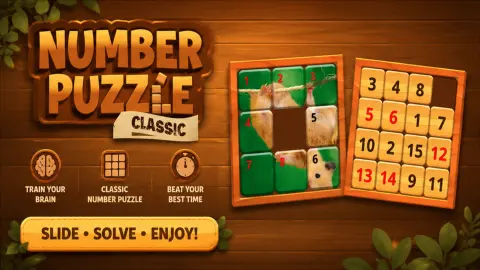
The board is three squares by three. The tiles carry the numbers 1 to 8 and one square is empty. A tile next to the gap can slide into it, and nothing else can move. You are done when the numbers read in order from the top left, with the gap in the bottom right corner.
The game is credited to Bravestars. It was published in September 2026.
What we played: the tutorial, which we finished, and one stretch of Level 1, which we did not. We never saw a solved level, the three locked levels, or what the buttons under the board do. Everything below comes from that stretch.
Red digits are the only feedback you get
Most sliding puzzles on the web show you a board and nothing else. This one adds a single piece of help, and it is easy to misread. At first we took a red digit for the tile we had just touched. It is not.
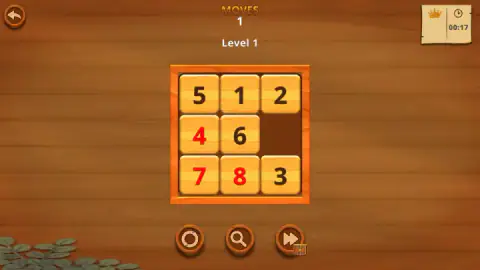
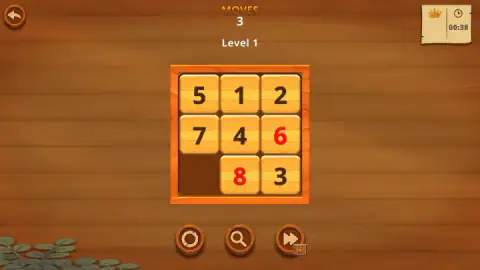
On the board we started with, the 4, the 7 and the 8 were red. All three sat where they belong: the 4 at the left of the middle row, the 7 and 8 at the start of the bottom row. By the time the counter read 3, the 4 and the 7 had left those squares and their digits were dark again. The 6 had arrived on its own square, and its digit had turned red.
So the colour is a count of how much of the picture is right. It also sets a trap. The natural urge is to protect red tiles, and on that first board protecting them does not work. The 5 was sitting on the 1's square in the top corner, with the 1 and 2 pushed one place along. The shortest way to clear that corner sends the 8, the 7 and the 4 out of their squares and brings them home again at the end.
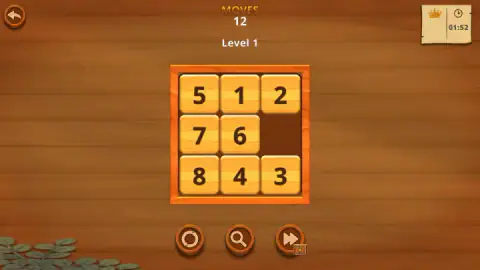
By our last screen no digit was red at all. That felt like failure, and by one measure it was.
Thirteen moves were enough, and we used sixteen to go backwards
After the session we worked through the board we had been dealt. Its shortest solution is 13 moves, counting one tile at a time. The board we left behind after 16 moves needs 17.
The lesson is about what a move is worth. Every slide either brings the board one step closer or takes it one step away. There is no neutral move in a sliding puzzle. Sliding a tile and sliding it straight back is two moves on the counter for nothing, and we did that more than once.
Nothing punished us for it. The clock counted up, the counter kept growing, and no limit appeared on either. The listing's page says the aim is the fewest moves and the shortest time, so the two numbers are probably what a finished level is judged on. We cannot confirm that, because we did not finish one.
One more thing we noticed: Level 1 is not a fixed board. It opened twice in our session and showed a different arrangement each time. The first had five tiles at home before a single move. You cannot learn this level by heart.
The levels we did not reach
The level list shows four cards, and every one of them says 3x3. Level 1 has a PLAY NOW button. Levels 2, 3 and 4 have an UNLOCK button with a small film icon, the usual sign of a video offer. The last two also carry a small clock tag, which may mean a timed version. We did not open them, so that is a guess.
Under the board there are three round wooden buttons: a pair of circular arrows, a magnifying glass, and a double arrow with the same film badge. We left all three alone, so we will not tell you what they do. We also saw no board larger than three by three.
The 1880 craze, and the man who did not invent it
This puzzle is well over a century old, and its story is better than most people know. Wikipedia's article on the 15 puzzle credits it to Noyes Palmer Chapman, a postmaster in Canastota, New York. A Boston woodworker, Matthias Rice, began making copies in December 1879 and sold them as the Gem Puzzle. In 1880 it became a craze across the United States.
The name most often attached to it is the wrong one. Sam Loyd, the American puzzle writer, claimed from 1891 until his death in 1911 that the puzzle was his. What he did do was offer a $1,000 prize for one particular starting board, with only the last two tiles swapped.
Nobody collected, because nobody could. Two mathematicians, Johnson and Story, had shown in 1879 that exactly half of all starting arrangements can never be solved, however long you slide. Loyd's board was in the wrong half.
That is why a game like this cannot scatter the tiles at random. Both boards Classic Number Puzzle dealt us sit in the solvable half; we checked. And the small version has a known ceiling: according to the same article, any solvable three-by-three board can be finished in 31 moves or fewer.
Who it is for
It suits someone who wants a few quiet minutes with one clean problem. There is no story, no shop that we saw, and nothing moves unless you move it. The red digits make it a fair first sliding puzzle for a child.
It is thin if you want variety. One board size, one open level and three behind a button is not much to look at on the first visit.
More puzzles in the same spirit
Picture Shift is the picture version of the same idea, with blocks you slide until a drawing joins up. Slide And Divide also plays on a three-by-three board of numbers, with division in place of order. Wood Block Journey shares the wooden look and the calm pace. From the same studio, Draw Bridge - Brain Game swaps tiles for a single drawn line. The rest are under puzzle games.
Screenshots
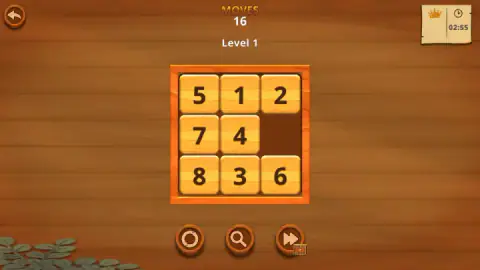
Taken by opening the game ourselves and letting it run — not supplied by the publisher, and not the same picture every other site shows.
How to play Classic Number Puzzle
- Follow the tutorial. It is three pulls long. A white hand shows which tile to drag, and the last pull moves two tiles at once: drag the far tile of a row towards the gap and the one between goes with it.
- Press PLAY NOW on Level 1. The level list is a sheet of parchment with four cards. Only the first is open.
- Drag a tile towards the gap. Tiles that do not touch the gap stay put.
- Build the top row first. Get 1, 2 and 3 into place, then leave them alone and work on the two rows below.
- Watch the counter, not the clock. MOVES sits above the board and the clock sits on a paper card in the top right corner.
What our run taught us:
- Red means home. A digit turns red when its tile is on the right square. This is the most useful thing on the screen, and the game does not explain it.
- A red tile is not a finished tile. Our first board had three red digits and still needed 13 moves. In the shortest solution we found, about half of them move those same three tiles away and back.
- Do not shuttle. We spent several moves sliding the 4 down out of the centre and back up again. Each trip costs a move and leaves the board exactly as it was.
- Think in loops. Tiles change places by travelling round a small square of four cells, with the gap leading. If a tile needs to go one square left, the gap has to walk round it first.
Controls
| Drag a tile towards the gap | Slides it into the empty square; only a tile beside the gap can move |
|---|---|
| Drag the far tile of a row towards the gap | Pushes the tile in between along with it, as the tutorial's last step shows |
| PLAY NOW (level list) | Opens the level that is unlocked |
| UNLOCK (level list) | Sits on the locked levels with a small film icon; we did not press it |
| Three round buttons under the board | Circular arrows, a magnifying glass and a double arrow with a film badge; we did not press them |
Features
- Eight numbered wooden tiles and one gap on a three-by-three board
- A digit turns red when its tile sits on the square where it belongs
- A move counter above the board and a clock that counts up, with no limit on either that we saw
- A short tutorial that walks you through three slides before the first level
- Four levels on the list, the first open and three behind an Unlock button
- Made by Bravestars
Game details
- Developer
- Bravestars
- Release date
- September 2026
- Last updated
- September 14, 2026
- Added here
- August 2026
- Technology
- HTML5 (2D)
- Platforms
- Browser (desktop, mouse), Browser (mobile & tablet)
- Classification
- Arcade , Educational , Puzzle
- Saved progress
- Saving, when available, is managed by this game. Mava cannot confirm your level.
FAQ
How do you play Classic Number Puzzle?
Slide the numbered tiles, one at a time, into the single empty square until they read 1 to 8 from the top left, with the gap in the bottom right corner. Only a tile next to the gap can move. A counter above the board adds up your moves and a clock in the corner counts the time.
What do the red numbers mean in Classic Number Puzzle?
A red digit marks a tile that is on the square where it belongs. In every screen we saw, the red tiles were exactly the ones already in their final place, and a digit went back to dark as soon as its tile left home. It is a progress light, not a hint about what to move next.
Is every board in Classic Number Puzzle solvable?
Both boards the game dealt us can be solved; we checked them afterwards. That matters because exactly half of all possible arrangements of a sliding puzzle cannot be solved at all, a result proved in 1879. We did not solve a level ourselves, so we cannot show you the win screen.
Is there a time limit or a move limit in Classic Number Puzzle?
Not that we saw. The clock counts up from zero and the move counter only grows. Nothing stopped us at 16 moves and nearly three minutes on the first level. The listing's page says the aim is the fewest moves and the shortest time.
How do you unlock more levels in Classic Number Puzzle?
The level list shows four levels, all marked 3x3. The first has a Play Now button and the other three have an Unlock button with a small film icon, which usually means a video. We did not press it and we did not finish the first level, so we cannot say whether solving a level also opens the next one.
What is the fewest moves needed to solve a 3x3 sliding puzzle?
It depends on the starting board, but no three-by-three board needs more than 31 single-tile moves. The board we played in Classic Number Puzzle could have been solved in 13. If your counter is far past 31, you are going round in circles.
Who made Classic Number Puzzle?
It is credited to Bravestars. It was published on 13 September 2026 and updated the next day.
Can you play Classic Number Puzzle on a phone?
It is listed for PC, Android and iOS, in landscape and portrait. We played it on a desktop with a mouse and did not test a phone or tablet.