


About NumoraPuzzle
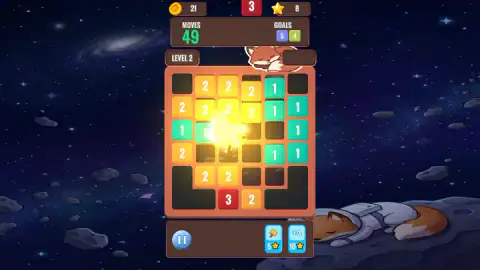
Most number-merging games are a slow drowning. The board fills, you keep combining to buy space, and the only real ending is the move you cannot make. NumoraPuzzle takes that ladder of numbers and puts a finish line at the end of it. Before the first click, the panel in the top-right corner tells you what the level wants: one tile showing a 5, one tile showing a 4. Build both and you have won. Everything else on the board is raw material.
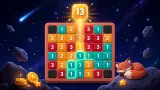
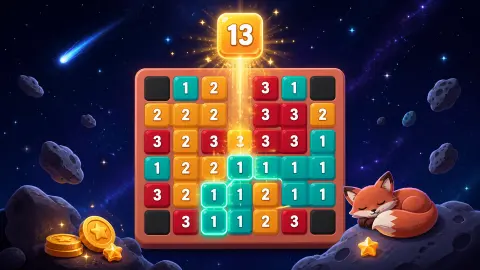
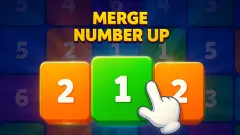
The verb is a single click. Tiles sit in a six-by-six grid, each carrying a small number, and any group of touching tiles that share a number can be collapsed into one tile worth one more. Two 1s become a 2. Three 2s become a single 3. The group vanishes, what sat above it drops into the hole, and some squares stay dark and empty for a while, so the board you get back is never quite the board you had. There is no dragging, no swiping and no undo.
What keeps it from being idle fiddling is the counter on the left, marked MOVES. Our level opened with fifty of them. That is not a timer — nothing on the screen moves while you think — but it is a budget, and every click spends one whether the merge was clever or careless.
The game is credited to Hong Kong Skyreach Interactive Limited. It went up in August 2026.
We could not find a studio site or any second source for the name, so that credit rests on a single page, and we would rather say so than dress it up.
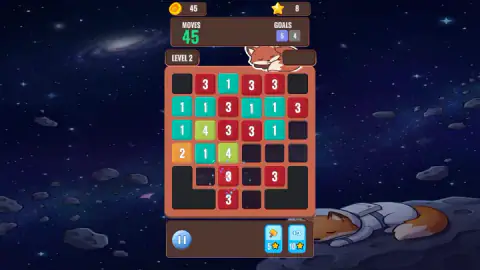
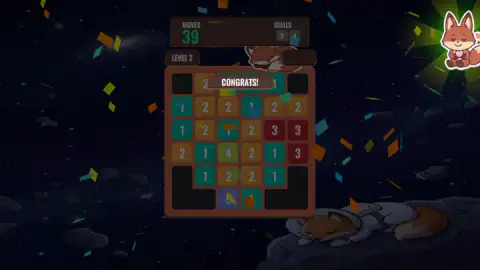
Here is what this page is built from. We came in at the tail of the first level, played the second from its opening move to the CONGRATS banner, and stopped there — about four minutes, on a desktop, with a mouse. The move counter read 49 in our first picture and 39 in the winning one. We never saw what comes after, never opened the pause menu, and never spent a coin or a star.
A 5 is not one more than a 4 — it is twice as much
This is the part the tidy little numbers hide. Because at least two tiles have to go in to get one tile out, every step up the ladder costs at least double the step below.
Two 1s make a 2. Two of those make a 3. Keep going and the cheapest 4 on the board has eight 1s buried inside it, and the cheapest 5 has sixteen.
So when the goals panel asked for one 5 and one 4, it was not asking for two tiles. It was asking for roughly two dozen 1s, arranged well enough to keep meeting each other. That is why a level with a two-item shopping list hands you fifty moves to fill it.
The number written on the tile is not a quantity, it is a count of doublings — and that trick has a name outside this game. It is an octave. The A above middle C on a piano vibrates 440 times a second; the A above that one, 880; the next, 1,760. Same letter, same name, and every step up doubles the vibration underneath it.
So musicians count octaves rather than counting hertz, for exactly the reason this game writes a 5 instead of writing thirty-two. Small numbers are easier to hold in your head than big ones, and when every step is a doubling, the small number is the honest one.
Earthquakes are named the same way, and so are decibels. A nine-year-old who has worked out why a 4 is so much harder to build than a 3 has worked out, without being told, why a magnitude 6 quake is not a bit worse than a magnitude 5.
Two currencies, and only one of them was ours
Under the board sit two blue buttons. One has a gold hammer on it and a price of five stars. The other says +3 and costs ten. In the corner above the grid there are two counters: a coin and a star.
The coin counter moves constantly. Ours read 21 early in the level, 45 around the halfway mark and 57 by the end — it climbs as you merge, and that is the entire economy we were able to observe.
The star counter, meanwhile, never moved at all. It said eight when we arrived and eight when the confetti came down.
Which produces a slightly cruel piece of arithmetic. We could always afford the hammer and could never afford the extra moves, all level long, no matter how well we played. Stars plainly come from somewhere else — finishing levels with a good margin, a reward chest, the shop the coins are for — and we did not find out where. We also never pressed the hammer, so what it does to a tile is a hole in this page rather than a guess we are going to dress up as a fact.
The fox is asleep until you finish
The art is doing quiet work. Behind the grid there are two spiral galaxies, a slow drift of asteroids and, down in the bottom-right corner, a fox in a spacesuit curled up asleep on a rock. A second fox dozes on a ledge directly above the board, next to an empty bar waiting to be filled with something we never filled.
Then the goals clear, and the banner reads CONGRATS, and confetti falls across the grid — and in the top-right corner a fox appears in a burst of green light, awake, upright, holding a pink heart. That is the whole reward ceremony, and it lands because of everything it is contrasted against. A game about arithmetic with a dark starfield behind it has spent the entire level being calm at you. Waking the fox up is the only loud thing in it.
More puzzles cut from the same grid
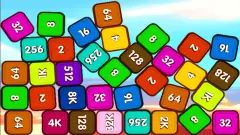
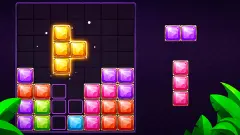
If the merging ladder is what you came for, Block Crush is the nearest neighbour we have: an eight-by-eight board where you drop pieces into rows instead of collapsing them, and nothing ever rotates to save you. Sand Blocks keeps the grid but makes the pieces pour — blocks break into coloured sand that stacks and settles where it likes, which is the falling half of this game turned into the whole game. Word Blossom swaps numbers for letters if you would rather hunt than calculate, and Hero Rescue Puzzle is the opposite temperament entirely: the question there is which pin to pull, and there is no budget of fifty anything to forgive a bad guess. The rest are in puzzle games.
Screenshots
How to play NumoraPuzzle
- Read the goals panel first. Top right, under the word GOALS, sit the tiles the level wants. Ours asked for a 5 and a 4. Nothing else on the board matters except as a route to those two.
- Find touching tiles that share a number. Touching means edge to edge, up, down, left or right. A lone tile with no twin beside it is dead weight for now.
- Click the group. It collapses into one tile showing the next number up, and the tiles above slide down to fill the gap.
- Work the small numbers while the board is crowded. The grid is at its most generous at the start, when teal 1s and orange 2s are everywhere. That is when the raw material for a 4 is cheapest.
- Watch the counter, not the clock. You are spending moves, not seconds. If a click would not get you closer to one of the two goal tiles, it is a move you have thrown away.
What the run taught us:
- The keyboard is not part of this game. We pressed every arrow key, space, Enter and Escape, over and over. The board never flickered. Mouse and touch are the whole control scheme.
- Bigger groups are not better groups. Collapsing two tiles and collapsing four tiles both cost one move and both produce exactly one tile of the next value. Merging the extra pair separately would have given you a second tile to work with. Clear the big clusters when you need space, not when you need numbers.
- Colour is quicker than digits. Each number has its own fixed colour, so once you know them you stop reading the board and start seeing it. Our winning picture has both goal tiles greyed out and a small periwinkle square sitting near the bottom of the grid, in the same shade the goals panel used for its 5. The colour reaches you before the digit does.
- Nothing punishes a pause. The board is entirely static between clicks. You can leave the tab, come back and the position is exactly where you left it.
Controls
| Left mouse button | Click a group of touching tiles that share a number; they merge into one tile worth one more |
|---|---|
| Tap (touchscreen) | The same thing, on a phone or a tablet |
| Pause button (bottom left) | Pauses the level; we left it alone |
| Hammer button (bottom right) | A booster priced at five stars. We never spent it, so what it breaks is a gap in this page |
| +3 button (bottom right) | A booster priced at ten stars. We finished the level with eight, so we could never afford it |
| Arrow keys, space, Enter, Escape | Nothing we could see. We pressed all of them, repeatedly, and the board never reacted |
Features
- A six-by-six grid where every number has its own colour: 1 teal, 2 orange, 3 red, 4 lime
- Levels are orders, not survival: the goals panel names the tiles you must manufacture, and you win when both are built
- A move budget instead of a timer — our level handed over fifty moves and nothing ever rushed us
- Merging is one click on a group of touching same-numbered tiles, with no dragging and no swiping
- Two boosters priced in stars, a hammer at five and a +3 at ten, sitting under the board where you can see what you cannot afford
- Coins tick up as you merge: ours climbed from 21 to 57 inside a single level
- A sleeping astronaut fox, two spiral galaxies and a drifting asteroid field behind the board
Game details
- Developer
- HONG KONG SKYREACH INTERACTIVE LIMITED
- Release date
- August 2026
- Last updated
- August 28, 2026
- Added here
- July 2026
- Technology
- HTML5 (2D)
- Platforms
- Browser (desktop, mouse), Browser (mobile & tablet, touch)
- Classification
- Puzzle
- Saved progress
- Saving, when available, is managed by this game. Mava cannot confirm your level.
FAQ
How do you play NumoraPuzzle?
You click a group of touching tiles that all show the same number, and the group becomes a single tile showing the next number up. The panel marked GOALS names the tiles you have to end up with, and a counter marked MOVES tells you how many clicks you have left to get there. Clear every goal before the moves run out and the level is won.
What do the numbers on the tiles mean in NumoraPuzzle?
They count steps, not amounts. Because two tiles have to go in to get one tile out, each number on the board is worth at least double the one below it. A 4 is not one better than a 3, it is twice the work, and a 5 is twice that again.
How many moves do you get in NumoraPuzzle?
The level we played began with fifty. Our first picture of it shows the counter on 49 and the winning picture shows 39, so the two goals cost us about ten moves out of a budget of fifty. That is a generous margin, and it is the main reason the game never feels like a race.
What are the stars and coins for in NumoraPuzzle?
They are two different currencies. Coins climb while you merge — ours went from 21 to 57 during one level — and we never found the shop they are meant for. Stars buy the two boosters under the board, a hammer for five and a +3 for ten. Our star count sat at eight from the first move to the last, so stars clearly come from somewhere other than merging, and we did not find out where.
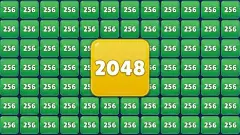
Is NumoraPuzzle the same as 2048?
The ladder is the same idea and the controls are not. In 2048 you swipe the whole board and matching tiles collide on their own. Here nothing moves until you pick a specific group of touching tiles and click it, so you choose exactly which merge happens and when. It also has a finish line: a goals panel to satisfy rather than a score to push.
How many levels does NumoraPuzzle have?
Nobody publishes a number and we did not reach the end. We arrived at the tail of the first level, played the second from its opening move to its CONGRATS banner, and stopped there. How many follow, and whether they get harder by shrinking the move budget or by raising the goals, is something this page cannot tell you yet.
Does NumoraPuzzle need fast reactions?
No. The board waits. Nothing falls, drains or ticks while you are looking at it, and the only cost of thinking is your own patience. The pressure in this game is arithmetic, not reflexes, which makes it an unusually calm thing to leave open in a tab.
Who made NumoraPuzzle and is it free?
It is credited to Hong Kong Skyreach Interactive Limited. It was published in August 2026. It is free to play in the browser, with no download and no account.