



About Memorya
The classic game of pairs costs you nothing when you get it wrong. You turn two cards, you put them back, and all you lose is your turn. Memorya keeps the rules and puts a price on both halves of that sentence. Every wrong pair takes one of your three hearts, and when a board is done the game hands you a card with your time on it and pays you accordingly.
Pays is the right word. Clear a board in a few seconds and the card reads 195 points with three gold stars. Spend more than a minute on the same job and it reads six. The points are not decoration: they add up on the level map, and they are the only thing the game carries forward from one board to the next.
The boards themselves are small, and that is the point. Ours held four cards, two pairs, for the first stages and grew to six later on. Before each one a sign reads REMEMBER THE PAIRS, with the faces showing pale behind it until you press START. That look is the only free information the game gives you.
Memorya is made by madewies.game, the only game listed under that name. It was published in September 2026.
The clock is the score
Every board we finished ended on the same card: the word EXCELLENT, up to three gold stars, and two numbers labelled TIME and POINTS. The stars look like a verdict on your memory. They are a verdict on your clock.
Our quickest clear took 6.41 seconds and paid 195 points, with every star on the card lit. It was the only one of the session.
Slow work pays close to nothing. A clear just under a minute was worth thirty points. One that ran past eighty seconds was worth six. Same rules, same size of board, one star each, a fraction of the reward.
You can watch the total grow. The map between boards carries a star counter in its top corner, and early in our session it read 48 — exactly what our first two stages had paid between them. After the fast board it read 249, which is the running total of every result we had collected. Nothing else we did moved that number, so the counter is simply the sum of your points.
There is one thing beside the points we never tested: a small green button marked with a star and a multiplier. We left it alone, and the total went up by exactly the figure printed on the card.
Three hearts, and the offer when they run out
You start each board with three hearts, and in our run the count reset to three for every new stage. Mistakes are the only thing that spends them.
On the six-card board we finally spent them all. The hearts hit zero, the board froze, and a panel came up offering three more lives in exchange for watching an advert, with a yellow button to accept and a quieter one to decline. We declined. The next screen read TRY AGAIN, with our time on it and nothing else: no points, no stars. Losing pays you nothing at all. Two buttons let you take the stage again or go back to the map.
That offer was the only advertising we met in ten minutes of play. Nothing cut into a board and nothing ran before one, which on a browser game is worth saying out loud.
Four cards, then six: the odds on a small board
On a four-card board, turn one card and three are left, only one of which matches it. Your opening pair is a one-in-three guess, so most of the time it misses.
What rescues you is the miss itself. It shows you two different pictures, and the two cards still face down must be their partners. Turn either one and you already know exactly where its match is. Played that way, a four-card board never costs more than a single heart, which makes three a generous allowance.
Six cards change the arithmetic without changing the method. Your opening flip is now a one-in-five guess, and a miss buys you less, because there are more unknown faces left to confuse you. That is where our hearts ran out.
The size is tied to the map, a sunlit park with a path winding through it, numbered stages along the path and padlocks on the ones you have not reached. Each stage you finish keeps its stars printed underneath it. Boards stayed at four cards for the first stages we played and jumped to six at the fifth.
Concentration, Pelmanism, Memory: the game under the name
Memorya's rules are far older than any screen, and the game of turning up pairs goes by several names. In the United States it is often called Concentration, after a television quiz show built around a board of hidden matching prizes that ran from the late 1950s into the 1970s. In Britain it is still called Pelmanism, after a memory-training course heavily advertised there in the early twentieth century. Plenty of families just call it Memory, or Pairs.
They all share one idea: you are not really guessing. Every card you turn and put back is a clue, and whoever keeps track of those clues wins. Memorya puts a number on that idea twice over. Each heart you keep is a card you remembered, and each second you save is points in the bank.
The board, and what we left untouched
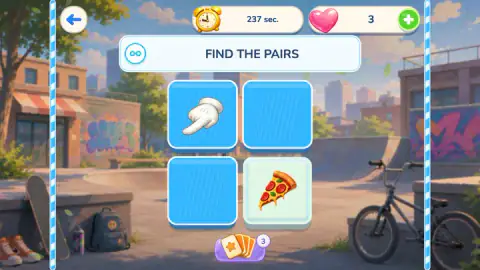
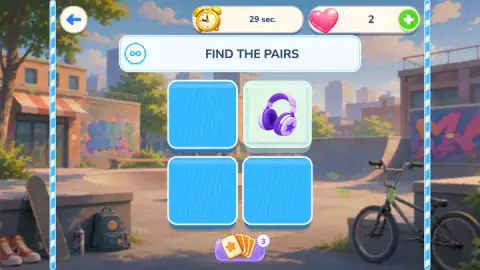
The setting is a city skatepark on a bright afternoon: a graffiti wall, a BMX leaning against the concrete, a skateboard, a backpack, trainers and a spray can at the edge of the frame. The card pictures belong to the same world — a pizza slice, a lighter, blue trainers, purple headphones with a star, a cup of bubble tea, a green backpack — so you are matching a skater's afternoon rather than fruit or farm animals.
A few things around the board stayed closed to us. A green plus sits beside the hearts. A small infinity symbol sits on the banner over the cards and on the first two stages of the map. A trophy and a settings gear sit in the corners of the map. The game's own instructions also mention choosing an atmosphere, and we only ever saw the skatepark.
We played five stages and cleared four of them. We cannot tell you how long the map runs, how far the boards grow, or what the hints do when you spend one. What we can tell you is that the game is quick to learn, quick to replay, and quietly ruthless about the clock.
More pair-finding games
If the flip-two-cards rule is what you came for, Emoji Memory: Find a Pair plays it with emoji faces, Match Them Up builds a tidier puzzle out of the same idea, and Find a Pair 3D moves the hunt for identical objects into a 3D room. The rest are in our puzzle games.
Screenshots
Taken by opening the game ourselves and letting it run — not supplied by the publisher, and not the same picture every other site shows.
How to play Memorya
- Look at the cards while the REMEMBER THE PAIRS sign is up, then press START.
- Click or tap a face-down card to turn it over, then turn a second one.
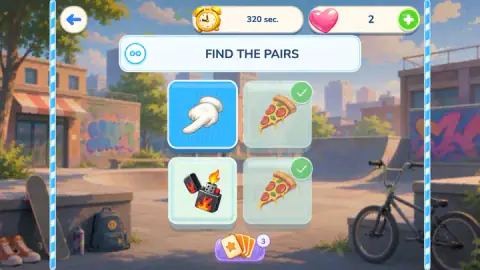
- If the pictures match, both stay face up, paler, with a green tick.
- If they do not, both are crossed out in red, one heart goes, and the cards turn back over.
- Clear every pair. The results card shows your time, your points and your stars, and then the map, where the next stage opens.
Tips from our run
- Speed is the whole score, so the moment you know where a pair is, take it. Hesitating costs more than a wrong guess does.
- After one miss on a four-card board you have enough information to finish without a second one. See below.
- Matched cards go pale and stay on the table. Only the bright blue backs are still in play, which makes a half-finished board easy to read at a glance.
- The white glove is not a card. It is the game pointing at where to tap, and it is drawn right on top of a face-down card.
- A hint button sits under the board, a stack of cards with a star and the number three. We never spent one, and the number never moved.
Controls
| Click or tap START | Begins the board after the REMEMBER THE PAIRS sign |
|---|---|
| Click or tap a face-down card | Turns it over; the second card you turn decides whether you have a pair |
| Click or tap a numbered stage on the map | Starts that stage; the ones you have not reached carry a padlock |
| Back arrow (top left) | Leaves the board; we did not use it mid-round |
Features
- Boards of four cards for the first stages, six cards by the fifth one we reached
- Three hearts a board, and one goes with every wrong pair
- A match stays face up with a green tick; a miss is crossed in red and turns back over
- The clock counts up from zero and sets your pay: 195 points for a clear in 6.41 seconds, six points for one that took over a minute
- Up to three stars a stage, and the points add up in the star counter on the level map
- At zero hearts the game offers three more lives for watching an advert; turning it down ends the stage
- A hint button sits under the board showing three uses, and nothing else interrupted our play
Game details
- Developer
- madewies.game
- Release date
- September 2026
- Last updated
- September 14, 2026
- Added here
- September 2026
- Technology
- HTML5 (2D)
- Platforms
- Browser (desktop, mouse), Browser (mobile & tablet, touch)
- Classification
- Puzzle
- Saved progress
- Saving, when available, is managed by this game. Mava cannot confirm your level.
FAQ
How do you play Memorya?
Press START while the REMEMBER THE PAIRS sign is up, then turn over two cards at a time. If the pictures match, they stay face up with a green tick. If they do not, both are crossed out in red, you lose one of your three hearts, and they turn back over. Clear every pair to finish the stage.
How do you get three stars in Memorya?
By being quick. The results card shows your time and your points, and the stars follow the clock. Our fastest clear took 6.41 seconds and scored 195 points with three stars, while a board that ran past eighty seconds scored six points and a single star.
What happens when you run out of hearts in Memorya?
The board stops and the game offers you three more lives in exchange for watching an advert. If you turn the offer down, as we did, the stage ends on a card reading TRY AGAIN with your time on it, no points and no stars, and you can replay it or go back to the map.
How many cards are on a Memorya board?
Four to start with, which is two pairs, laid out in a square. The boards grow: the fifth stage we reached had six cards in two rows of three. We did not get far enough to see whether they grow beyond that.
Does Memorya have ads?
Only one offer, and it is optional. In ten minutes of play nothing interrupted a board and nothing played before one. The single advert on the table was the one the game offers in exchange for three extra lives when your hearts reach zero.
What is the white glove in Memorya?
It is the game's pointing hand, not a card picture. It is drawn over the card it wants you to turn, and on the level map it points at the stage you should play next. It sits on a plain blue card back, while every real card face has a pale background.
Who made Memorya?
Memorya is made by madewies.game, and It was published in September 2026.
Can you play Memorya on a phone?
The game is listed as playable on phones and tablets, and every move is a single tap on a card or a stage. We played it on a computer with a mouse and did not test it on a touch screen ourselves.