



About Merge Mania
Most merge puzzles drop numbers on your head. Tiles fall from the top, the pile grows from the floor, and you lose when it reaches the roof. Merge Mania turns that upside down. Here you are the one at the bottom, firing numbered tiles upwards, and the danger is a pile that grows down towards you.
There is a second twist, and it is the one that decides your score. The roof does not stay put. A pale blue ceiling sits at the top of the board, and every time we looked at it, it was lower than before. The board you start with is not the board you finish on.
The rule underneath is the old one from 2048: two equal numbers touch and become one worth double. We played three games in about four minutes, and the best of them ended on 48 points, after a pair of 16s and a pair of 8s had both doubled.
The ceiling that keeps coming down
The game's own description calls Merge Mania a race against time, and the ceiling is where that race lives. At the start of a game the blue band at the top is a thin strip, and roughly seven tiles fit in a column below it. Half a minute later the band had grown to a thick slab. By the end of our games a column held about five tiles before it touched the tray.
That changes how you should think about every column. A stack that was safe at the start becomes dangerous without you adding a single tile to it, because the space it lives in is shrinking. The tiles stay stuck under the ceiling and ride down with it.
What we could not pin down is what moves it. The band grew at a steady pace in every capture we took, which points to the clock, but it also grew in step with our moves, and we never sat still long enough to tell the two apart. Either way, slow play does not buy you room.
Merges go sideways too
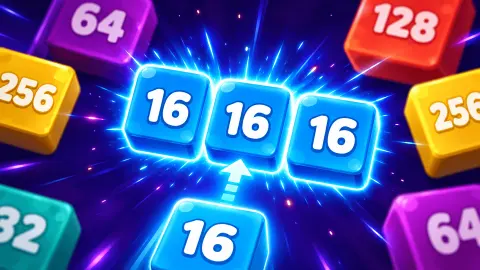
The instructions talk about tiles meeting as they travel up a column, which suggests merges only happen in a straight line. Our first game showed otherwise. We sent a 16 up the left column and another 16 up the column next to it, and the two ended up side by side in the top row. A moment later they were gone, replaced by a single 32 in the second column, and the score jumped from 4 to 36.
Something else happened in the same move. The 4 that had been sitting under the first 16 slid up into the space it left. Tiles in Merge Mania fall up, the way objects fall down in other games: when a gap opens above a tile, it rises to fill it.
That gives you two things to plan with. A pair can be built across two columns, not only inside one. And clearing a tile from the top of a column pulls the rest of that column upwards, which can line up the next merge for you or ruin the one you were building.
How the score adds up
The yellow number at the top counts only what you make. Each merge adds the value of the new tile, and nothing else scores. In our third game the first pair of 16s took the counter straight to 32. A pair of 8s added the next 16, and that was the whole game: two merges, 48 points.
This is the part Merge Mania shares with 2048, the 2014 browser puzzle in which a whole grid of numbered tiles slides at once and equal neighbours combine. Every tile in both games is a power of two, each value double the one before, starting from 2. So every score is a sum of tiles you built, and you can read a score back into the merges that made it.
The difference is control. In 2048 every move shifts the whole board. Here you place one tile at a time and choose exactly where it goes, but the ceiling takes away the time you would need to set up long chains. New tiles came in values up to 32 in our games, so the board also hands you big numbers you did not earn and have to find a place for.
What we saw, and what we did not
Our three games ended on 44, 32 and 48 points. The best score on screen before our first move already matched that last one, left over from an earlier sitting, so we tied our record and did not beat it. The biggest tile we built was a 32, and we cannot tell you whether the colours, the speed of the ceiling or anything else changes beyond it.
Two of our games ended the same way: a single tall column in the middle reached the tray. In the second one the last tile was a 2 landing on another 2. The merge would have shortened the column, but the game was already over. If a column is one tile from the tray, a merge on that tile will not save you.
When a game ends, an ad break can appear before the score card. The card itself has a home button and a restart button, and a new game starts on an empty board with the ceiling back at the top.
Who it is for
Merge Mania suits players who like a quick number puzzle with some pressure on it. Rounds are short, there is a single control and the rule fits in a sentence, so children can pick it up from the first tile. Doubling numbers is also decent practice for anyone learning the two times table and beyond.
It is not a relaxing puzzle and it is not a long one. There are no levels, no goals beyond your best score and no way to stop the ceiling. The game is built for a tall portrait screen and is listed as playable on phones, but we played with a mouse and did not test touch.
More merge puzzles
Drop & Merge 2048 is the mirror image: five lanes again, but the numbered cubes fall down instead of flying up. Merge 2048 has you drag and drop numbered blocks onto a board, and Funny Cubes 2048 has you throw cubes onto a pile and lets physics decide where they land. The rest are in our puzzle games.
Screenshots

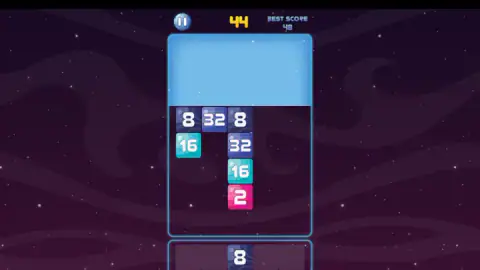

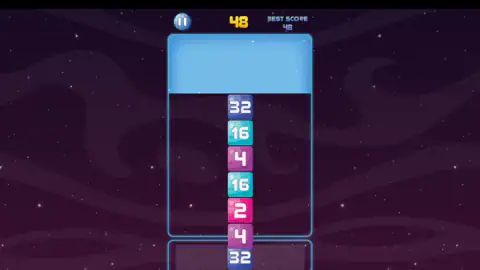
Taken by opening the game ourselves and letting it run — not supplied by the publisher, and not the same picture every other site shows.
How to play Merge Mania
- Look at the tray under the board. It has five slots, and the next tile always waits in the middle one.
- Click or tap the column you want. The tile shoots up that column until it hits the ceiling or the lowest tile already there.
- When the tile touches another with the same number, the two merge into one worth double, and the new value is added to your score.
- Keep going until a column reaches all the way down into the tray. That ends the game, and a card shows your score next to your best.
What three short games taught us
- Spread out. Our first game used three columns and lasted about 80 seconds. In the other two we sent nearly everything up the middle, and both were over in under a minute.
- Look sideways as well as up. Equal tiles merge when they sit next to each other, not only when one lands under the other.
- A small number at the bottom of a tall column is a cork. In our second game a 4 got trapped between two 16s and nothing could reach it again.
- Merges can take a moment to happen. Wait for the board to settle before you fire the next tile, or you may aim at a tile that is about to move.
- Placing a tile without a merge scores nothing. Points only come from making new tiles.
Controls
| Click or tap a column | Sends the waiting tile up that column until it meets the ceiling or another tile |
|---|---|
| Pause button (top left) | Pauses the game |
| Restart button (game over card) | Starts a new game with an empty board |
Features
- Tiles travel upwards, from a launcher at the bottom to a ceiling at the top
- Five columns to aim at, with the next tile always waiting in the middle slot
- Equal tiles merge when they touch, side by side as well as one above the other
- The ceiling creeps down as the game goes on, so every column gets shorter
- Your score grows by the value of every tile you make, and the best one is kept on screen
- New tiles came in values from 2 up to 32 in our games
- Rounds are short, from about 45 seconds to a minute and a half in our three games
Game details
- Developer
- Partner studio
- Release date
- September 2026
- Added here
- September 2026
- Technology
- HTML5 (2D)
- Platforms
- Browser (desktop, mouse), Browser (mobile & tablet, touch)
- Classification
- Arcade , Educational , Puzzle
- Saved progress
- Saving, when available, is managed by this game. Mava cannot confirm your level.
FAQ
How do you play Merge Mania?
A numbered tile waits at the bottom of the screen. Click or tap one of the five columns and the tile flies up it until it hits the ceiling or another tile. When two tiles with the same number touch, they merge into one tile worth double.
How do you lose in Merge Mania?
The game ends when a column of tiles reaches all the way down to the launcher at the bottom. A ceiling at the top also creeps lower as you play, so each column holds fewer tiles over time. In our games about seven tiles fitted in a column at the start and about five near the end.
How does scoring work in Merge Mania?
Every merge adds the value of the new tile to your score. Two 16s make a 32 and add 32 points, two 8s make a 16 and add 16. Placing a tile without merging scores nothing, and the best score stays on screen next to the current one.
Do tiles merge sideways in Merge Mania?
Yes. In our first game two 16s landed next to each other in the top row and became a 32 a moment later, even though they sat in different columns. A tile that moves away also lets the tiles below it slide up to fill the gap.
What is a good strategy for Merge Mania?
Use more than one column. In our games, the round where we spread tiles over three columns lasted about 80 seconds, while the two where we stacked everything in the middle ended in under a minute. Keep small numbers away from the bottom of a column you still need.
Is Merge Mania like 2048?
It uses the same idea as 2048, where equal numbers join into one worth double, but the board works differently. You do not slide the whole grid; you fire one tile at a time up a column, and a ceiling moving down replaces the filling grid as the pressure.
Who made Merge Mania?
No developer name appears in the game or in the listing we carry. Merge Mania is distributed, and other games with the same name exist on other sites, so search results may point to a different game.
Can you play Merge Mania on a phone?
The game runs in a tall portrait frame, the shape of a phone screen, and it is listed as mobile-friendly. We played it on a computer with a mouse and did not test touch ourselves.