


About 2048 3D: Merge Cubes
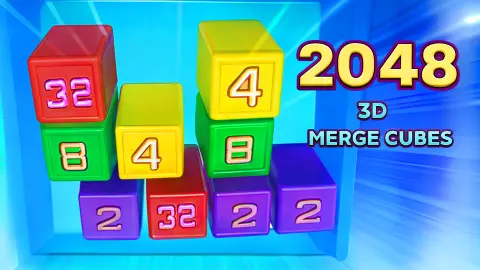
The original 2048 never lets anything fall. Its tiles slide across a flat grid, and gravity is not part of the deal. 2048 3D: Merge Cubes keeps the doubling and throws away the grid. Numbered cubes drop one at a time into a blue glass, they land where they land, and the only border that matters is a thin red line just under the rim.
You choose where each cube goes before it drops. Put it on a cube with the same number and the pair bursts into small pieces and comes back as one cube worth double: two green twos make a yellow four, two yellows a red eight. Miss, and the cube stays where it is, taking up room. In a glass, room runs out upward.
We played the first level on a desktop with a mouse for about four minutes, and we did not beat it. When our run ended the clock showed 10 seconds and the score 160, against a target of 400. What follows is what that one level showed us, and we say plainly where it stops.
The game is credited to Kirill Vetrinskiy. It was published in April 2025.
What changes when 2048 gets gravity
The original 2048 was written over a weekend by Gabriele Cirulli, then a 19-year-old Italian web developer, and released free and open source in March 2014. It went viral within days, and a flood of variations followed, from bigger and smaller boards to a three-dimensional version and one crossed with Tetris.
In Cirulli's game every move slides every tile on a four-by-four board at once, and a new tile appears in a random empty square after each move. The game ends when the board is full and no two neighbours match.
This one changes three things. You move one cube, not the whole board. You know what is coming, because the queue shows the next two cubes, where the original only reveals a new tile after you move. And the pressure comes not from a full board but from the red line and the clock. A bad drop costs you a space; it does not scramble everything else.
The scoring, though, is the original's. Cirulli's 2048 adds the value of each new tile to your score, and our counter behaved the same way. Our first red eight took it to 12, which fits: four for a yellow cube made on the way, eight for the red one.
That rule explains why the target felt far away. Small merges pay small points, and a single merge into a 32 is worth as much as eight merges into a 4. The way to the target is to build up, not to make many little pairs.
Level 1: a target, a clock and a red line
The first level opened with the clock at about three minutes and a target of 400 points. The bar at the top of the screen fills as you score, so you can see at a glance how far you are.
We fell well short. Most of our merges made yellow fours and red eights, and the score climbed by a handful of points at a time. The two pink cubes that sat side by side for so long had finally become a blue 32 by the time our run ended.
At that point the clock showed 10 seconds and the counter 160. We do not know what the game does when the clock reaches zero, because our session ended first.
The red line never came into play for us. Our pile stayed in the lower half of the glass. The listing says a level is lost if cubes stay above the line for more than three seconds, which reads as a short grace period: a cube that bounces above it for a moment should not end the level. We cannot confirm that from our run.
Boosters: X2, bomb and lightning
Three round buttons sit under the glass, each with a counter that started at zero. Late in level 1 the game paused to give us a free X2, with a message saying it doubles a block with any number. Its counter changed to one. We did not use it before our run ended.
The listing describes the other two. The bomb destroys the cubes around it. The lightning clears stones, blocks that cannot merge at all. We met no stones in level 1, so they probably arrive in later levels, but we have not seen them.
What we did not see, and who it is for
We played level 1 only, on a desktop, and did not finish it. We did not see later levels, stones, the bomb or lightning in action, the end of a level, or the endless mode the listing mentions. We did not play on a phone.
The game suits anyone who knows 2048 and wants a slower, more physical version of it, where you deal with one cube at a time and see the next two coming. It is also a gentle way into doubling for younger players: every merge is a sum you can watch happen. It is not a pure logic puzzle. Cubes bounce and tilt, so now and then a good plan lands slightly wrong, and the clock means you cannot think forever.
More merge and drop games
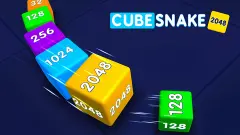
The closest relative in our catalogue is Merge 2048, where you also hold a numbered tile over a jar and let go before the pile crosses a red line. Fruit Merge: Juicy Drop Game uses the same drop-and-merge idea with fruit instead of numbers. For a flat board closer to the original, try 2048 Merge Blocks, and for numbered cubes on the move, Cube Snake 2048. The rest are under puzzle games.
Screenshots
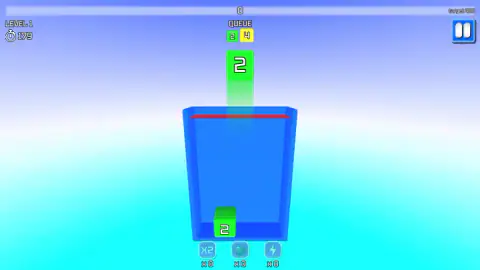
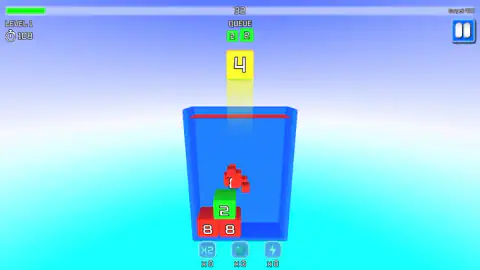
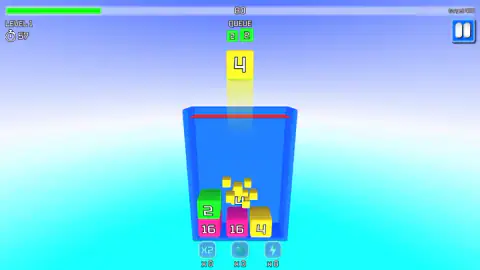
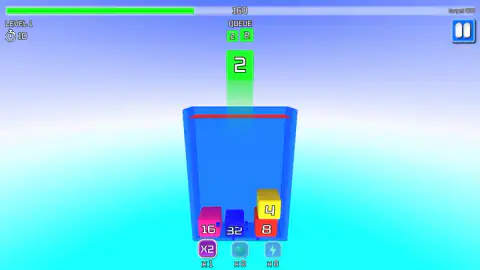
Taken by opening the game ourselves and letting it run — not supplied by the publisher, and not the same picture every other site shows.
How to play 2048 3D: Merge Cubes
- Pick a level from the Level Selection screen, a grid of numbered squares. We played level 1.
- Read the top of the screen: the level and a countdown clock on the left, your score in the middle above a bar that fills toward the target, and the Queue with the next two cubes.
- Hold the left mouse button and drag sideways to move the waiting cube. A pale beam under it shows the column it will fall into.
- Let go to drop it. When two equal numbers meet, they merge into one cube worth double.
- Climb toward the target score while the clock runs down, and keep the pile below the red line.
What our level taught us:
- Read the queue, not just the cube. It shows two cubes ahead, and every cube we were given was a 2 or a 4. Plan where the next pair will go before you drop this one.
- Neighbours do not merge. Two pink 16s sat touching on the floor of the glass for more than half a minute without joining. Equal cubes merge when one lands on or is knocked into the other, so drop onto your target, not beside it.
- These are blocks, not tiles. Cubes tumble and settle. In one of our screenshots a yellow 4 rests at a slant on the edge of a green 2, touching nothing it could merge with. A cube dropped on a corner may not end up where the beam pointed.
- Keep the big cubes low and to one side. Our 16s ended on the floor while small cubes kept piling on top of them. The floor holds only about four cubes side by side, so a big number in the middle splits the glass in two.
Controls
| Hold the left mouse button and drag sideways | Moves the waiting cube left or right above the glass; a pale beam shows where it will fall |
|---|---|
| Let go of the mouse button | Drops the cube into the glass |
| X2, bomb and lightning buttons below the glass | Use a booster, when its counter is above zero |
| Pause button, top right | Pauses the level |
Features
- Numbered cubes that drop into a blue glass and merge into one cube worth double when two equal numbers meet
- A red line just under the rim of the glass that marks how high the pile may grow
- A queue at the top of the screen that shows the next two cubes before they arrive
- A countdown clock and a target score for each level, with a bar that fills as you score
- Cubes that tumble and settle like real blocks, so one can come to rest tilted on another
- Three boosters, X2, bomb and lightning, with an X2 handed out during our first level
- A level select screen with 20 numbered levels
Game details
- Developer
- Kirill Vetrinskiy
- Release date
- April 2025
- Last updated
- August 10, 2026
- Added here
- May 2025
- Technology
- HTML5 (3D)
- Platforms
- Browser (desktop)
- Classification
- Puzzle
- Saved progress
- Saving, when available, is managed by this game. Mava cannot confirm your level.
FAQ
How do you play 2048 3D Merge Cubes?
A numbered cube waits above a blue glass. Hold the mouse button, drag sideways to line it up and let go to drop it. When two cubes with the same number meet they become one cube worth double, so two green twos make a yellow four. Each level gives you a target score and a countdown clock.
Do two equal cubes merge if they are just next to each other?
Not in our experience. Two pink 16s sat side by side on the floor of the glass for more than half a minute without joining. Merges happened when a cube landed on, or was knocked into, its twin, so aim your drops rather than relying on neighbours.
How is the score counted in 2048 3D Merge Cubes?
Each merge adds the value of the new cube, the same rule the original 2048 uses. Our first red eight put the counter at 12, four for a yellow cube made on the way, plus eight for the red one.
What is the red line in 2048 3D Merge Cubes?
It runs around the inside of the glass just below the rim and marks how high the pile may go. The game's listing says a level is lost if cubes stay above it for more than three seconds. Our pile never came close, so we did not see that happen.
What do the X2, bomb and lightning boosters do?
X2 doubles any numbered cube; the game told us so when it handed us one during level 1. The listing says the bomb destroys the cubes around it and the lightning clears stone blocks, which cannot merge. Each booster has a counter under its button, and all three started at zero.
How many levels does 2048 3D Merge Cubes have?
The level select screen shows 20 numbered levels. We played only the first. The listing also mentions an endless mode for high scores, which we did not see.
Is level 1 of 2048 3D Merge Cubes hard?
Harder than it looks. The target was 400 points and the clock started at about three minutes. We finished our run at 160 points with ten seconds left, because most of our merges were small ones.
Who made 2048 3D Merge Cubes?
The game is credited to Kirill Vetrinskiy. The game was published in April 2025.