
About 248 Scribble
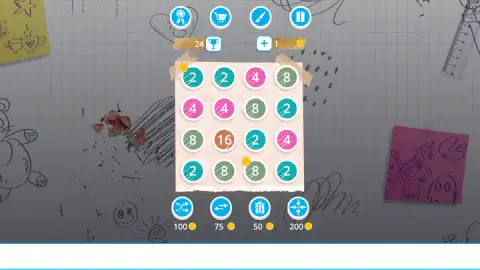
The board is a piece of paper. Somebody tore it out of a pad, taped it down by its top two corners over a sheet of squared exercise paper, and then left the desk exactly as it was: a heap of pencil shavings on the left, a ruler lying along the right-hand edge, a bear and a smiley face doodled into the background, a yellow sticky note with a coffee cup on it and a purple one with a doll in a box.
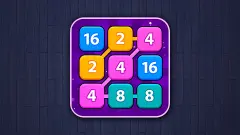
On the paper sit sixteen round counters, four rows of four, carrying numbers that start at two. Drag one onto a neighbour with the same number and the pair becomes a single counter worth double. That is the entire rule.
The family this belongs to is obvious, and the game is not shy about it. What is less obvious is the thing it took out. In the game everybody knows, you press an arrow key, the whole board lurches that way, and the pairs that happen to meet are the ones that merge. Here there is no lurch. You choose the pair with a stroke of the mouse, and the counters you did not touch do not move a millimetre.
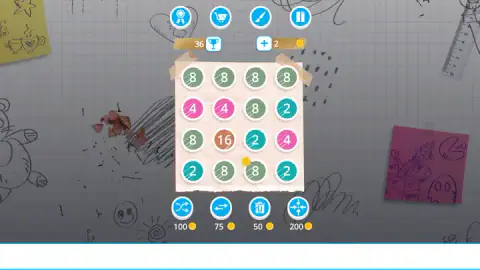
The game is credited to a studio called SecGame and has been available since March 2026. Our own session ran about four minutes on a desktop: we took the smaller of the two boards offered on the way in, worked up to a sixteen, and left with the score on the tape at the top reading thirty-six. We never got near the number in the title, and nothing below pretends otherwise.
2048 was a weekend's work, and this is one of its grandchildren
The game at the root of this one was made in two days. Gabriele Cirulli, an Italian web developer, was nineteen when he built 2048 as a test of whether he could program something from scratch, and the web version went up on 9 March 2014. He published it under the MIT licence, which in plain terms means anyone may take it, change it and sell the result without asking.
Over four million people visited in under a week, and that licence is why there are thousands of these. Cirulli had not invented the idea either: his was a version of a game called 1024, which came from Threes, and by the April after 2048 appeared one trade magazine counted fifteen new imitations a day arriving on the iPhone store alone. The genre is a hand-me-down that was legally handed down.
What makes a descendant worth playing is what it changes, and 248 Scribble changes the verb. In 2048 your move is a direction: you cannot merge one chosen pair, you tilt the table and take what falls out. Here your move is a line drawn between two neighbours. That single swap takes out the famous strategy — pin your biggest tile in a corner and never press the key that would dislodge it — because nothing can be dislodged. It also takes out the luck. You are no longer managing a board that moves on its own; you are tidying one that only moves when you say so.
Nothing on this board moves unless you move it
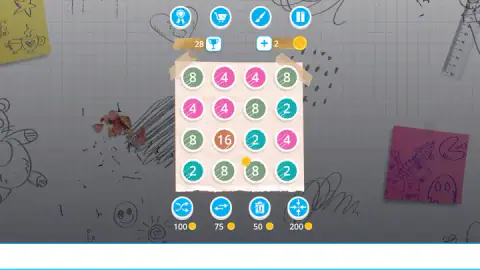
We can show this rather than assert it. Between the last two pictures we kept, one row changed and nothing else did. The top row went from an eight, two fours and an eight to four eights, and the score rose by eight. The other fourteen counters, the sixteen in the middle of the sheet among them, are identical in both.
That is the game in one frame. Your sixteen stays where you made it. In the sliding original a sixteen is a passenger: every move shoves it somewhere, and keeping a big number where you want it is most of the skill. Here the big number is furniture, and the skill is working out which of the small ones to spend.
One honest limit. Two pink fours became two green eights, and merging two fours makes one eight, not two. Something filled the gap, immediately and in place. We cannot tell you the rule behind that, so we report the change rather than explain it.
248 is not a number you can reach by doubling
Start at two and keep doubling: four, eight, sixteen, thirty-two, sixty-four, a hundred and twenty-eight, two hundred and fifty-six. The ladder steps straight over 248. It is not a counter you can build, not on this board or any other that doubles.
So the title is a pun before it is a target — 2048 with the nought taken out, which is roughly what the game does to its ancestor. The number may well be a score, since the score here climbs in eights and sixteens and would cross 248 in a decent run. The provider says you are aiming for a 248 counter; we only ever reached a sixteen, so we pass that on as their account and leave the question open.
There is a second clue that this is a house format rather than a one-off. The same studio has a title on the listing's shelves called 248 Deluxe Wooden Edition: the same arithmetic with the paper swapped for wood. The scribbled desk is a costume, and a good one.
The desk, the coins, and four buttons you cannot afford
Nothing here is trying to hurry you. We saw no timer, no lives counter and no failure noise; the margins are full of somebody's idle drawing, and even the score lives on a strip of tape rather than in a bar. It is a deliberate calm, and it works.
The economy underneath is the usual arrangement, and at least the prices are printed where you can see them. The buttons below the sheet ask 100, 75, 50 and 200 coins.
What they do is less certain. The game's listing calls them undo, hint, shuffle and boost in that price order, while the icons on screen are crossed arrows, a double-headed arrow, a waste basket and a four-way arrow, which do not line up neatly with those names. So we give you the prices as fact and the names as the provider's word.
What we can tell you is the gap between those prices and what you hold. Our coin counter reached two. A panel came up during the session offering fifty coins in exchange for watching an advert, with a blue X in the corner to dismiss it; we dismissed it and watched nothing, so that offer exists and that is the whole of our account of it. The shopping trolley above the sheet we never opened.
More games by SecGame
The same studio keeps a quiet shelf of puzzles. HEX Connect swaps the grid for hexagons and merging for linking, Tangram Puzzle 2 is the ancient seven-piece silhouette puzzle, and Code Breaker Deluxe is the guess-the-combination game once sold as a board with coloured pegs.
If it is the doubling you came for rather than the paper, two near relatives are worth your time. Merge 2048 drops numbered tiles into a jar and asks you to join them before the pile reaches the line, so gravity does what the arrow keys used to. Block Blast 2048 merges whole groups with one tap instead, chasing 512. The rest is in puzzle games.
Screenshots
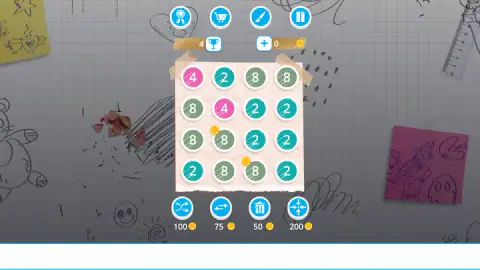
Taken by opening the game ourselves and letting it run — not supplied by the publisher, and not the same picture every other site shows.
How to play 248 Scribble
- Pick your board on the first screen. Two options come up with a blue arrow each, a four by four and a five by five. We took the four by four.
- Drag from one counter to a matching neighbour. Not a tap and not a swipe across the board: a short stroke from one circle to the one beside it. The listing's notes say neighbours count up, down, left and right, and that is how it behaved for us.
- Read the number, never the colour. Every four we saw was pink and the only sixteen was brown, but twos and eights turned up in two different greens, sometimes next to each other.
- Watch the two strips of tape at the top. The one with the trophy is your score and it climbs by the value of whatever you just made. The one with the blue plus is coins, and it climbs very slowly.
- Leave the four priced buttons alone at first. The cheapest asks fifty coins. You begin with none.
What the session taught us:
- A drag that is not a pair is not a move. We spent a good share of our four minutes pulling at counters that did not match, and the board simply sat there. There is no penalty and no feedback either, which makes it easy to think the game has frozen when it is only waiting.
- The keyboard is dead. We worked through the arrow keys and the space bar and nothing we could see or hear answered. Given the ancestry, that is the single most surprising thing in the game.
- The coins are sitting on the table. Small gold coins rest on top of counters on the sheet, and our total crept up while they were there.
- The pause button is a stray click away. It sits in the row above the sheet and twice we opened it by accident. A panel comes up with a house, a restart and a blue arrow to carry on.
Controls
| Drag from one counter to the one next to it | Joins two matching counters into one worth double. The listing's notes say neighbours count up, down, left and right, and that is what worked for us |
|---|---|
| The first screen, before the board | Two board sizes, 4 by 4 and 5 by 5, each with a blue arrow. We took the smaller one |
| Four round buttons under the sheet, priced 100, 75, 50 and 200 coins | The paid help. The prices are printed under them and you start with nothing |
| Four round buttons above the sheet | An award rosette, a shopping trolley, a paintbrush and a pause. The pause sits close enough to the board to catch a stray click |
| Arrow keys, space bar | Nothing we could see or hear. This is a game for one hand and a drag |
Features
- A board drawn as a torn sheet of paper taped over squared exercise paper, with pencil shavings and doodles left around it
- Merging by stroke rather than by slide - you pick the pair, so the rest of the board stays exactly where it was
- Four rows of four counters running 2, 4, 8 and up, with the number doubling each time two of a kind meet
- A score that climbs by the value of what you just made - ours went from four to thirty-six in about four minutes
- Four priced tools under the board at 100, 75, 50 and 200 coins, against a coin counter that reached two in our session
- Gold coins that sit on top of counters on the sheet, and a shop button we never opened
- Listed since March 2026
Game details
- Developer
- SecGame
- Release date
- March 2026
- Last updated
- August 10, 2026
- Added here
- December 2025
- Technology
- HTML5 (2D)
- Platforms
- Browser (desktop), Browser (mobile & tablet, touch)
- Classification
- Puzzle
- Saved progress
- Saving, when available, is managed by this game. Mava cannot confirm your level.
FAQ
How do you play 248 Scribble?
Sixteen round counters sit on a sheet of paper, carrying numbers that start at 2. You drag from one counter to a neighbouring counter with the same number, and the two become one worth double: two eights make a sixteen. The listing's notes say neighbours count up, down, left and right, which matches what worked for us, and the score at the top rises by the value of whatever you just made.
Is 248 Scribble the same as 2048?
It is descended from it and it does not hide that, but the controls are the opposite way round. In 2048 you press an arrow key and the entire board slides that way, and whichever matching tiles happen to collide are the ones that merge. Here you pick the pair yourself with a drag, and everything you did not touch stays put. We tried the arrow keys and the space bar and nothing answered.
What are the four buttons under the board in 248 Scribble?
They are the paid help, and each has a coin price printed under it: 100, 75, 50 and 200. The game's listing names them undo, hint, shuffle and boost in that price order. On screen the icons are a pair of crossed arrows, a double-headed arrow, a waste basket and a four-way arrow, which do not line up with those names in any obvious way, so we can tell you what they cost but not what each one does.
Can you actually reach 248 in 248 Scribble?
Not by doubling, which is the odd thing about the name. Start at two and double and you pass through 128 and land on 256; 248 is never one of the stops. The title reads like 2048 with the nought taken out, so the figure may be a score rather than a counter. We only ever reached a sixteen, so we cannot settle it from our own play.
Does 248 Scribble have adverts?
A panel came up during our session offering fifty coins in exchange for watching one, with a blue X in the corner to dismiss it. We closed it and watched nothing, so we can confirm the offer exists and tell you the coins are what it is dangling, and that is as far as our account goes.
Who made 248 Scribble?
The game is credited to a studio called SecGame, which also has HEX Connect, Tangram Puzzle 2 and Code Breaker Deluxe on our shelves. No studio name appears on screen while you play. It has been available since March 2026 and was last updated in August 2026.
What do the colours of the counters mean in 248 Scribble?
As far as we can tell, less than you would hope. Across the four pictures we kept, every four was pink and the only sixteen was brown, but twos and eights each turned up in both a bright teal and a muted sage green, sometimes side by side in the same row. The safe habit is to read the number and ignore the shade.
Is 248 Scribble good for children?
There is nothing in it to upset anyone: no timer we saw, no lives, no failure noise, and a desk full of doodles for a backdrop. It is arithmetic in disguise, since every merge is a doubling, so a child who can see that two eights make sixteen has the whole rule. It carries no age badge, and the only pressure in our session came from a panel offering coins for an advert.