

About Merge Number Up
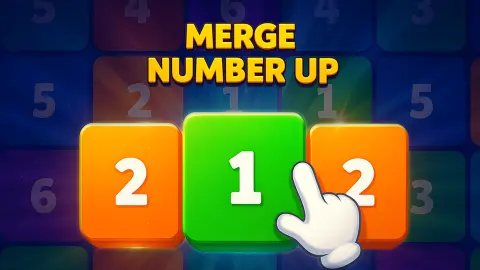
The name suggests you pick up numbers and join them. You never pick up anything in Merge Number Up, and you do not choose groups either. The only thing you can do is tap one tile, and what the tap does is change that tile's number by one.
That single rule is the whole game. A plain tile goes up one when you tap it. A tile with a small down arrow under its number goes down one. If the tile you just changed now touches two others showing the same number, the three merge into one tile a step higher, and new tiles arrive to fill the holes. If it does not, you lose one of five hearts. When the hearts are gone, so are your moves.
The game is credited to a developer listed as GameBer. It was published in July 2025.
A word on how much of it we saw. We played for a little over four minutes on a desktop computer, with the mouse. In that time we made one merge, ran out of moves twice and saw the game over panel once. The level marker never left 1. Bigger groups, higher tiles and the coin tools are all outside this page, and we say so where it matters.
One merge, read slowly
It is worth going through the only merge we made, because it shows everything the board does.
The top row read 3, 2, 3. We tapped the 2. It became a 3, which put three 3s in a line, and they merged at once. Afterwards the square we had tapped held a 4: the merged tile lands on the square you tapped, not somewhere else in the group. The two squares beside it held new tiles, a 3 and a 5. Nothing else on the board had moved.
The score went from 0 to 9. That is the three 3s added together, though one merge is not enough to call it a rule. The game's own description says larger groups pay more and that new tiles fall in from the top; we did not make a larger group, and our merge was on the top row, so we could not watch anything fall.
A small crown under the score keeps your best result. Ours read 9 for the rest of the session.
Five hearts, and what the game offers when they are gone
The bar of five hearts under the score is the real board. Thirty tiles look like plenty of room, but you only get five mistakes, and every tap that is not a merge counts as one.
We emptied the bar twice. Each time the board dimmed and a panel titled Out Of Move appeared, with the line "Use rescue to add more moves" and a yellow Watch Ads button. The rescue, in other words, is an advert. The panel also has an X in its corner. We closed it and did not take the rescue, so we cannot say how many moves it gives back.
Closing it led to a Game Over panel with a single Play Again button. After that came a card headed Goal that names a target number and has a Start button, and then a new board with five full hearts and the score back at zero. Losing costs you the board and nothing else that we could see.
Under the board sit four tools with prices in coins: 100, 150, 200 and 300. Our coin counter read zero from start to finish, and the one merge we made did not move it. We do not know how coins are earned, and we never saw a tool work.
Where merging numbers comes from, and what this game changes
The idea of joining equal numbers to make a bigger one became a genre in a few weeks of 2014. Threes came out for iPhone on 6 February of that year. According to Wikipedia, it was designed by Asher Vollmer with the illustrator Greg Wohlwend after 14 months of work. You slide every tile on a four-by-four grid in one direction, and matching tiles that collide combine.
2048 followed on 9 March. Wikipedia credits it to Gabriele Cirulli, a 19-year-old Italian web developer who wrote it in a weekend, basing it on a game called 1024 that was itself a copy of Threes. It drew more than four million visitors in under a week.
Merge Number Up has no link to either, but it inherits their bargain: the board hands you small numbers, and merging is the only way to climb. What it changes is the cost. In the sliding games every move shifts the whole grid, and you lose when there is no space left. Here a move touches one tile, the grid is always full, and what you run out of is taps. The numbers also climb by one step instead of doubling, and a pair is not enough. That is why the game feels closer to arithmetic than to tidying: before each tap you are asking which tile is one step away from making three.
Who it is for
It suits players who like to stop and count before they act. There is no clock on screen, and nothing moves until you do. A board can be over in five taps if you guess, which makes it a quick game to restart and a hard one to rush.
It is not a relaxed tap-anything merge game. If you want to drag tiles together and watch numbers grow without a penalty for a wrong touch, the hearts will annoy you, and the way back after an empty bar is an advert or a new board.
More games to try next
2048 Merge Blocks is the version the name might have led you to expect: tap a group of equal tiles and they join. NumMerge Clash pulls matching neighbours into the card you tap and adds them up. Merge Combo has you drag numbered cubes between stacks, and Merge 2048 drops them into a jar. The rest are under puzzle games.
Screenshots
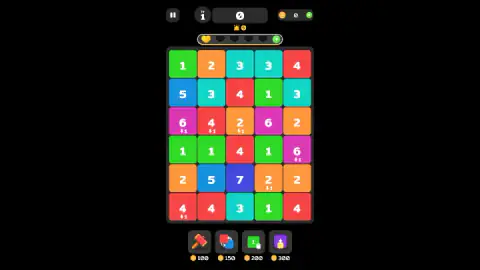
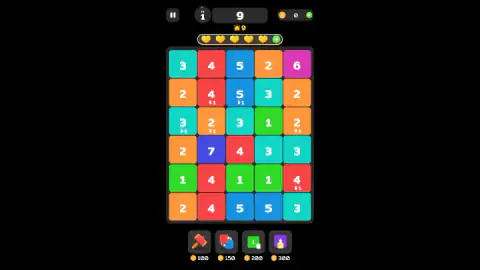
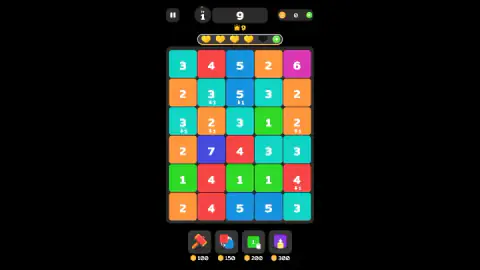
Taken by opening the game ourselves and letting it run — not supplied by the publisher, and not the same picture every other site shows.
How to play Merge Number Up
- Look for two equal tiles that touch. A pair is not a merge yet. It is two thirds of one.
- Find a neighbour of that pair that is one step away. A plain tile one below the pair's number, or an arrow tile one above it.
- Tap that neighbour. It moves one step, matches the pair, and the three become one tile a step higher.
- Check the hearts. A tap that merged nothing has cost you one.
- Repeat until the board gives you nothing, or the hearts run out.
What our session taught us:
- Two equal tiles do nothing by themselves. Our first board had four such pairs sitting untouched. Later we tapped a 4 that had another 4 directly above it, expecting them to join. It turned into a 3 and a heart went black.
- The arrow tiles are not damaged tiles. We read the little arrow as a warning at first. It is a second direction. An arrow 4 beside two 3s is exactly as useful as a plain 2 beside two 3s.
- Do not tap to find out what happens. By the time we looked properly at our first board, one heart was left. One more curious tap and the Out Of Move panel was on screen.
- A setup tap is a paid tap. Raising a 3 to 4 next to another 4 gives you a pair, but you paid a heart for it and still need a third. We did that twice on the bottom row and ended on two hearts with nothing merged.
- A merge kept our hearts full. The tap that merged three 3s left all five hearts lit. The bar was full before that tap, so we cannot tell you whether a merge also wins back hearts you have already lost.
Controls
| Click or tap a plain tile | Raises its number by one; if that leaves it touching two equal tiles, the three merge |
|---|---|
| Click or tap a tile with the small down arrow | Lowers its number by one instead of raising it |
| Four buttons under the board | Tools paid for with coins: 100, 150, 200 and 300. We never had the coins to try one |
| Pause button (top left) | Pauses the game |
Features
- A board of 30 tiles, five across and six down, with numbers from 1 to 7 at the start
- One input: a tap moves a single tile one step up, or one step down if it carries the arrow mark
- Three equal tiles that touch merge into one tile a step higher; two equal tiles do nothing
- Five hearts that work as spare moves, with a tap that merges nothing costing one
- An Out Of Move panel when the hearts are gone, offering a rescue in exchange for an advert
- Four coin-priced tools under the board, from 100 to 300 coins
- Made by GameBer
Game details
- Developer
- GameBer
- Release date
- July 2025
- Last updated
- August 10, 2026
- Added here
- June 2025
- Technology
- HTML5 (2D)
- Platforms
- Browser (desktop, mouse), Browser (mobile & tablet)
- Classification
- Puzzle
- Saved progress
- Saving, when available, is managed by this game. Mava cannot confirm your level.
FAQ
How do you play Merge Number Up?
You tap one tile at a time on a board of numbered squares. A tap raises a plain tile by one, or lowers it by one if it shows a small down arrow. When the tile you changed ends up touching two tiles with the same number, the three merge into a single tile one step higher and new tiles fill the gaps. A tap that causes no merge costs one of your five hearts.
Why did my tile change number instead of merging in Merge Number Up?
Because a tap does not select a group; it changes the tile you touch by one. In our session two equal tiles side by side never merged, including a 4 sitting right under another 4. The only merge we made came from turning a 2 into a 3 between two other 3s, which made a group of three.
What does the small arrow with a 1 mean on some tiles?
It marks a tile that goes down when tapped. We tapped a 4 with that mark twice in our session and both times it became a 3. Plain tiles went the other way: a 2 became 3, a 5 became 6, a 3 became 4. The mark stays on the tile after the tap.
What are the hearts at the top of Merge Number Up?
They are your spare moves, five when a board starts. Each tap that did not produce a merge turned one heart black in our session, while the one tap that did merge left all five lit. When the last heart goes, a panel reading Out Of Move appears.
What happens when you run out of moves?
A panel titled Out Of Move offers a rescue that adds more moves if you press a Watch Ads button. It also has an X to close it. We closed it and got a Game Over panel with a Play Again button, followed by a fresh board with five full hearts.
What do the four buttons under the board do?
They are tools bought with coins, priced 100, 150, 200 and 300. The icons show a hammer, two tiles swapping places, a tile with a bin and a tile with an up arrow. Our coin counter stayed at zero for the whole session, so we could not test any of them and will not guess.
Is Merge Number Up the same as 2048?
No, and it has no connection with it. In 2048 you slide every tile on a four-by-four grid at once and equal pairs add together. Here nothing slides: you nudge one tile by one, numbers climb 1, 2, 3 rather than doubling, and it takes three equal tiles to merge.
Who made Merge Number Up?
It is credited to a developer listed as GameBer. It was published on 27 July 2025. It is listed for PC, Android and iOS with a portrait layout; we played it on a desktop computer with the mouse.