



About Maths Puzzle
Most maths games ask you a question and wait. Maths Puzzle hands you the answers first. They are all on the sheet the moment a level opens, down the right-hand side, with the sums down the left in a different order. Nothing is typed. The job is to say which answer belongs to which sum, and you say it by joining the two.
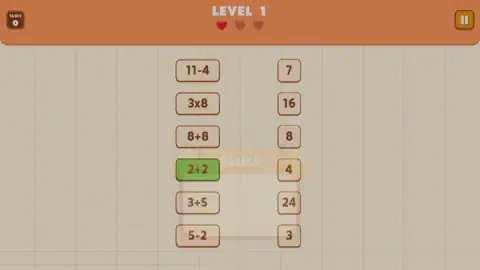
That is a worksheet, and the game knows it. The background is cream squared paper, the colour of a school exercise book, and an orange bar runs across the top carrying the level name, three red hearts and a pause button. A teacher marks a wrong line with a cross. This game takes a heart.
We have now played it twice, and the surprise of the second visit was that level 1 was not the same level. Not one sum had survived from the first sheet. The first set stayed small and found room for a division; the second left division out altogether and reached up into the twenties. Whatever "level 1" means here, it is not a fixed puzzle you can memorise.
Maths Puzzle is by Drivix Games, and, where it is published. The second visit also turned up the menu we had missed the first time: behind the green PLAY button sit four game modes, and one of them swaps the sheet for something much closer to an exam paper.
Level 1 is a different level every time
The two sheets we were given, weeks apart, both labelled as the first level:
| Our first visit | Our second visit |
|---|---|
| 2+3 | 11-4 |
| 6+2 | 3x8 |
| 2x5 | 8+8 |
| 1-1 | 2+2 |
| 6÷3 | 3+5 |
| 6-3 | 5-2 |
Same level name, same three hearts, same six pairs to clear, and not one sum in common. The mix changed too: the first sheet asked for a division and the second never did, while the second pushed its answers well past ten.
That matters more than it sounds. A child can come back to the first level tomorrow and meet different arithmetic, which is the whole point of a practice sheet rather than a puzzle. It also means there is no level 1 solution to look up, because our first level and yours are not the same page.
Behind the Play button there are four games
The main menu is plainer than the game that follows it: a green PLAY button, a blue CATEGORIES button under it, and a settings cog in the corner. Press Play and a panel comes up with four names on it — ARCADE, CLASSIC, CONNECT PUZZLE and YES/NO — and a red cross to back out.
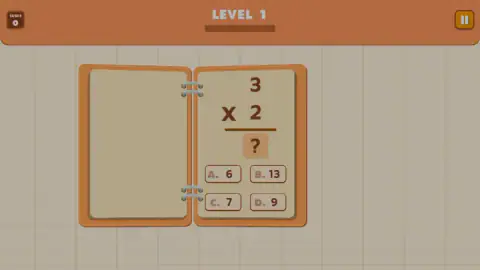
We took Arcade, and it is a different game. The columns are gone. In their place is one sum on an open notebook page with four lettered answers underneath, A to D. The first card we were dealt asked for 3 x 2, and the wrong answers sat close enough to the right one that a careless glance would cost you.
The gap is not always in the same place. Sometimes the answer is missing, as above. Sometimes a number inside the sum is missing and the answer is given, so you work backwards. Once the sign itself was missing: both numbers and the result were there, and the four buttons offered a minus, a times, a plus and a divide, with only one making the line true.
That last format deserves a correction from us. After the first visit we wrote that the publisher's description, which talks about missing numbers and missing operators, did not describe the game we had played. It describes this mode precisely. We had simply never found the menu. Classic, Connect Puzzle and Yes/No we still have not opened, so we are not going to guess at them.
The clock only exists in one of the modes
Nothing counted down on either matching sheet. You can sit and stare at the columns, and the hearts are the only pressure in the room. The card mode is the opposite, and it does not warn you: twice, in the middle of reading an equation, the screen dimmed and a TIME OVER panel came up over it.
The panel is where the countdown finally shows itself, running down from ten. Under the number there is a green ADD TIME button, marked as an advert, and under that, in plain text, NO, THANKS. Watch the advert and you buy your seconds back. We turned it down both times, and the second refusal was followed by a LEVEL FAILED screen offering Restart and Home.
So: on the sheet you lose by being careless and nothing by being slow, and on the card you lose by being slow. No advert played while we were actually playing; the only one on offer was the one that buys time.
Matching is a recall exercise, which is why it suits the table-learning years
There is a reason the match-the-pairs sheet has outlived most of what gets printed in a maths workbook. When you type an answer into a box, you can arrive by any route you like, counting on your fingers included, and the box cannot tell. When the answer is already in front of you among five others, you have to recognise it. That is retrieval: the question is whether 3x8 is a fact you hold, not whether you can build it.
The times tables are taught that way on purpose. Seven eights is not meant to be worked out each time it comes up; it is meant to be remembered, the way a word is remembered, so that the working memory it would have eaten is free for whatever the sum is part of.
The sheet makes that recognition harder than paper does, and in a useful way. The near misses are on the page with the right answer, so a wrong line is a specific confusion rather than a blank. Our second sheet had both a sum and an answer beginning with the same digit, and that is exactly where we came unstuck. Notice too that no tile carries an equals sign. The line you draw from a sum to its answer is the equals sign, which is a better picture of what it means — these two are the same thing — than any empty box.
Which school year, then? The arithmetic we were given is what a child meets when the four operations are new and the tables are being learned, so the first years of primary school, with the missing-sign card a step beyond that because it asks what the operations do. Whether that makes a particular child quicker at sums is not something a games site can measure, and we will not claim it. What we can tell you is which skill the sheet asks for, and it is recall rather than calculation. The one British thing about it is the "maths" in the title.
More number games on Mava Games
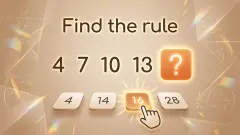
If the hearts feel too gentle, Correct Math gives you three seconds a question and ends the run on the first mistake. Brain Buster turns mental arithmetic into a duel where the faster answer lands a punch. Find the Rule drops the clock and asks what a row of numbers has in common, Binary Drop counts in twos with lights, and Master of Numbers turns the total into a runner that swallows every number smaller than itself. More games for younger players are in kids.
Screenshots
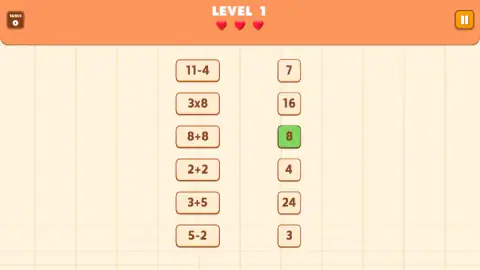
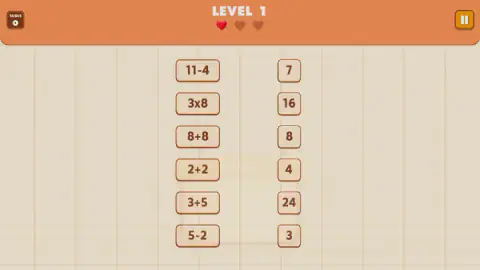
Taken by opening the game ourselves and letting it run — not supplied by the publisher, and not the same picture every other site shows.
How to play Maths Puzzle
- Tap a tile in either column. It lights up green. You can start from a sum on the left or from an answer on the right.
- Tap its partner in the other column. If the pair is right, a line is drawn between the two tiles and both leave the sheet.
- Clear every pair to finish the sheet. The TASKS counter in the top-left corner goes up by one each time a pair disappears.
- Do not guess. A wrong pair costs one of your hearts, and the heart goes grey where it was red.
- If the level is a card instead of a sheet, read the equation and press one of the lettered buttons under it.
What we learned playing it:
- Dragging works as well as tapping. Press on one tile and pull across to the other, and the pair is made in a single movement.
- Start from the side you are sure of. If you spot the 24 before you spot the sum that makes it, light the 24 first. The game does not mind which end you begin at.
- The gaps are a hint. Solved tiles vanish and the rest stay where they were, so every pair you clear leaves fewer candidates behind. The last pair cannot be wrong.
- Beware the number that appears on both sides. Our second sheet had an 8 waiting in the answer column and a sum beginning with 8 on the left. We lost most of that level to it.
- Resume, not Home. The pause panel offers both, and Home does exactly what it says: back to the main menu, with the sheet you were halfway through gone.
- Click back in. Click outside the game and a dark "Click to keep playing" strip appears, and nothing moves until you click inside.
Controls
| Click or tap a tile | Lights it green, whether it is a sum on the left or an answer on the right |
|---|---|
| Click or tap a tile in the other column | Joins the two; a correct pair gets a line and both tiles leave the sheet |
| Drag from one tile to the other | Joins them in one movement |
| Click or tap a lettered button | Answers the card in the mode that gives you one sum and four options |
| Pause button (top right) | Stops the level behind a Pause panel, with Resume and Home on it |
Features
- Two columns on squared paper, sums on the left and answers on the right, in mixed-up order
- Level 1 is drawn fresh, and our two visits did not share a single sum
- Three hearts under the level name, and each wrong pair puts one of them out
- A TASKS counter in the top-left corner that goes up by one for every pair solved
- A pair can be started from either side, the sum or the answer
- Four modes behind the Play button, one of which replaces the sheet with a lettered card
- In the card mode the time runs out, and extra seconds are offered in exchange for an advert
- Made by Drivix Games
Game details
- Developer
- Drivix Games
- Release date
- October 2025
- Last updated
- August 10, 2026
- Added here
- August 2025
- Technology
- HTML5 (2D)
- Platforms
- Browser (desktop, mouse), Browser (mobile & tablet)
- Classification
- Educational , Kids , Puzzle , Word & Trivia
- Saved progress
- Saving, when available, is managed by this game. Mava cannot confirm your level.
FAQ
How do you play Maths Puzzle?
The sheet has sums in the left column and answers in the right, in a different order. Tap a sum, then tap its answer, and a line joins them before both tiles disappear. Clear every pair to finish the sheet. A wrong pair costs one of your three hearts.
What game modes does Maths Puzzle have?
The Play button opens a panel with four names on it: Arcade, Classic, Connect Puzzle and Yes/No. Arcade gives you one sum on a notebook page with four lettered answers underneath. We played Arcade and the matching sheet, so we cannot say what the other two are.
Is level 1 the same every time you play Maths Puzzle?
No. We played level 1 twice, weeks apart, and the two sheets had no sum in common. Both had six pairs and three hearts, but the arithmetic was redrawn: one sheet included a division and kept its answers small, the other had no division and reached into the twenties.
How many lives do you have in Maths Puzzle?
Three, shown as red hearts in the bar at the top. Each wrong pair puts one out and the heart goes grey. We have never lost all three in a session, so we cannot say whether the sheet restarts or the game ends.
Is there a timer in Maths Puzzle?
It depends on the mode. Nothing counted down on either matching sheet we played, so you can take as long as you like over a pair. In the card mode the time does run out: a Time Over panel appears, counts down from ten, and offers extra seconds in exchange for watching an advert, with a No, Thanks underneath. Decline and the level can end as failed.
What does the TASKS number mean in Maths Puzzle?
It counts the pairs solved in the current level. It starts at zero and goes up by one each time a matched pair leaves the sheet, so it is a progress counter rather than a score. We saw no separate points total.
What age is Maths Puzzle for?
The sums are the ones a child meets when the four operations are new and the times tables are being learned, so roughly the first years of primary school. There is no reading beyond the numbers. The card mode that asks which sign is missing is a step harder, because it tests what the operations do rather than what the numbers are.
Who made Maths Puzzle, and can you play it on a phone?
It is by Drivix Games and is published, and it was published in October 2025. It is listed for PC, Android and iOS as a portrait game, and everything is done by tapping, but we played on a computer with the mouse and cannot confirm how it feels on a small screen.