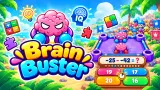








About Brain Buster: Multiplayer Math Puzzle Game
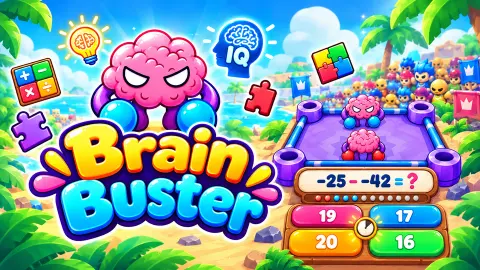
Most maths games for the browser are a worksheet with a timer on top. You answer, a tick appears, the next sum arrives. Brain Buster turns the same sums into a fight. There are two cartoon brains in a boxing ring, a crowd in the stands, and a rival who is trying to answer before you do.
The rules are short. Each question comes with four answers, and the first correct click wins the point. Your brain swings, the other one sees stars, and the crowd waves its signs. After 14 questions, whoever has more points wins the match.
That small change, from beating the clock to beating someone, is what makes it a game rather than a drill. A sum you would solve in three seconds on paper feels different when the other side might solve it in two.
Brain Buster is by Silent Dogs. It was published on 21 September 2026 and updated the next day.
The row of dots tells you the whole match
Under the question card there is a strip of 14 dots, one per question, and it is the clearest scoreboard in the game. White dots are questions still to come. A settled question turns blue if you won it, red if your rival did, and goes faded brown if nobody got it right in time.
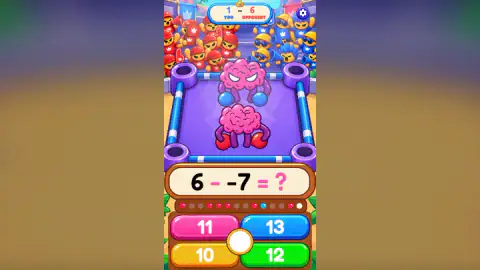
Our first match reads like a confession. Going into the last question the strip showed six red dots, one blue and six faded ones. We were 6 to 1 down with one question left, so the match was gone.
The faded dots matter more than they look. They mean the rival does not answer everything either. In our first match it let almost half the questions pass. If you are fast and accurate on the questions it skips, you can win without being quicker on every one.
Minus a minus is a plus, and the game knows you will forget
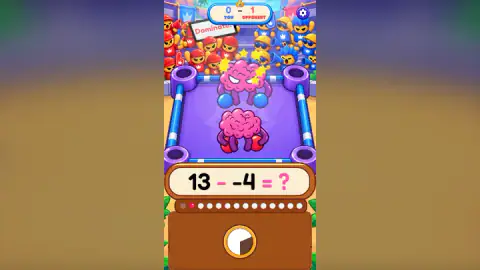
The question we saw most often was not a big multiplication. It was a subtraction with a negative number in it: 6 minus minus 7, 13 minus minus 4. These look harmless and catch out a lot of people, adults included.
The rule is that taking away a negative is the same as adding. One way to see why: picture a number line. Subtracting moves you left. A negative number points the other way, so subtracting it turns you round and moves you right. That is why 13 minus minus 4 lands on 17, not 9.
Brain Buster leans on this. When you are rushing, your eye reads the first minus and your hand subtracts. The game then offers you a tile one or two away from the right answer, so a half-right sum still finds something to click. Slow down on the double minus and you win a point many players throw away.
The sequence questions work on the same idea in a gentler form. Rows like 2, 0, -2 or 6, 8, 10 go up or down by the same step every time, so the answer is one more step. Find the step, check which way it goes, and the negative numbers stop being scary.
Multiplayer, as far as we could see
The game's full name promises multiplayer, so here is exactly what we saw. In the online mode a red and blue screen says "Searching for opponent..." with your brain on one side and a dark silhouette on the other, and below it, "Joining room". Within about half a minute the ring appeared with a rival in it.
What we cannot tell you is who that rival was. No name or profile appeared during our matches, and nothing on screen said whether it was a person or the computer. The game's own description says there is a mode against an AI and another against live players, but we did not check that ourselves, so treat it as the developer's claim.
Either way the match feels the same from your side: the rival answers some questions fast and lets others go. The punch and the stars make every point feel won, and losing one hurts in a way a red cross on a worksheet does not.
What a match is like, start to finish
A full match took about two and a half minutes. When it ended we chose to play again and found ourselves back at a GET READY card at 0 to 0. Our second match was level at 1 to 1 after four questions. The points we did win came on simple multiplications that we answered without hesitating.
We did not see an ad break during our matches. The game's description talks about coins, trophies, levels and a daily reward. We did not play long enough to check any of that, so we cannot say how it works or whether it changes the questions.
Who it is for
Brain Buster suits anyone who knows their times tables and wants a reason to get faster at them. The sums stay small, so a child who has met negative numbers at school can keep up. The rival and the ring are what push you.
It is not a lesson. There is no explanation when you get one wrong, and a slow reader will lose the race on every question. If you want to work through number patterns at your own pace, a calmer puzzle will suit you better. It is laid out for a tall phone screen and listed as playable on mobile, but we played with a mouse and did not test touch.
More quick-thinking games
Find the Rule is the calm version of the sequence questions here: a row of numbers, four answers and no clock. Quizmasters keeps the four-answer format but switches to general knowledge, and Quick Draw Cowboys is a duel decided by reaction speed alone. From the same developer, Solitaire Tile Match is a slower puzzle. More head-to-head games are in our multiplayer games.
Screenshots
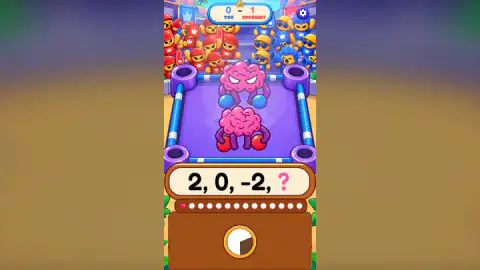
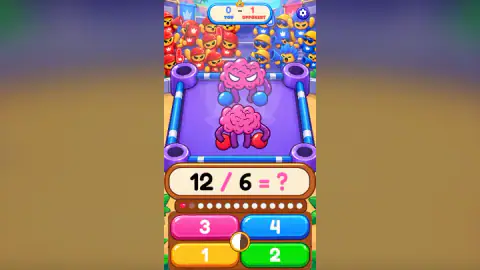
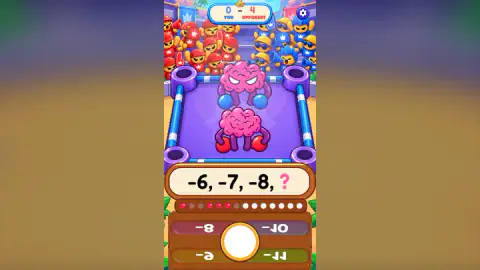
Taken by opening the game ourselves and letting it run — not supplied by the publisher, and not the same picture every other site shows.
How to play Brain Buster: Multiplayer Math Puzzle Game
- Start a match. We played the online mode, which opens on a "Searching for opponent" screen while it joins a room.
- Wait for the GET READY card. Your brain wears blue gloves and your score is the blue number at the top; the rival is red.
- Read the question on the card under the ring. The four answer tiles turn over a moment later.
- Click or tap the right tile. The first correct answer takes the point and a punch.
- Play through all 14 questions. The dots under the card keep the tally until the match ends.
Tips from our matches
- Solve the question before the tiles appear. The card shows up first, on its own, with a round clock beneath it. By the time the answers flip into view you should already know which one you want.
- Do not trust a tile that looks roughly right. For 6 minus minus 7 the choices were 10, 11, 12 and 13. For 12 divided by 6 they were 1, 2, 3 and 4. The wrong answers sit right next to the real one.
- Watch the signs in sequences. When the row ran -6, -7, -8 the choices included -8 itself, the number already on the card.
- Speed is half the game. We were slow, and the rival took most of the points we did not grab first.
Controls
| Click or tap an answer tile | Locks in that answer for the current question |
|---|---|
| GET READY card | Shown before each match; the questions start from it |
| Gear button (top right) | Opens the settings; we did not change anything there |
Features
- A one-on-one duel of 14 questions, each with four possible answers
- The first correct answer wins the point and a punch in the ring
- A row of 14 dots under the question keeps the tally, blue for your points, red for your rival's, faded when nobody scored
- Number sequences, multiplication, division and subtraction with negative numbers, mixed in one match
- The question appears a moment before the answers, so you can work it out before the tiles turn over
- Wrong answers sit one or two away from the right one, so a rough guess rarely works
- An online mode that starts with a "Searching for opponent" screen
Game details
- Developer
- Silent Dogs
- Release date
- September 2026
- Last updated
- September 22, 2026
- Added here
- September 2026
- Technology
- HTML5 (2D)
- Platforms
- Browser (desktop, mouse), Browser (mobile & tablet, touch)
- Classification
- Arcade , Educational , Multiplayer , Puzzle , 2 Player , Word & Trivia
- Saved progress
- Saving, when available, is managed by this game. Mava cannot confirm your level.
FAQ
How do you play Brain Buster?
A maths question appears on a card under a boxing ring, and four answer tiles turn over beneath it. Click or tap the correct one before your opponent does. The first right answer wins the point and your brain lands a punch, and whoever has more points after 14 questions wins the match.
How many questions are in a Brain Buster match?
Fourteen. A strip of 14 dots under the question card shows them all, and each dot changes colour once its question is settled. Blue marks your points, red marks your rival's, and a faded dot means nobody answered correctly in time.
What kind of maths questions does Brain Buster ask?
In our matches we got number sequences to complete, such as 6, 8, 10, multiplication like 6 times 5, a division of 12 by 6, and subtractions with negative numbers like 6 minus minus 7. The sums are small, but the clock and the rival make them harder than they look.
What does it mean to subtract a negative number?
Taking away a negative is the same as adding. So 13 minus minus 4 is 13 plus 4, which is 17. Brain Buster asks this kind of question often, and it is the one where a quick reader is most likely to pick the wrong tile.
Is the opponent in Brain Buster a real player?
In the online mode the game shows a "Searching for opponent" screen and joins a room before the match. Nothing on screen during our matches told us whether the brain across the ring was another person or the computer, so we cannot say for sure.
What happens if nobody answers in Brain Buster?
The question passes with no point for either side, and its dot in the tally strip goes faded instead of blue or red. In our first match six of the first thirteen questions ended that way.
Who made Brain Buster?
It is credited to Silent Dogs. It was published in September 2026.