





About Knock Your Mind
Most browser games want the whole screen. Knock Your Mind takes a strip of it.
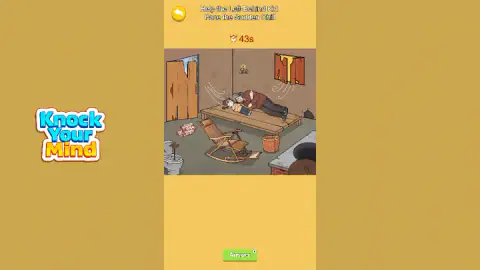
It is built at the proportions of a phone held upright, roughly twice as tall as it is wide, so a desktop browser opens it as a narrow column down the middle of the page with the game's own logo parked in the empty margin beside it. Inside that column the drawing you are supposed to study is smaller still, filling less than half the height, with the level's name and a clock above it and one green button a long way below. This is a phone game that has been let into a browser without being asked to grow.
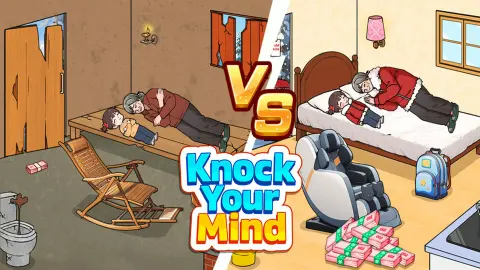
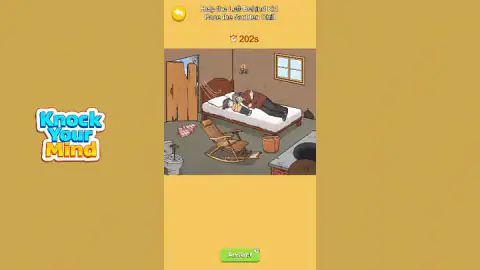
What is inside the little picture is a cold room. An adult in a dark red jacket lies on a bare wooden plank raised on legs, with a small child in a yellow jumper tucked in against them. The door on the left is split down the middle and you can see daylight through the crack. A panel of the back wall has been smashed out. White curls of draught loop in from both, drawn like the breath lines in a comic. On the cement floor there is a wicker rocking lounger, an orange bucket, a toilet, a brick stove with a round pot on it, and, neatly stacked, a wad of pink banknotes. The level's name sits above it on two lines: Help the Left-Behind Kid / Face the Sudden Chill. Beside an alarm clock, a number counts down.
Nothing in that sentence tells you what to do, which is the entire design. The solution is not a blanket and it is not the door. It is the money. A banner eventually says so in the game's own words — drag money to the items that need repair — and from then on the puzzle is working out what counts as broken. The title frames the problem as cold; the answer is economic. That gap is the genre in one level.
One thing before the rest. Our session ran about ten minutes and we never finished that level. We solved parts of it, lost it to the clock once, and never reached a second one.
Four pictures of the same room, and no neat before-and-after
The honest way to describe what we saw is as four states rather than four steps.
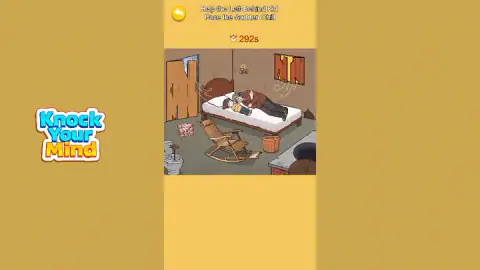
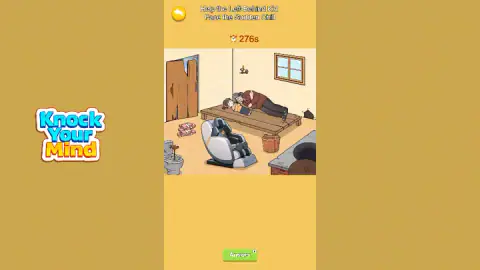
In the first, the pair are lying on a bare plank, the door is split, the wall has a hole in it, and the draught comes in from both. In the second, the plank has become a proper bed: a dark red frame, a rounded headboard, a thick white mattress. In the third the bed is still there and the hole in the wall has turned into a framed window with four panes of blue glass, so the only draught left curls in from the door. In the fourth the grey cement walls and floor have turned warm cream and sand, there is no draught drawn anywhere, and the wicker rocking lounger has become a grey and black massage chair.
That last picture is also where the tidy story breaks. The clock on it reads more time than the one before it, the walls are finished — and the bed is a bare plank again. The level had restarted on us somewhere in between, and we picked the repairs up in a different order.
We are leaving that in rather than tidying it, because it says something real about the level. The repairs are independent: there is no sequence to memorise, and losing a level only means starting the room again and spending the money somewhere else first. The door, for what it is worth, is still split in every picture we have. We never worked out what fixes it.
Five minutes, and what the clock is actually for
The level opens with three hundred seconds and the number ticks down while you think, which in a puzzle about noticing things is an odd choice until you see what it does.
It does not kill you. It resets you. When ours ran out, a panel slid up offering extra time in exchange for watching a video, with a plain refusal beside it; we refused, and the level came back whole with the clock reloaded and our repairs gone with it. So the clock is less a difficulty setting than a nudge toward the shop — the one place here where money leaves your hands rather than entering the picture.
Which makes the green Answer button worth looking at closely. It sits alone at the foot of the column, and at a glance it reads like a button that gives you the solution. The small play symbol in its corner says otherwise: it is the mark games put on things a video pays for. We pressed it and the room did not solve itself.
Where sideways puzzles come from, and why people keep playing them
The useful word for this kind of game is older than browsers. Lateral thinking was coined in 1967 by Edward de Bono, a Maltese doctor and writer, in a book called The Use of Lateral Thinking. His argument was that most problems are not hard because the steps are hard; they are hard because of the frame you accepted in the first sentence. Step-by-step reasoning digs the same hole deeper. The way out is to move sideways and attack the problem from a direction the question never suggested.
Knock Your Mind is that idea built into a level. You are told a child is cold, and everything your instincts reach for — the blanket, the door, the stove in the corner — follows from the word cold. The move the game wants is to notice the money on the floor and decide that a broken room, not a cold child, is the problem on the table. Make that jump and the level stops being a riddle and becomes a shopping list.
It is also why this family of games is hard to put down, for a kinder reason than it looks. Failing one is not failing a reflex test; it is reading the sentence the obvious way, which is how everyone reads it. The answer always feels one thought away, so you take one more go.
What we did not see
We never completed the level, so we cannot tell you what finishing one looks like, or what noise it makes. Nothing in our whole session sounded like a reward.
We never reached a second level, so everything above describes one puzzle out of however many there are. A counter reading 1/7 appeared on screen once. We are not going to tell you what it means, because we do not know: it could be counting levels, or pages of them, and we never got far enough to settle it. The game's own listing promises a variety of levels and stops there, and so do we.
We also played on a computer, with a mouse, so the tap-and-drag controls above are the game's listed ones rather than our experience of them.
More puzzles that argue with you
If the appeal here is being wrong in an interesting way, Brain Test: IQ Challenge is the template most of these borrow from, and Brain Crazy: IQ Challenge Puzzle runs the format with a different sense of humour. Help Me: Tricky Puzzle Games is closer to this one in shape, with a character in trouble and a scene to rearrange rather than a question to answer. The rest are under puzzle games.
Screenshots
How to play Knock Your Mind
- Click things. Almost everything drawn in the room answers to a click, and finding out which things answer usefully is most of the puzzle.
- Find the money. It is stacked on the floor, drawn as neat pink wads, and it is the only object in the room that behaves like a tool.
- Drag a wad onto something broken. The object is redrawn as a fixed object the moment it lands — no animation to sit through, no confirmation to click.
- Keep an eye on the alarm clock at the top. It is counting, and it is counting from five minutes.
What only sitting in front of it teaches:
- The clock is not a threat, it is a nuisance. When ours hit zero, nothing was lost but the level. A panel offered more time for a video, we said no, and the same room came back with five fresh minutes on it.
- The green Answer button is not a free skip. It has a small play symbol in its corner, the badge games use for something a video is meant to buy. We pressed it and the room stayed exactly as broken as it was.
- Read the picture before you touch it. The art is small on a monitor, and the draught lines are the clearest clue in the frame: they point at whatever is still unfixed.
- Play it on a phone if you can. The keyboard does nothing we could find, the column is built for a thumb, and on a phone the drawing fills the screen instead of hiding in the middle of a monitor.
Controls
| Mouse click | Picks things up and pokes at them. Almost everything drawn in the room answers to a click, which is part of the puzzle |
|---|---|
| Click and drag | The move that matters. You drag a wad of money onto whatever is broken, and the game prints that instruction on a banner the first time |
| Tap and drag | The same two moves on a phone or tablet, per the game's own listed controls |
| The green Answer button | Sits at the foot of the column with a small play symbol in its corner. We pressed it and the room did not solve itself |
| Keyboard | We found nothing it does. The arrow keys and the space bar gave us no response we could hear, so treat this as a game for a pointer or a thumb |
Features
- The whole level is one picture of a broken room, and each repair redraws part of it in front of you
- Money is the tool rather than the score: the game's own banner reads Drag money to the items that need repair
- A five-minute clock runs on the level, and letting it reach zero restarts the level rather than ending the game
- When the clock runs out a panel offers you extra time in exchange for watching a video, with a plain No Thanks beside it
- The green Answer button carries a small play symbol, the badge games use for something a video is meant to buy
- It is built at phone proportions, so on a desktop it is a narrow strip down the middle of the page with the logo parked in the empty margin
- The level we played is called Help the Left-Behind Kid Face the Sudden Chill, and its title never mentions the thing that actually solves it
Game details
- Developer
- Partner studio
- Release date
- October 2026
- Last updated
- October 25, 2026
- Added here
- October 2026
- Technology
- HTML5 (2D)
- Platforms
- Browser (desktop), Browser (mobile & tablet, touch)
- Classification
- Puzzle
- Saved progress
- Saving, when available, is managed by this game. Mava cannot confirm your level.
FAQ
How do you play Knock Your Mind?
Each level is a single drawing of a scene with something wrong in it, and a clock counting down above it. You work out what is wrong by clicking and dragging the things in the picture. In the level we played the answer was money. Wads of banknotes lie on the floor, and the game's own banner tells you to drag them onto whatever is broken. Fix enough of the scene and the level is solved.
What is the money for in Knock Your Mind?
It is the tool, not a score. A banner appears across the picture reading Drag money to the items that need repair, and the wads sit on the floor of the room waiting to be dragged. Drop one on a broken thing and the thing is redrawn as a fixed thing. We watched a bare plank become a bed with a mattress and a hole in the wall become a glazed window.
How many levels does Knock Your Mind have?
We do not know, and we would rather say so than guess. A counter reading 1/7 appeared once during our session, but we could not tell whether it was counting levels, pages of levels or something else, and we never reached a second level to check. The game's own listing promises a variety of levels without naming a number.
Is there a time limit in Knock Your Mind?
Yes. The level starts with five minutes on an alarm-clock icon at the top of the screen and counts down in seconds while you think. We watched ours reach zero, and nothing dramatic happened. A panel offered extra time for a video, we turned it down, and the same level began again with the clock back at five minutes. The clock costs you the level, not the game.
What does the Answer button do in Knock Your Mind?
It is the green button at the foot of the column, and it carries a small play symbol in its corner, which is how games mark something a video is meant to pay for. We pressed it more than once and the room did not solve itself, so it is not a free skip. What it shows after the video is something we cannot tell you, because we never watched one.
Why is Knock Your Mind so narrow on a computer?
Because it is a phone game. It is built roughly twice as tall as it is wide, so a desktop browser shows it as a narrow column down the middle of the page with the game's logo parked in the empty margin beside it. Inside that column the drawing you are meant to study takes up less than half the height. On a phone held upright the same layout fills the screen.
Is Knock Your Mind free, and who made it?
It is free and runs in a browser tab with nothing to install. The studio behind it is not recorded anywhere we can check, so this sheet names no author rather than inventing one. It reached our catalogue on 24 October 2026, which makes it days old at the time of writing rather than a back-catalogue title.