
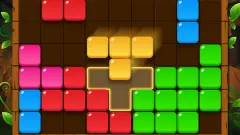

About QBlock Puzzle
Block puzzles tend to hide their scoring behind combos, streaks and multipliers. QBlock Puzzle counts the way a child would: one point for every wooden block you set down. We have now watched the counter read two, seven, eleven and three across two sittings, and every one of those was exactly the number of blocks sitting on the board at that moment.
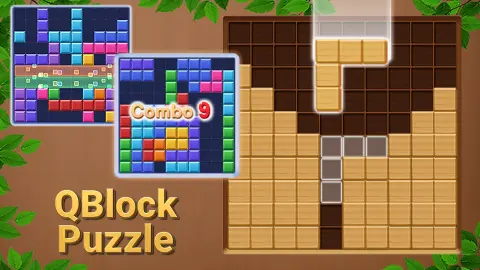
The game under the woodgrain is the familiar one. A square grid is carved into a plank, ivy trails over the four corners, and three pieces wait in a tray to the right of it. You put them on the board, and the rule is that a completely filled row or column disappears and frees the space. Nothing falls. Nothing is timed. The only way to lose is to run out of room.
Its own title screen gives the pitch in three words: Sharpen Your Mind. It is by Anna Inc. It was published in December 2025.
We should say how little we got done. Our latest sitting ran about ten minutes and finished on a score of three: one flat run of blocks in the bottom-left corner, and a great deal of nothing. An earlier one placed four pieces and reached eleven. In neither did we complete a single line. This page tells you what those few pieces showed, and says plainly where it stops.
The tray can hand you nine blocks at once
Our first sitting never drew a piece larger than four blocks, and on that evidence we expected a row of ten to need at least three pieces every time. The second sitting took that apart. One tray held a square of nine blocks, three cells by three. Another held a flat bar five blocks long.
Both change the arithmetic of the board, which we counted by hand at ten cells wide and ten tall. Two of those five-block bars fill a row exactly, with nothing left over, so a clear can arrive in two moves rather than three or four. The nine-block square is the opposite kind of problem: it needs a clear three-by-three area, and an untidy board stops offering one very early.
Set out in full, the shapes we have been dealt are a single block, a corner of three, an L of four, a two-by-two square, flat bars of four and five, and the three-by-three. That spread, rather than any clock, is the real difficulty here, and it argues for keeping a square of open board in reserve instead of scattering pieces into whatever gap is nearest. Scattering earns the same points as building along one row, but only the second habit ever reaches a clear.
The tray waits until it is empty
Three slots sit beside the board. After our first piece, that slot stayed empty and the other two pieces stayed put. Only when the third went down did three new ones arrive together.
That matters for planning. You are never choosing one piece. You are choosing the order of three, and the last of the three has to fit on whatever board the first two leave behind. The long bar is the one to worry about: lay it while there is still a clean run of five cells, then tuck the small shapes around it.
We have seen one refill, so treat this as what happened to us rather than a rule we tested over and over.
A bar lying down and a bar standing up are two different pieces
In one deal the tray offered the same bar twice, once lying down and once standing. The game treats those as separate pieces, and there is a piece of mathematics behind that choice.
Shapes made of squares joined edge to edge are called polyominoes. The word was invented by the mathematician Solomon W. Golomb in 1953 and reached a wide public through Martin Gardner's column in Scientific American in November 1960. Two squares make a domino, three a tromino, four a tetromino.
How many there are depends on what counts as the same shape. If you may turn a piece and flip it over, sizes one to four give only nine shapes; those are called free polyominoes. If you may do neither, every orientation is its own piece and the same sizes give 28 of them, the fixed polyominoes.
Every block puzzle sits somewhere on that scale, and where it sits decides how you play. When a bar cannot be turned, a standing one needs five free cells in a column and a lying one needs five in a row, so you must keep both kinds of gap open. When it can be turned, one gap serves either.
Which is it here? The description says rotation is available, the game's listing gives a rotate control, and those curved arrows around each tray piece look like an invitation to turn one. We never managed it, so we cannot tell you the gesture or whether it costs anything. We played every piece the way it was dealt.
The stars, the themes and the buttons we left alone
Two buttons sit under the board. The left one reads 50 beside a star and a plus sign. The right one shows a star, -10 and a circular arrow, which is the usual mark for a refresh. Our reading is that you begin with 50 stars and that ten of them swap the three pieces in the tray when nothing fits. We pressed neither, so that is a reading of the icons.
A trophy counter under the score stayed at 0 through both sittings, which fits a best-score box we never gave anything to beat. A palette sits in the top left corner and a gear in the top right. The description promises four themes; we only ever saw the wooden one.
Partway through a session the board dimmed and a card came up over it, with a heart and the line "We skipped the ad this time", followed by a Continue playing button that put us back where we were. So there is an advert slot in the middle of a run, and on that occasion nothing ran in it.
We never saw a line clear, so we cannot describe what it looks like or what it scores. We never filled the board, so we did not see the end of a run. We did not test a phone.
Who it suits
Players who want a board to think over with no clock on it. Nothing moves until you move it, a misplaced drop is forgiven, and the only pressure is the one you build for yourself by filling the board badly. If you want levels, goals or an opponent, this is not that game.
More from Anna Inc, and more block boards
From the same studio, Sudoku Block Puzzle uses a 9×9 grid and adds squares to the rows and columns you can clear, while Nonogram trades the pieces for number clues. Outside the studio, Wood Block Journey is another wooden board with a level mode beside the endless one, and Stack the Blocks also plays on ten by ten. The rest are under puzzle games.
Screenshots
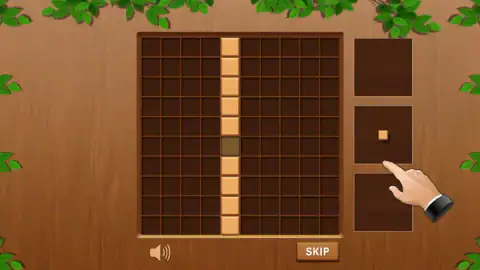
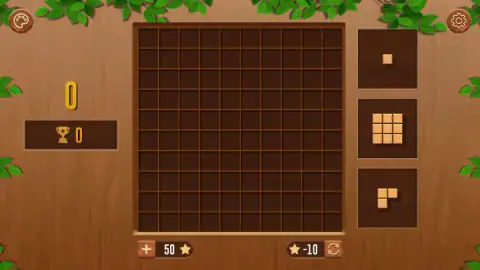
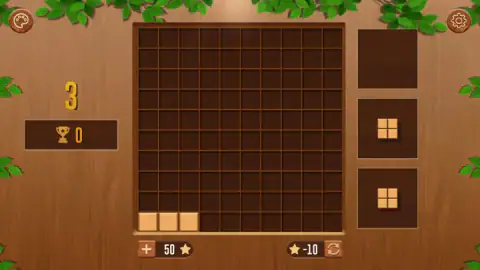
Taken by opening the game ourselves and letting it run — not supplied by the publisher, and not the same picture every other site shows.
How to play QBlock Puzzle
- Pass the tutorial. It opens on a board with one column already filled except for a single dark cell, a lone block waiting in the middle tray slot, and a white hand pointing at it. The block is meant for the gap. A speaker icon sits under the board on the left and a SKIP button on the right.
- Take a piece from the tray. Stall for a moment and the game spells out its own control: the words CLICK THE BLOCK appear beside the tray, and a pair of curved arrows wraps around each of the three pieces.
- Put it on free cells. It stays where it lands, and the score goes up by one for each block in it.
- Fill a whole row or a whole column. The game's own instructions say the line clears, gives points and leaves you room to carry on.
- Use all three pieces. In our runs the tray only refilled once the third piece was down. The instructions say the run ends when a piece no longer fits anywhere.
What our handful of pieces taught us:
- Take that prompt at its word. Dragging vaguely at the board got us almost nowhere: ten minutes of it bought three points. A piece only went down when the release landed squarely on free cells.
- The piece rides above the pointer. Every piece we did land settled a row or two higher than the spot where we let go. Watch the piece, not the cursor.
- A bad drop costs nothing. A corner piece we failed to place twice was back in its slot afterwards, and the score had not moved. There is no penalty for trying.
- You choose the order. With three pieces showing, nothing forces you to play the top one first.
- The keyboard is not part of this. Space and the A key got no response we could detect.
Controls
| Click a piece in the tray | The game's own hint reads CLICK THE BLOCK; curved arrows appear around all three pieces |
|---|---|
| Carry it onto free cells and let go | It stays where it lands and the score rises by one for each of its blocks |
| A drop that does not take | The piece goes back to its tray slot and the score does not change |
| SKIP (tutorial screen) | Leaves the one-move tutorial and opens an empty board |
| Circular arrow with a star and -10 (bottom right) | Not pressed by us; a refresh mark, so it appears to swap the three pieces for 10 stars |
| Plus button with 50 and a star (bottom left) | Not pressed by us; shows the stars in hand and a way to add more |
| Palette (top left) and gear (top right) | Themes and settings by their icons; we did not open either |
Features
- A 10×10 wooden board carved into a plank, with ivy over the four corners
- Pieces from a single block up to a square of nine, including flat bars five long
- A tray of three pieces that refilled only after we had placed all three
- One point per block placed, which is what all four of our scores came to
- No clock and no move limit on screen
- A one-move tutorial that can be skipped, and an on-screen hint when you stall
- Made by Anna Inc
Game details
- Developer
- Anna Inc
- Release date
- December 2025
- Last updated
- August 10, 2026
- Added here
- October 2025
- Technology
- HTML5 (WebGL)
- Platforms
- Browser (desktop, mouse), Browser (mobile & tablet)
- Classification
- Puzzle
- Download size
- 11.7 MB
- Ad requests
- 2 (few)
- Has a save
- Yes
- Saved progress
- Saving, when available, is managed by this game. Mava cannot confirm your level.
Measured by opening the game ourselves on 2026-09-11, not taken from the feed. Twelve seconds on a phone-sized screen, with ad requests counted and blocked rather than loaded.
FAQ
How do you play QBlock Puzzle?
Take a wooden piece from the tray on the right and put it on free cells of the 10×10 board. When we stalled, the game printed its own instruction beside the tray: CLICK THE BLOCK. The game's description says that a completely filled row or column clears and gives points, and that the run ends when a piece no longer fits anywhere. There is no clock.
How does scoring work in QBlock Puzzle?
Every block you place is worth one point. Over two sittings our score read 2, 7, 11 and 3, and each of those was exactly the number of blocks on the board at the time. We never completed a row or a column, so we cannot say what a clear is worth. The game's instructions say clearing lines gives points.
How big are the pieces in QBlock Puzzle?
They range from a single block to a square of nine, three cells by three. In between we were dealt a corner of three, an L of four, a two-by-two square and flat bars four and five blocks long. The nine-block square is the one that ends runs, because it needs a clear three-by-three space.
How big is the board in QBlock Puzzle?
The board is ten cells wide and ten cells tall, 100 cells in all, which is larger than the eight or nine a side used by many block puzzles. Two of the five-block bars fill a row exactly, so a line can be cleared in as few as two pieces if the right ones turn up.
Can you rotate the blocks in QBlock Puzzle?
The game's description says block rotation is available, its listing gives a rotate control, and a pair of curved arrows appears around each tray piece when the game prompts you. We never managed to turn a piece, so we cannot tell you how it is done. What we saw is that the tray deals the same bar lying down and standing up as two separate pieces.
What are the stars for in QBlock Puzzle?
Two buttons sit under the board. One reads 50 beside a star and a plus sign, the other a star and -10 beside a circular arrow, which is the usual mark for a refresh. We read that as 50 stars in hand and ten stars to swap the three pieces in the tray. We pressed neither, so that is our reading of the icons and not something we tested.
Are there ads in QBlock Puzzle?
There is an advert slot partway through a run. In our session the board dimmed, a card came up over it saying the ad had been skipped this time, and a Continue playing button put us straight back on the board. So the break exists, but on that occasion nothing was shown in it.
Who made QBlock Puzzle?
QBlock Puzzle is by Anna Inc. It was published in December 2025 and last updated in August 2026.