




About Block Sort Puzzle
Sorting puzzles usually put the work in your hands. You pour one ball into one tube, or slide one block out through one gate, and the game counts every move you make. Block Sort Puzzle hands you a bare grey board and takes the pouring away. You choose a square. The bricks sort themselves out from there.
The clearest moment of our session lasted about a second. One piece was left in the tray, a short stack with yellow plates sitting on green ones. We dropped it, and two separate piles on the board grew at the same time: the green one went from a couple of plates to roughly seven, and the yellow one did the same. The square we had dropped on was left bare. One drop, two piles, nothing left behind.
We should be as clear about what did not happen. We played for ten minutes across three boards, placed every piece offered to us, and the counter at the top read zero at the start and zero at the end. Stacking is not scoring here, and we never found the thing that is. What follows is what the board did; where we lean on the game's own listing instead, we say so.
The game is credited to the account tubik2405. It was published in April 2025 and updated in August 2026.
One drop, two piles: why the board does the sorting
In a tube-sorting game you are the hand that moves each piece. Here you are closer to someone dropping magnets on a table. You pick the spot, and the board works out what the colours do about it.
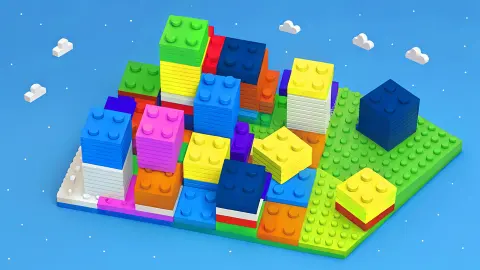
Two moments a few seconds apart show it plainly. In the first, a green pile near the right edge is barely two plates high, a yellow pile near the middle is the same, and one piece waits in the tray with yellow over green. In the second, both piles stand roughly seven plates tall, no new square is occupied, and the tray has refilled.
That is the rule worth carrying into your own game. Your piece is not a thing you place so much as a delivery of two colours. If both of them have somewhere to go, the piece vanishes into the board and costs you no space at all. If neither does, you have just created a new obstacle with your own hand.
It also explains why the opening feels so quiet. On a bare board there is nothing for your colours to join, so the first pieces just sit where you put them. The sorting only starts once the board has something to sort with.
Ten minutes, and the counter never moved
This is the part you only learn by sitting with the game. We placed pieces for ten minutes, built piles and merged colours across the board more than once. The big counter in the middle of the top bar stayed on zero, and so did the small coin counter beside it.
So something else triggers a score, and we did not reach it. The game's own listing says the goal is to collect the highest tower and that each combination raises a points multiplier. Both point the same way: a pile of seven plates is not yet a finished tower, and the reward sits above the heights we managed. For scale, the daily leaderboard on its listing showed a top score in the low hundreds on the day we checked. People clearly do score. We were not among them, and we would rather say so than invent a number.
One more thing we owe you. Near the end of our session the screen stopped answering altogether: two pieces sat in the tray and the board did not change for a minute and a half, however we dragged them. We cannot tell you whether we had run out of legal drops or whether the game had stopped listening.
Twenty-five plates and three pieces at a time
The board is five squares by five, grey studded plates seen from one corner, and it begins bare. There is no frame, no target zone and no marked square. Every plate is identical, so the only thing that makes one better than another is what is standing beside it.
The tray is the other half of the puzzle. Three pieces, replaced only when all three are gone, and no way to skip one. You are not choosing where one piece goes, you are choosing an order for three, and the board you hand to the second is the one the first just made.
Space goes faster than you expect. Over one run we went from an empty board to about a dozen squares occupied, almost all of them clustered in the middle, because the middle is where neighbours are. A pile pushed to the edge has fewer squares touching it, and so fewer chances to receive plates later.
Seven colours, and a note for colour-blind players
We counted seven brick colours across our session: white, yellow, red, green, bright blue, dark navy and violet. The bricks carry no symbols, numbers or patterns. Colour is the only thing the game tells you about what belongs with what.
That matters to more players than you might assume. Colour vision deficiency, usually called colour blindness, affects roughly 1 in 12 men and 1 in 200 women, according to the charity Colour Blind Awareness. The most common form makes reds and greens hard to separate, and this board uses both, often on neighbouring squares.
Two habits help. Use brightness rather than hue, since white and yellow are the lightest things on the board and the navy is by far the darkest. And use the animation: when plates travel after a drop, the game is telling you which piles it considers a match, which is more reliable than your own reading of two similar blues.
What we still cannot tell you
We never saw the board fill up, so we do not know what happens when no square is free. We saw no level screen, no menu beyond the pause button, and no sound to mark anything won or lost. We never found out what a finished tower looks like, or how tall one has to be. We also played only with a mouse, so we cannot tell you how the small squares feel under a thumb.
Who it is for
Block Sort Puzzle suits players who enjoy watching a system work: no clock, no enemies, no penalty for thinking, and a board that reacts in a way that is pleasant to predict. The toy-brick look and the single control make it easy for a child to start.
It suits impatient players much less. The game explains nothing, the reward for playing well stayed invisible to us for ten minutes, and you work out the rules by watching plates move.
More sorting and block puzzles
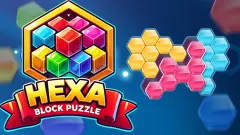
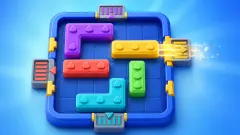
Hexasort is the closest relative we host: stacks on a hexagonal board that pass matching tiles to their neighbours, and the colours vanish once a stack is complete. Ball Sort Puzzle is the classic tube version, where you move every piece by hand and nothing happens unless you make it happen. Bottle Color Match Challenge runs the matching idea through two rows of bottles and a single screen, with a thought bubble naming the order you have to hit. Wood Blocks Jam swaps stacking for sliding, dragging each coloured block out through a gate of its own colour. For more, browse the puzzle games.
Screenshots
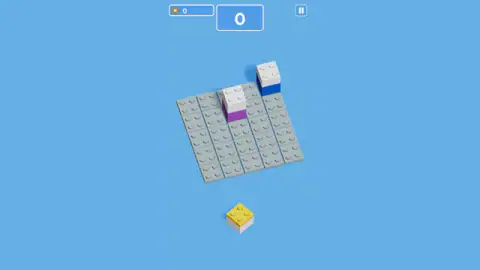
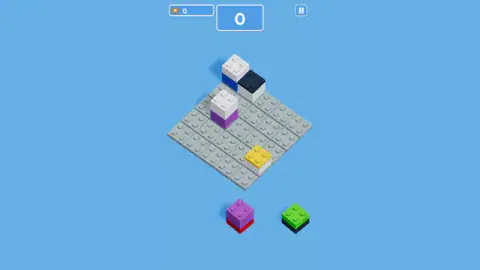
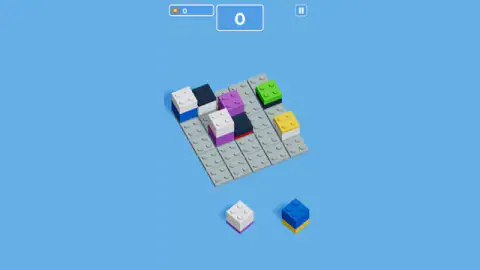
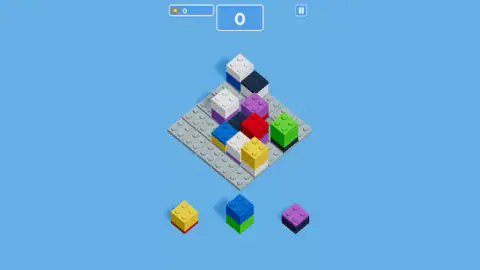
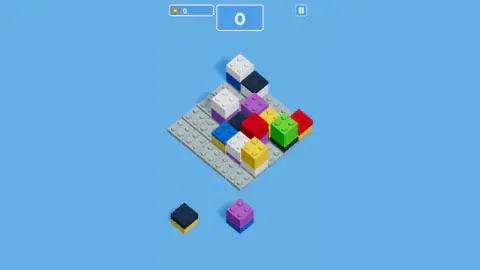
Taken by opening the game ourselves and letting it run — not supplied by the publisher, and not the same picture every other site shows.
How to play Block Sort Puzzle
- Look at the tray under the board. It holds three pieces. Each one is a short stack of thin plates with one colour on top and a second colour underneath.
- Drag a piece onto one of the grey plates. It goes where you let go of it.
- Watch what happens next. If a pile of either of your piece's colours is already standing nearby, those plates leave your piece and travel over to join it.
- Empty the tray before you get more. Three fresh pieces appear only once all three of the old ones are gone.
- Keep the board breathing. Nothing we did ever took a pile off the board, so each square you fill is a square you no longer have.
What our run taught us:
- Try to spend the whole piece. Our best drop left nothing on its own square, because both colours found homes. The worst ones parked a new two-colour pile in the middle, where it blocks you for the rest of the game.
- Read the bottom colour first. A piece carries about four plates of each of its two colours, so the colour underneath is half the drop. Plan a destination for it before you commit.
- Navy is not blue. The board can hold a bright blue and a very dark navy at once. At a glance they read as one colour, and they do not go together.
- Watch the sides, not the tops. From this angle a pile seven plates tall and one of two look almost alike from above. The side of a pile is where the information is.
- There is no rush we could find. No clock appeared at any point, so you can look at all three pieces, and at every pile on the board, before you move the first one.
Controls
| Drag with the mouse or a finger | Picks up a piece from the tray under the board and drops it on a square of the grid |
|---|---|
| Pause button, top right | Pauses the game |
Features
- A board of twenty-five grey studded plates, seen from above at an angle, that starts completely bare
- A tray of three pieces under the board, each a short stack with one colour on top and a second colour underneath
- Pieces carrying about four thin plates of each of their two colours, so a single drop can be worth a lot of height
- Plates that leave the piece you dropped and walk to piles of their own colour, sometimes in two directions at once
- Three new pieces only once all three of the old ones are gone, so the order you spend them in is yours
- Seven brick colours, including a bright blue and a dark navy that are easy to confuse at a glance
- A coin counter and a score counter at the top that both sat at zero through our ten-minute session
Game details
- Developer
- tubik2405
- Release date
- April 2025
- Last updated
- August 10, 2026
- Added here
- May 2025
- Technology
- HTML5 (WebGL, 3D)
- Platforms
- Browser (desktop), Browser (mobile & tablet, touch)
- Classification
- Puzzle
- Saved progress
- Saving, when available, is managed by this game. Mava cannot confirm your level.
FAQ
How do you play Block Sort Puzzle?
You drag a piece from the tray under the board and drop it on one of the twenty-five grey plates. Each piece is a short stack of two colours. If a pile of either of those colours is already standing nearby, the matching plates leave your piece and join that pile. You get three new pieces once all three of the old ones have been placed.
Do the blocks really move on their own in Block Sort Puzzle?
Yes, and that is the whole idea. You never pick up a single brick. We dropped one piece that had yellow plates on top of green ones, and in the next moment a green pile across the board had grown from about two plates to about seven while a yellow pile did the same. The square we had dropped on was left empty.
How do you score points in Block Sort Puzzle?
We could not find out. We played for ten minutes, filled about a dozen of the twenty-five squares and built piles roughly seven plates tall, and both counters at the top of the screen stayed on zero the whole time. The game's own listing says that combining blocks raises a points multiplier and asks you to build the highest tower, so height clearly matters, but merging plates on its own did not score for us.
How many pieces do you get at a time in Block Sort Puzzle?
Three. They sit in a row under the board, and new ones only appear once all three have been placed. That means you choose the order, which is the main decision the game gives you.
How big is the board in Block Sort Puzzle?
Twenty-five squares, five by five, and it starts bare. Nothing we did ever took a pile off the board, so every square you fill is one you keep. By the end of one of our runs about a dozen were occupied, almost all of them crowded around the middle.
Is there a time limit in Block Sort Puzzle?
We never saw one. There is no clock on screen, only a coin counter, a score counter and a pause button. Nothing punished us for taking a long look at the tray before placing a piece.
How many colours are there in Block Sort Puzzle?
Seven in our session, namely white, yellow, red, green, bright blue, dark navy and violet. The bricks carry no symbols or numbers, so colour is the only clue to what goes with what, and the two blues are close enough to mix up.
Who made Block Sort Puzzle and can you play it on a phone?
It is credited to the account tubik2405 and lists it for PC and Android with a portrait layout. It is played entirely by dragging, which works with a finger, though we only played it on a desktop computer.