





About Slinky Color Sort
Most colour sorters ask you to move one small thing at a time: a ball, a nut, a splash of liquid. Slinky Color Sort moves a spring. Click a stack and the whole top band of colour lifts off its post and stretches open in the air, loose and wobbly, waiting for you to decide where it lands.
That is the one new idea here, and it does real work. In a sorter built from balls you have to count what you are holding. Here you see it: one band, one colour, hanging over the board. The rest is the puzzle you may already know. Posts hold mixed bands, and you finish a level when every colour has a post to itself.
The game is credited to Drivix Games. It was published on 4 September 2025.
We should be plain about how far we got. We played for four minutes. Level 1 fell in one move. Level 2 kept us for the remaining three, and we did not solve it. What follows is what those two boards showed us, with the untested parts marked.
Level 2 is where the puzzle begins
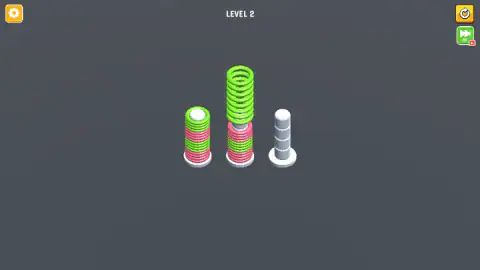
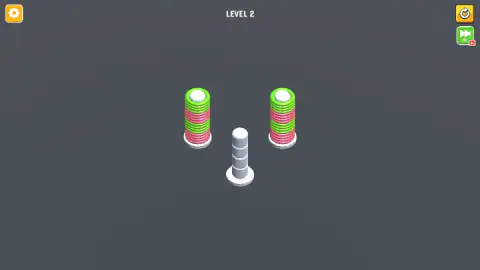
The second board has three posts. Two of them are full, and they are identical: green on top, then pink, then green, then pink. The third post is bare.
That bare post is marked off in four sections, and each full post carries four bands. Our reading is that a post holds four bands and no more. If so, the level has eight bands, four of each colour, and it ends with one green post, one pink post and one empty.
Here is the catch that makes it a puzzle. Both stacks have green on top, and both are full. If our reading of the four sections is right, a green cannot go across to the other stack, because there is no room for it. The first band has one place to go, and after that every band you park takes room that the other colour will need.
That one place is the bare post, the way out in every game of this family. We have to be honest here: we never landed a band on it. We lifted a green and pressed the empty post, and the band stayed where it was. We cannot tell you whether we pressed the wrong spot, whether the drop needs a drag, or whether something else was in the way. The level is built so that the empty post must be usable. How you use it is the first thing to find out when you play.
One more thing we noticed. The three posts stood in a row at first. Later in the session they stood in a triangle, with the empty post in front. The stacks were the same in both. We do not know what triggers the change, and it does not alter the puzzle.
Two buttons and no scoreboard
The screen is close to empty. The level number sits at the top. A gear is in the left corner, and we did not open it. On the right there are two buttons.
The orange one with a round arrow restarts the level. The green one under it shows a double arrow and a small AD tag: a skip you pay for by watching an ad. We pressed it twice on level 2 and remained on level 2.
There are no coins, no stars, no lives and no score. Nothing is earned and nothing is spent. An ad break also came up between level 1 and level 2. That is the whole of the furniture, and for a game of this kind it is a fair deal: the board, and two ways out of it.
We heard no sound at any point in our session, so we cannot tell you what the springs sound like.
Three posts and a stack: a puzzle from 1883
Rings on a peg, three pegs in a row, and only the top piece may move. That set-up is older than any screen. The French mathematician Édouard Lucas presented it in 1883 as the Tower of Hanoi: a stack of discs on one of three rods, to be rebuilt on another rod one disc at a time.
Lucas sold it with a legend. In a temple, priests are moving a tower of 64 golden discs, and the world ends when they finish. There is no hurry. At one move a second the job takes about 585 billion years.
Colour sorters keep the pegs and the top-piece rule and swap the size rule for a colour rule. That swap changes the feeling. The old puzzle has one correct path and a known length. A sorter has many paths and plenty of dead ends, which is why the empty post matters so much: it is the only place where a wrong colour can wait.
The spring has its own history. The walking spring toy dates from 1943, when a naval engineer named Richard James watched a spring fall off a shelf and step its way down. When it reached a Philadelphia department store, the first 400 were gone in 90 minutes. The game borrows that shape for its pieces. Nothing we saw in it suggests any link to the toy's makers.
Who Slinky Color Sort is for
Players who want to think at their own pace: no timer ran while we played. The pieces are large and the colours on the first two levels are easy to tell apart. A child can see what the goal is from the first screen.
It is not for you if you want a score to beat or a reason to come back tomorrow: there is nothing to collect. And if you have never played a sorter, be ready for level 2 to ask more of you than level 1 suggests. It did of us.
More sorting puzzles
The closest relative we have is Nuts Puzzle: Sort By Color, which threads coloured nuts onto bolts under the same top-piece rule. Stack Sort does it with blocks, Sand Sorting Challenge pours coloured sand between bottles, and Marble Color Sort drops marbles into matching boxes. The rest are under puzzle games.
Screenshots

Taken by opening the game ourselves and letting it run — not supplied by the publisher, and not the same picture every other site shows.
How to play Slinky Color Sort
- Look at the posts. Each one is a white peg on a round base. A band of colour is a spring pressed flat around the peg, and bands sit one on top of another.
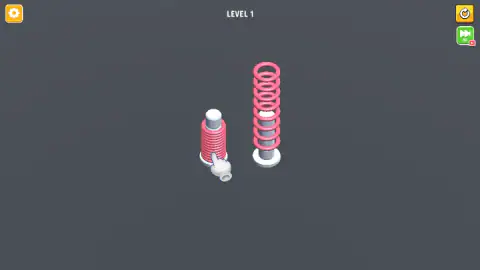
- Click a stack. Its top band rises and stretches open above the post. Only the top colour comes up. Whatever was under it stays put.
- Send the band to another post. On level 1 a pointing hand shows you which one. The game's instructions say a band can only land on a band of the same colour.
- Fill each post with one colour. When that is done a blue ribbon reads Level Complete and a green Next Level button takes you on.
What our session taught us:
- A lifted band is not a move. On level 2 we lifted green bands again and again and none of them ended up anywhere new. Lifting is free. The puzzle only changes when the band comes down on a different post.
- Do not expect the first level to tell you much. It has two posts and one colour, and it is over before you have thought about anything. The game starts on level 2.
- The round arrow costs time. It restarts the level, and most of the times we pressed it an ad break came up before the board returned. On level 2 there is nothing to undo yet, so leave it alone.
- Nothing is counting. There is no clock and no move counter on screen. Stop and look for as long as you need.
Controls
| Click on a stack | Lifts the top colour band off the post and holds it stretched in the air |
|---|---|
| Click or drag to another post | Drops the lifted band there; this is how our level 1 ended, and we did not manage it again on level 2 |
| Round arrow (top right) | Restart button for the level; most of our presses were followed by an ad break |
| Green double arrow tagged AD (top right) | Skip button paid for with an ad; we got no skip out of it |
| Gear (top left) | Settings, which we did not open |
Features
- Coiled springs in place of the usual balls or liquids, each colour band pressed flat on a white post
- A band that stretches open like a spring when you lift it, so you always see what is in your hand
- A one-move first level with a pointing hand that teaches the only gesture in the game
- A second level with three posts, two colours and four bands on each full post
- No timer, no score, no move counter and no lives anywhere on screen
- A restart button and an ad-paid skip button on every level
- Made by Drivix Games
Game details
- Developer
- Drivix Games
- Release date
- September 2025
- Last updated
- August 10, 2026
- Added here
- July 2025
- Technology
- HTML5 (3D)
- Platforms
- Browser (desktop, mouse), Browser (mobile & tablet)
- Saved progress
- Saving, when available, is managed by this game. Mava cannot confirm your level.
FAQ
How do you play Slinky Color Sort?
Click a stack and its top colour band lifts off the post, stretched open like a spring. Then send it to another post. The game's instructions say a band only goes onto a band of the same colour, and a level ends when each colour sits on a post of its own.
How do you beat level 1 of Slinky Color Sort?
Level 1 is one move. There are two posts with a pink band on each, and a pointing hand shows you where to go. Lift one band, drop it on the other, and the Level Complete card appears with a Next Level button.
How many levels does Slinky Color Sort have?
We do not know. The game's description says only that there are multiple levels. We finished level 1 and spent about three minutes on level 2 without solving it, so we saw nothing beyond that.
Is there a timer or a move limit in Slinky Color Sort?
Not on the two levels we saw. The screen shows the level number, a gear, a restart arrow and a skip button, and nothing else. No clock, no score and no move counter, so you can take as long as you like over each move.
What does the green button with AD on it do?
It is a skip button: the double arrow is the usual sign for jumping a level, and the AD tag means you pay for it by watching an ad. We pressed it twice on level 2 and stayed on level 2, so we cannot confirm what a working skip looks like.
Who made Slinky Color Sort?
It is credited to Drivix Games. It was published on 4 September 2025 and last updated on 10 August 2026.
Can you play Slinky Color Sort on a phone?
It is listed for PC, Android and iOS, and the game's instructions talk about tapping. We played on a computer with a mouse and did not test a phone ourselves.