



About Liquid Sort
Most games of this kind let you look at the tubes for as long as you like. Liquid Sort draws a thin white bar under them, and the white bar is a clock. It shrinks whether you pour or not, and each time we watched it, it went from full to nothing in about a minute.
The rest is the familiar idea, kept small. You get three test tubes on a dark lab wall. Two hold stacked layers of two colours, the third is empty. Lift a tube, tip it over another, and the top colour pours across. The board is done when each colour has a tube to itself.
We should say how far we got. We played for four minutes and saw three boards, all with LVL1 written in the corner, because we did not solve any of them in time. So this page can tell you exactly how the first level behaves and nothing about the second.
The game is credited to John Hany. It was published in April 2026.
Level 1 dealt us three boards, not one
The label never changed, and the board did.
The first time, the colours were orange and green. One tube held a single layer of orange over three of green. The other was mostly orange with one green layer trapped in it. The empty tube stood on the right.
The second time the colours were cyan and pink, the empty tube was in the middle, and the stacks were not the same shape at all. One tube alternated cyan, pink, cyan, pink from the top down. The other had two cyan layers shut between two pink ones.
The third time we got yellow and green, with the empty tube on the left. Look past the colours and it was the first board again, turned round: the same two stacks in mirror order.
So you cannot learn level 1 as a fixed sequence of clicks by position. What you can learn is the shape of the stacks. We saw two shapes in three tries. Whether there are more, we do not know.
About a minute, and the settings do not pause it
The bar starts full and loses length at a steady pace. We compared it across our captures, and the pace was the same on all three boards.
Its listing says there are no time limits. That is not what we saw. Our first round ended just after the bar emptied, without a single pour made. The second ended the same way, with our first pour still in the air, a thin line of cyan falling into the middle tube. Both times a game-over card took the place of the board, and from there we went back to the title, through SELECT TUBE, and into a fresh board.
That trip back costs you nothing in the game, as far as we could see. No score was lost, because no score was on screen.
One more thing about that minute. Part of ours went on lifting a tube, clicking a tube that was already full, and watching the first one settle back down. Nothing on screen says why a pour did not happen. If a tube comes back down, look at where you were aiming.
Four pours solve one board, six the other
There is room in a minute for either board, once you have seen the answer.
The orange-and-green board, and its yellow-and-green twin, takes four pours. Send the double layer from the mixed tube into the empty tube. Add the single top layer from the other tube, which has the same colour. The mixed tube now shows its odd layer on top: pour that onto the three waiting for it. Then pour the last layer home.
We made the first two of those pours on the yellow board and they went as described, three yellow layers standing together in the left tube. Then our session stopped, with roughly a quarter of the bar left. The last two pours are our working, not our play.
The cyan-and-pink board needs six, by our count on paper. Top cyan from the striped tube into the empty one. Top pink from the other tube onto the striped one. The two cyan layers now exposed go to join the first cyan. The two pink layers go back the other way. Then one cyan and one pink finish it.
Both answers only ever pour a colour onto itself or into an empty tube. That is the usual rule in this genre. We never tried to pour onto a different colour here, so we cannot tell you whether this game stops you.
The wallpaper is chemistry, the liquids are not
Behind the tubes, the wall is covered in faint chalk drawings: hexagon rings, short zigzag lines, the letters CH3. Those are the diagrams chemists use for carbon compounds, and CH3 is a methyl group, one carbon atom holding three hydrogens.
The liquids in front of them would puzzle a chemist. In a real tube, two liquids only stay in separate bands if they refuse to mix and one is heavier, like oil floating on water. The heavier one always ends up underneath. Here orange sits both above and below green in the same tube, in bands of equal thickness. These are not liquids so much as coloured blocks that happen to pour.
That is worth knowing when you play. Nothing settles, nothing blends, and nothing changes while you wait. Only the bar moves.
What four minutes did not show us
A solved board, and whatever the game says when you solve one. Level 2. What the LEVELS button opens. What the arrows on SELECT TUBE put on offer. Whether more tubes or more colours arrive later.
We also did not press the sound, music or exit buttons, and we noticed one sound as the game opened and none after. Every move here was a mouse click.
Who this is for
Players who like sorting puzzles and find the patient kind a little too patient. A minute is enough for a small board if you see the order early, and too little if you poke at it. Losing costs you a few seconds on the way back in.
If you want to sit and think with no clock, this is the wrong tube game.
More tubes, sand and blocks
Liquid Sort Puzzle is a different game with the same pouring idea, drawn on squared paper. Sand Sorting Challenge pours sand between bottles instead. From the same developer, Block Bloom has you match shooters to coloured blocks on a moving belt, and Picture Shift is a sliding-block picture puzzle. The rest are under puzzle games.
Screenshots


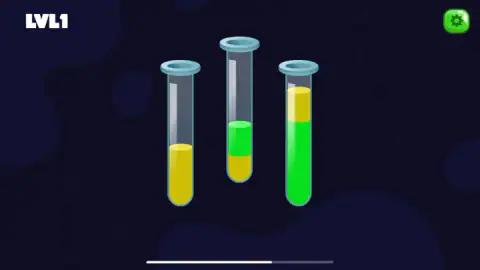
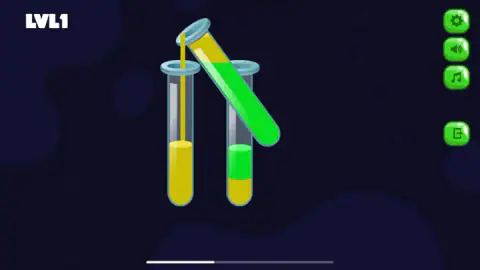
Taken by opening the game ourselves and letting it run — not supplied by the publisher, and not the same picture every other site shows.
How to play Liquid Sort
- Press PLAY on the title screen. A screen headed SELECT TUBE shows one tube between two arrows. Press SELECT to go on.
- Read the board before you touch it. Each full tube holds four layers, and one tube starts empty.
- Click a tube. It rises a little and stays up.
- Click another tube. The raised one tilts over it and pours its top colour in a thin stream.
- Keep going until each colour is alone, and do it before the white bar is gone.
Things the clock taught us:
- Start with the empty tube. On every board we saw, the two filled tubes were full to the top, so neither could take a drop. The only first move is into the empty one.
- Touching layers move as one. Where two layers of yellow sat together at the top of a tube, a single pour carried both. Count those as one move when you plan.
- A raised tube waits, and the bar does not. We left a tube hanging in the air for several seconds while we thought. It stayed up. The bar kept shrinking.
- Do not open the gear to think. The settings opened over a live board, and the bar went on draining behind them.
Controls
| Click a tube | Lifts it; it stays up until you click again |
|---|---|
| Click a second tube | The lifted tube tips over it and pours its top colour, with every touching layer of that colour |
| PLAY (title screen) | Opens SELECT TUBE, and SELECT there starts the board |
| LEVELS (title screen) | On the title screen next to PLAY; we did not press it |
| Gear (top right) | Opens a column of sound, music and exit buttons; the bar under the tubes keeps shrinking while it is open |
| Enter, Space and the arrow keys | Pressed, with no result we could make out |
Features
- A white bar under the tubes that empties in about a minute, moving or not
- Three test tubes and two colours on every board we saw, four layers to a full tube
- Pours that carry every touching layer of one colour in a single move
- A first level that dealt us three boards in three colour pairs, one of them a different puzzle
- A SELECT TUBE screen before every board, with arrows either side of the tube on show
- Settings you can open in mid-pour, though the clock does not wait for them
Game details
- Developer
- John Hany
- Release date
- April 2026
- Last updated
- August 10, 2026
- Added here
- February 2026
- Technology
- HTML5
- Platforms
- Browser (desktop, mouse), Browser (mobile & tablet)
- Classification
- Puzzle
- Saved progress
- Saving, when available, is managed by this game. Mava cannot confirm your level.
FAQ
How do you play Liquid Sort?
Click a tube to lift it, then click another and the first one tips and pours its top colour into the second. Layers of the same colour that touch travel together. The board is solved when each colour sits alone in its own tube, and a white bar under the tubes shows how much time is left to do it.
Is there a time limit in Liquid Sort?
Yes, in the version we played. A white bar under the tubes shrinks without stopping and went from full to empty in about a minute on each of our three boards. Our first two rounds ended just after it ran out. Opening the settings did not stop it.
How do you beat level 1 in Liquid Sort?
It depends on the board, because level 1 gave us more than one. Where one tube holds a single layer over three of the other colour, four pours do it. Send the double layer from the mixed tube into the empty one, add the single top layer from the other tube, then pour the two layers left in the mixed tube onto their own colours. We made the first two of those pours ourselves and worked out the rest.
How many levels does Liquid Sort have?
We cannot say. In four minutes we played three boards and all three were labelled LVL1, because we never solved one. There is a LEVELS button on the title screen that we did not open.
What does SELECT TUBE do in Liquid Sort?
It is a screen that comes up every time you press PLAY, with one test tube and an arrow on each side of it. We pressed SELECT without browsing each time, and the tubes on the board looked the same in every round. What the arrows offer is something we did not look at.
Does Liquid Sort have ads?
One advert break came up in our four minutes, when the first round ended. Nothing on the board itself asked us to watch one, and we saw no coins, hints or extra tubes on offer.
Can you play Liquid Sort on a phone?
It is listed for PC, Android and iOS, in portrait. Every action in the game is a press on a tube or a button. Our own time with it was on a desktop with a mouse, so the phone side is the listing's word and not ours.
Who made Liquid Sort, and is it the same as Liquid Sort Puzzle?
This Liquid Sort is credited to John Hany, was published in April 2026. Many games and apps share the name, which describes a whole genre. Liquid Sort Puzzle on this site is a different game by a different developer.