
About Sort Puzzle
The name promises tubes of coloured water, or balls, or sheep on shelves, because that is what nearly every browser game with Sort in its title is. Sort Puzzle opens on none of that. Its first level is a world map drawn on old parchment, a compass rose in the corner, five continents cut out in bright colours and dropped anywhere but where they belong. The bar across the top says Place each continent in the correct slot, and that is the whole level.
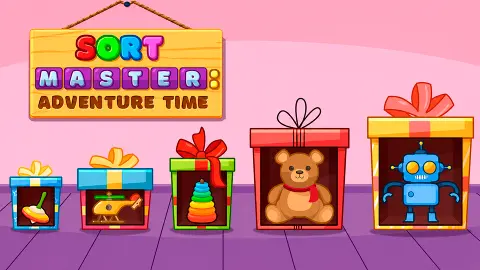
The game does not even agree with itself about its name. It is listed as Sort Puzzle; the cover you see first carries a wooden sign reading Sort Master: Adventure Time over five open gift boxes with a spinning top, a yellow helicopter, a tower of coloured rings, a teddy bear and a blue robot inside. The provider describes a collection of mini-puzzles, from sorting things to arranging school items around obstacles. We can only tell you about the one we reached.
We should be plain about that one. In ten minutes on a computer we moved the continents around a great deal, got three of the five lying over the right outlines, and did not finish the level, because none of them clicked in. So this page tells you what the map shows, what the shop and the ads do, and the mistake that kept our pieces floating, so that yours do not.
Ivan Popenya and dates the game is credited to August 2026; no name appears on the cover, the world screen or the level.
Five pieces, not seven: how this map counts continents
Most schoolrooms in English-speaking countries teach seven continents: North America, South America, Europe, Asia, Africa, Australia and Antarctica. Much of Europe and Russia teaches six, with Europe and Asia joined as Eurasia, and Latin America often teaches six a different way, with the two Americas as one. Sort Puzzle takes the Eurasia route and then drops Antarctica, so the map asks for five.
That decision shapes the level. The red piece is Eurasia, one slab from a jagged Spain and Scandinavia on the left to the far end of Siberia on the right, with Arabia and India hanging off the bottom. It is the biggest piece on the board and the one we had most trouble seating. The purple piece is North America, with Alaska at one corner, Central America tapering off the other, and Greenland riding along as a separate lump inside the same piece. The blue piece is South America, the yellow piece is Africa with Madagascar attached, and the green piece is Australia, which brings New Guinea above it and the two slivers of New Zealand to its right.
The drawing style helps more than you might expect. Every coastline is cut in straight lines, a dozen or so corners per continent, so Italy is a short spike, Florida is a stub and the Gulf of Carpentaria is a single notch in the top of Australia. There is no detail to study, only silhouettes, and silhouettes are exactly what a nine-year-old can match. The parchment underneath has a faint grid and a dashed border, and the compass rose in the bottom-left corner stays put while the continents move.
The beige outlines include the small islands too, a Greenland-shaped hole beside North America, a Madagascar sliver off Africa, New Zealand off Australia, and when you drag a piece near, the islands are the easiest things to line up against.
What we saw of the coins, the second world and the ads
The world screen is where the game's economy lives. A gold coin counter in the top-right corner read 100 from our first second to our last, since we never finished anything to earn more. Next to the green planet sits a second world, a black ink blot with bats, a dragon and a ghost in silhouette, and under it a coin with the number 350 and the words Not enough in red. The game puts that message up on its own; you do not have to click to be told.
Inside a level the only thing that looks like a purchase is the purple fast-forward button in the top-right corner, with a small pink video tag at its foot. Its icons say skip the level by watching a video. We did not press it, so we cannot tell you whether it costs coins as well or how long the video runs, only that it is there from the first second, within reach of a small hand.
Ad breaks came twice in our session. The first was the moment we opened level 1: the map dimmed, a notice read that the ad had been skipped this time, and a Continue playing button brought the colours back. The second came on the world screen some minutes later and behaved the same way. We saw no shop with real-money prices and no banner over the map while playing.
What we did not reach
- A piece clicking into place. Three lay over their outlines; none was accepted, so we cannot describe the sound or the change that marks a correct drop.
- The end of the first level, the reward it pays and what the next one asks for. The provider talks of sorting puzzles and school items with obstacles; we saw a map.
- The dark world and a single coin earned. Our counter never moved off 100.
- The skip button. Not pressed.
- A phone. The drag is the same gesture with a finger; we played with a mouse in a landscape window and everything fitted.
- Sound. Nothing we can report, so we say nothing about it.
Who it is for, and more puzzles like it
This is a game for a child who is learning what the world looks like, and for an adult who wants to check whether they still know. Five big shapes, one instruction, no clock and no way to lose. The only things to supervise are the skip button and the coin-priced world, both of which sit in plain sight.
If the map is the part you liked, two geography games on the portal go further. GeoVex shows you a flag and asks you to pin its country on a world map with no names on it, scored by how far you miss, and Flag Learn makes you type country names or paint flags from memory. If it is the sorting you came for, Never by Color! tidies building bricks by shape in a Japanese room, Foxy Eco Sort stacks litter into tubes with a fox and a forest story, and Cute Shapes is an odd-one-out puzzle for the youngest players with no timer or score.
More in our puzzle games and our games for kids.
Screenshots
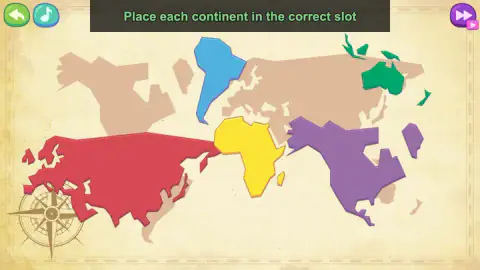
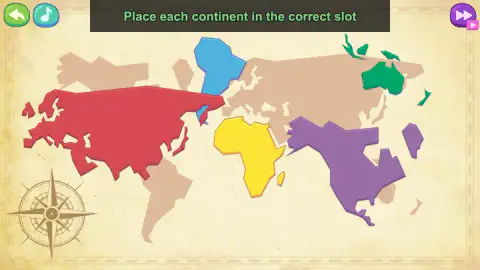
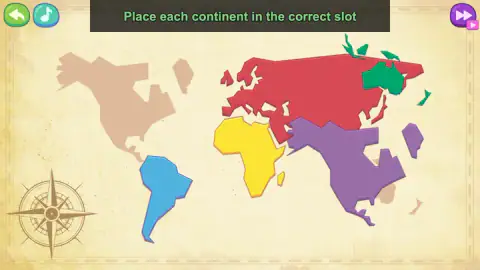
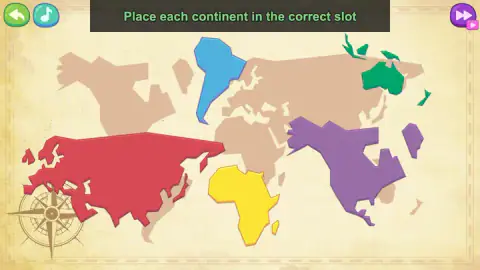
Taken by opening the game ourselves and letting it run — not supplied by the publisher, and not the same picture every other site shows.
How to play Sort Puzzle
- Press Let's Play on the cover. You land on the world screen: a green planet on the left with a road, a school bus, towers made of pencils and trees made of open books, and 1/20 written beneath it. Click the planet.
- Pick the lit badge. The level grid is three rows of dark round badges, twenty in all, and only the first is green, with a cluster of little red bells on top. Click it. The screen may go dark for an ad break here; ours was skipped and a Continue playing button brought the map up.
- Drag a continent onto its outline. Press on a coloured piece, move it with the button or finger held down, and release over the beige shape that matches it. The piece stays exactly where you let go. Nothing happens on a plain click or a tap.
- Do the same for all five. The instruction bar never changes and there is no counter, so the only way to know a piece is home is that it fits.
- Use the corners when you need them. The green arrow top-left goes back to the grid, the teal note toggles the music, and the purple fast-forward button with a pink video tag is the skip offer, which we left alone.
Tips from our run:
- Close is not placed. Our red, blue and yellow pieces each spent a stretch lying over the right outline, every one a finger's width off, with beige showing around the edges. None was counted. Line the coast up before you release, and if you can still see the outline, pick the piece up again.
- Start with the shapes you cannot confuse. Africa, South America and Australia are the three everyone recognises, and they are the three smallest outlines. The big red piece and the big purple one are where you need the next tip.
- Europe is not a separate piece. The largest beige shape, across the top of the map, is Europe and Asia together, and the largest red piece is the one that fills it. If you are hunting for a Europe-shaped hole, stop.
- Wait for the hand. Leave the pieces alone for a while and a red pointing hand appears over one of them. In our game it picked the purple one, North America, the piece furthest from home.
- Do not click the black blot. The second world on the world screen costs 350 coins and you start with 100; the game writes Not enough under the price before you even ask.
Controls
| Click and hold, then move, then release | Drags a continent; it stays wherever you let go of it |
|---|---|
| Click the green planet, then the lit badge | Opens the level grid from the world screen, then level 1 from the grid |
| Green arrow, top left | Back to the level grid from inside a level |
| Teal music note, top left | Music on and off |
| Purple fast-forward button with a video tag, top right | By its icons, an offer to skip the level after a video; we did not press it |
| Touch | The same drag with a finger; the game is listed for phones, not tried by us |
Features
- Level 1 is a world map on parchment with five beige outlines and five coloured pieces: red Eurasia, purple North America, blue South America, yellow Africa and green Australia
- Europe and Asia come as one piece, Greenland travels with North America and there is no Antarctica
- A piece stays exactly where you drop it, so a near miss sits on top of its outline without being counted; we left three that way
- No timer, no move counter and no score inside a level: the only text is the bar reading Place each continent in the correct slot
- Twenty levels in the first world, shown as dark round badges with only the first lit; a second world is a black silhouette priced at 350 coins, and you start with 100
- Leave the pieces alone for a while and a red pointing hand appears over one of them
- An ad break can come the moment you open a level; a notice and a Continue playing button bring the map back
Game details
- Developer
- Ivan Popenya
- Release date
- August 2026
- Added here
- June 2026
- Technology
- HTML5 (2D)
- Platforms
- Browser (desktop), Browser (mobile & tablet, touch)
- Saved progress
- Saving, when available, is managed by this game. Mava cannot confirm your level.
FAQ
How do you play Sort Puzzle?
Press Let's Play on the cover, click the green planet on the world screen and then the lit badge on the level grid. Level 1 shows a world map on parchment with five beige continent outlines and five coloured continent pieces scattered on top. Press on a piece, move it onto the outline with the same shape and let go. The bar at the top reads Place each continent in the correct slot, and the level is done when all five are home.
Is Sort Puzzle the same game as Sort Master: Adventure Time?
Yes. It is listed as Sort Puzzle, and the cover you see first carries a wooden sign reading Sort Master: Adventure Time over five open gift boxes with toys in them. The provider describes it as a collection of mini-puzzles, from sorting to arranging school items. The one level we reached was a world map.
Which continents are in the Sort Puzzle world map?
Five pieces: Eurasia in red, North America in purple with Greenland attached, South America in blue, Africa in yellow with Madagascar, and Australia in green with New Guinea and New Zealand. Europe and Asia are not separated and there is no Antarctica. The outlines are drawn with straight cuts, so Italy is a short spike and Florida a stub, which makes the shapes easy to tell apart.
Why does my continent not snap into place in Sort Puzzle?
Because the piece has to land close to its outline. A piece stays exactly where you release it, and when it is a finger's width off it simply lies on top of the beige shape, with the outline peeking out around the edges, and the game does not count it. Three of ours ended that way in a ten-minute session. Line the coast up before you let go, and try again if the beige still shows.
How many levels does Sort Puzzle have?
The first world shows twenty round badges, with only the first one lit and marked with little red bells, and the world screen reads 1/20. A second world sits next to it as a black blot with bat and dragon silhouettes and a price tag of 350 coins. We started with 100 coins and the game wrote Not enough under the price, so we cannot say what is inside.
Does Sort Puzzle have ads?
Yes. Twice in our session the screen went dark for an ad break, the first time the moment we opened level 1 and the second on the world screen. Both times a notice said the ad had been skipped this time and a Continue playing button returned us to the game. Inside the level, a purple fast-forward button with a small video tag sits in the top-right corner, which we read as an offer to skip the level after watching a video. We did not press it.
Is Sort Puzzle good for kids?
The first level is a geography lesson in disguise: match five continent shapes to their outlines on a parchment map, with no timer, no lives and no score to lose. The pieces are big, the colours are distinct and the only writing on screen is one instruction. A child who can drag with a mouse or a finger can play it; the only things to steer them past are the skip button and the dark world that costs coins.
Who made Sort Puzzle?
Ivan Popenya and dates the game is credited to August 2026. Nothing on the cover, the world screen or the level names a maker. The game is free to play in the browser and is listed for phones as well as computers.