




About Capybara-HexaSort
Every sorting game you have played teaches the same reflex: pick up the purple pile and put it on the other purple pile. Capybara-HexaSort refuses it. We spent a good part of ten minutes dragging stacks onto stacks of the same colour, and each one ended up back in its slot. The move the game accepts is the one that feels wrong: you drop a stack on an empty cell, next to its match, and the tiles do the sorting themselves.
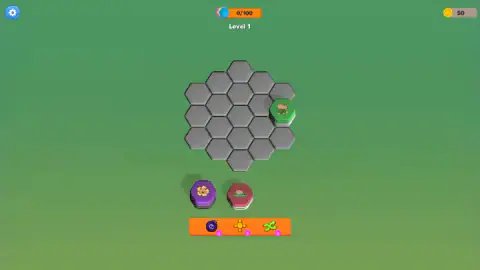
The board is a honeycomb of 19 grey cells in the middle of a plain green screen. Under it, a tray holds up to three stacks of hexagonal tiles. Each stack mixes colours: you see the top one with its emblem, and thin strips of the others down the side. By the game's own instructions, touching stacks with the same top colour merge by themselves, and you clear tiles until you reach the level's goal or run out of free cells.
Here is how far we got. Everything below comes from one ten-minute session on a computer with a mouse, all of it on Level 1. We reloaded once after getting stuck, which put us back on an empty board.
We placed stacks and watched tiles jump between neighbours, but the counter never left 0/100. So we did not finish a level, saw no group clear and never saw the board fill. Our last count, about two minutes before we stopped, was eight of the 19 cells occupied.
The game is credited to Hong Kong Skyreach Interactive Limited. It was published on 12 August 2026.
You drop on empty cells, never on a stack
The rule is easy to state and took us an embarrassingly long time to believe. Our early drops went to empty cells because the tutorial's arrow sent them there, and they worked. Then we started thinking for ourselves. Black belongs on black, surely, so we dragged black onto black, purple onto purple, red onto red. Nothing moved.
The tray is what gave it away. From the moment it dealt us a green and two blacks, it held those same three stacks through move after move, while we kept aiming at stacks that matched them. There were still 11 free cells on the board the whole time.
So the thinking in this game is about adjacency, not about stacking. The question is never which stack this one should sit on. It is which empty cell touches the stack you want it to join, and what else it will touch when it lands.
What the tiles do when two stacks touch
Our clearest proof is a pair of photos taken a minute or so apart. In the first, a stack sits near the right of the board with a black top and a band of red beneath. In the second, we have dropped another black-topped stack on the cell just below it. The upper stack now shows red on top, and the lower one has grown visibly taller. The black layer crossed over by itself.
That is the part worth understanding. Only the top colour moves, and when it leaves, whatever was underneath becomes the new top. A stack is a queue of colours, not one colour. Each merge changes what the stack can match next, which is why the strips on the side are worth reading.
A later photo catches it in motion, with yellow tiles strung out in an arc through the air, one behind the other. At our last count there were three olive-topped stacks on the board, and none of them touched another, which is what the rule predicts.
Stacks got taller, but none cleared in our session. The instructions speak of clearing tiles, and we read the 100 as how many must go. Presumably a colour has to pile up high enough on one cell before it clears. We do not know how high, because we never got there.
Why the middle of the honeycomb should be worth more than the rim
This part is our reading of the board's shape, not something we tested. The cells run in short columns that widen toward the middle. A cell near the centre has six neighbours, while a corner has only three.
So a stack dropped near the centre can meet more possible matches, and it also blocks more. A stack in a corner is out of the way and rarely useful. If you are holding a colour that matches nothing yet, the rim looks like the place to park it. Keep the centre for colours that already have a partner. We did not play well enough to prove this; it is simply what the geometry suggests.
The bomb is called Hammer, and it can lock you out of the board
The orange bar under the tray holds three icons, each with a pink 1: a dark bomb, an orange four-point shape and a green twist. We brushed the bomb by accident while aiming at something else, and the screen changed completely. The bar, the counter and the coins all vanished. A blue card titled HAMMER appeared at the top, saying it destroys a column of your choice, even though the icon is a bomb.
We were stuck there for well over a minute. Escape did nothing, Enter did nothing, and dragging our last stack to the board did nothing. The card may have been waiting for us to pick a stack to destroy; we did not try that. A click at the red cross on the corner of the card finally brought the bar back.
We reloaded shortly afterwards, so we cannot say whether opening the card uses up the booster. The reload also taught us that an unfinished level does not survive: we came back to the title screen and an empty board.
What we did not reach
- The end of a level, and so any reward, or Level 2 and beyond.
- A cleared group of tiles, or any movement on the 0/100 counter.
- A defeat. The rule that a full board loses comes from the instructions.
- Any use for coins. The counter read 50 from first to last.
- The other two boosters, and any booster actually fired.
- The gear. The instructions list sound, music and haptics among the in-game buttons.
- A phone. The instructions describe tapping or dragging; we used a mouse.
Who it is for, and more from the studio
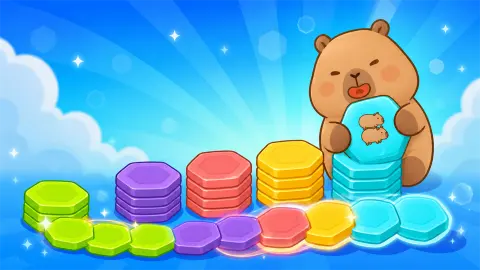
It suits someone who likes a quiet board with no clock. In ten minutes nothing hurried us and nothing punished a bad drop except the slow loss of free cells. The capybara is mostly a matter of decoration: it appears on the title screen and on the tiles, and no character walks the board. Anyone hoping for a story or an animal to look after will not find one on Level 1.
Skyreach has other puzzles in our catalogue. Block Puzzle: Jewel Block has the same kind of tray, dealing three pieces at a time onto an 8×8 board. Monster Tile Party ends the level when its seven-slot tray fills, which is a similar fear in another form. NumoraPuzzle swaps colours for numbers to merge against a limit of moves.
If the honeycomb is what you came for, Hexa Block Puzzle asks you to fit nine fixed shapes onto one. For more capybara, Candy for capybara is a timed drop-and-merge with a claw machine attached.
More in our puzzle games.
Screenshots
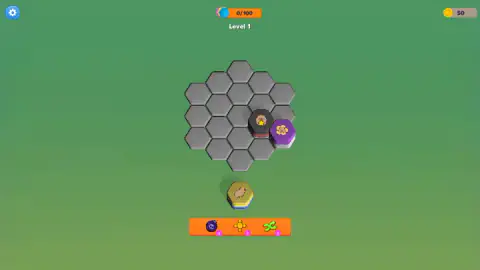
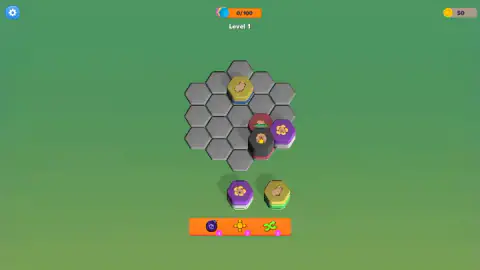
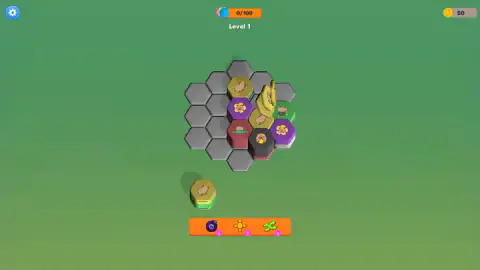
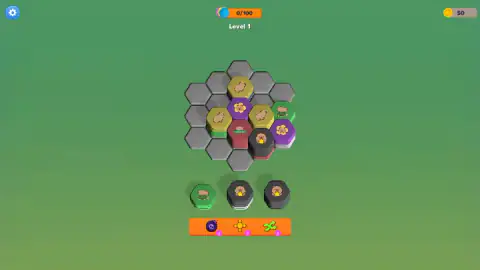
Taken by opening the game ourselves and letting it run — not supplied by the publisher, and not the same picture every other site shows.
How to play Capybara-HexaSort
- Start Level 1. The title screen has a blue PLAY button with Level 1 written under it. A card then announces the level with the number 100 on it; a click moves you on.
- Follow the dotted arrow once. The tutorial points from the tray to one empty cell. Drag the stack there.
- Play all three stacks in the tray. You can take them in any order. A slot you have played stays empty, and three new stacks arrive only when the last one has gone.
- Leave matching tops side by side. Drop a stack on an empty cell touching a stack with the same top colour, and the tiles of that colour go across without any further input.
- Keep cells free. The instructions say the level is lost when there is no room for another stack.
Tips from our run:
- Aim for the middle of a cell. Drops that landed on an occupied cell or just outside the board placed nothing, and the game gives no message about it. For the last two minutes of our session the tray did not change, and this was why.
- Read the emblem. Purple carries an orange flower, black a capybara face with a yellow star, olive a capybara in profile. The dark and muted tiles are easier to tell apart by picture than by colour.
- Look at the side of a stack. The strips show what sits underneath, such as blue under olive or red under black. That is the colour you will be dealing with once the top layer leaves.
- Keep the pointer off the orange bar unless you mean it. See the section on the bomb below.
Controls
| Drag a stack from the tray to an empty cell | Places it on the board; this is the only move that counted for us |
|---|---|
| Drag a stack onto an occupied cell or off the board | Nothing is placed and the stack stays in its tray slot |
| Click the bomb in the orange bar | Opens the HAMMER card and hides the bar, the counter and the coins |
| Click the red cross on the card | Closes it; Escape and Enter did nothing for us |
| Other two icons in the orange bar | Boosters we did not open |
| Gear, top left | Settings, according to the game's instructions; we did not open it |
Features
- A honeycomb board of 19 grey cells on a plain green screen
- A tray of three mixed stacks; a slot you play stays empty until all three are gone
- Each top colour has its own emblem: an orange flower on purple, a capybara face with a yellow star on black, a capybara in profile on olive
- Stacks show strips of the colours beneath them, so you can see what the next layer will be
- Three boosters in an orange bar, each marked with a 1; the bomb icon is the one called Hammer
- A goal counter reading 0/100 and a coin counter reading 50, neither of which moved in our session
Game details
- Developer
- HONG KONG SKYREACH INTERACTIVE LIMITED
- Release date
- August 2026
- Added here
- July 2026
- Technology
- HTML5
- Platforms
- Browser (desktop), Browser (mobile & tablet, touch)
- Saved progress
- Saving, when available, is managed by this game. Mava cannot confirm your level.
FAQ
How do you play Capybara-HexaSort?
Drag a stack of hexagonal tiles from the tray under the board and drop it on an empty cell of the honeycomb. When two touching stacks show the same top colour, the tiles move across on their own. The tray deals three stacks at a time and refills only after the third is played. According to the game's instructions, you clear tiles until you reach the level's goal.
Why won't my stack stay on the board in Capybara-HexaSort?
Most likely you are dropping it on a cell that already holds a stack, or just off the board. It is tempting to put purple on purple, but in our session those drops placed nothing and the stack stayed in its tray slot. Drop it on an empty grey cell beside the stack you want it to join and let the tiles move by themselves.
How do you win or lose a level in Capybara-HexaSort?
According to the game's instructions, you win by reaching the level's goal and lose when there is no room left for another stack. We can vouch for neither ending. In ten minutes on Level 1 our goal counter stayed at 0/100, and eight of the 19 cells were occupied the last time we counted.
What does 0/100 mean in Capybara-HexaSort?
It is the goal counter at the top of the screen, and a card before Level 1 also shows the number 100. We read it as the number of tiles to clear, because the game's instructions talk of clearing tiles to reach a goal. We cannot prove that: moving tiles between stacks did not change it, and it stayed at zero for our whole session.
What are the three icons at the bottom of Capybara-HexaSort?
They are boosters in an orange bar under the tray, each with a pink 1 beside it. The bomb opens a card titled HAMMER, which says it destroys a column of your choice. The other two are an orange four-point shape and a green twist; we did not open them, so we cannot say what they do.
How do you close the HAMMER card in Capybara-HexaSort?
Click the red cross at the top right of the card. Escape and Enter did nothing for us, and we could not place a stack while the card was up, so it held us for well over a minute. If you opened it by accident, the cross gives you the bar, the counter and the coins back.
Can you play Capybara-HexaSort on a phone?
The game's instructions describe tapping or dragging a stack on mobile, and a drag is all it asks of you. We played on a computer with a mouse, so we did not try a touchscreen. On a computer it fills a wide screen, with the small board in the middle.
Who made Capybara-HexaSort?
The game is credited to Hong Kong Skyreach Interactive Limited. It was published on 12 August 2026.