







About Jewel Gem Puzzle
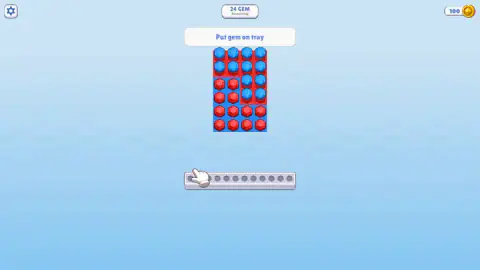
Most sorting puzzles are kind enough to leave something already in the right place. Jewel Gem Puzzle leaves nothing. The first board we were handed is a tidy rectangle of hexagonal gems, four across and six down, and the floor beneath them is painted in two colours: red over the top, blue over the bottom. Every gem standing on red is blue. Every gem standing on blue is red. Not most of them — all twenty-four.
The counter at the top of the screen says so, if you know how to read it. It shows a number and the word Remaining, and it is neither a clock nor a move limit. It counts the gems that are not home yet. Our board opened at 24, which is exactly how many gems it holds, and the level ended the moment it hit zero.
Between the board and the bottom of the screen there is a grey rail with twelve empty sockets. That rail is the whole of your working space, because you cannot drop a gem where a gem already stands. Twelve slots on a board of twenty-four gems sounds generous. It is the most generous this game ever gets.
The listing credits 29Studio, puts the game up in August 2026. Our own session ran about four minutes. We finished the opening board, collected ten coins, reached a second board of forty-nine gems in three colours, and did not move it an inch. The rest of this page is honest about both halves of that.
Everything starts on the wrong colour, and that is the design
It is worth dwelling on, because it is the one idea the whole game is built from. We checked the opening board gem by gem against the floor underneath it, and there was not a single match anywhere on it: twelve blue gems on the red half, twelve red gems on the blue half. A puzzle that begins with a few pieces already placed gives you a foothold. This one gives you none, and the counter in the corner is simply the size of that hole.
What you get instead of a foothold is a shape that tells you what to do. The red half and the blue half of the opening board are both twelve cells, the gems split twelve and twelve, and the rail below has twelve slots. Three twelves. Lift one colour out, put the other colour home, bring the first colour back down: the board is laid out so that the obvious plan is also the only plan, and finishing it teaches you the move you will need on every board after it.
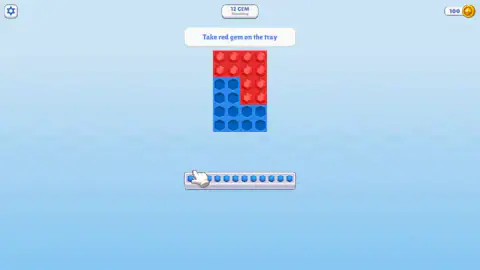
The halfway state shows how the game thinks. Mid-run, the red area was full of red gems, the blue area was twelve bare sockets, and all twelve blue gems sat in a row on the rail — and the counter read 12, because gems in the tray are not home either. The tray is not a scoring area. It is a waiting room.
Twelve slots, twenty-four gems: the tray is the real puzzle
The thing Jewel Gem Puzzle is quietly about is an old and genuinely interesting problem: you cannot swap two things when there is nowhere to put one of them down.
The famous demonstration is the fifteen puzzle, the sliding tile toy that holds fifteen numbered squares in a frame built for sixteen. The missing sixteenth square is not a flaw in the toy — it is the entire mechanism. Fill it in and the tiles become a solid block that cannot move at all. Everything the puzzle can do, it does by moving that one hole around. It swept Europe and the United States as a craze around 1880 on the strength of exactly that idea.
The same rule runs through the Tower of Hanoi, the stack of graded discs you move from one peg to another. It comes with three pegs, and the third does no work in the final answer: every disc starts on one peg and ends on another. It exists purely so discs have somewhere to wait. Take it away and you can move precisely one disc before the puzzle stops dead.
Now look at the rail at the bottom of this game. It is the hole from the fifteen puzzle and the spare peg from Hanoi, drawn as twelve sockets and handed to you up front. On the opening board it is luxurious — half the gems fit on it at once, so you can clear an entire colour in one sweep and never think about space. That is why the first board feels so easy, and it is a slightly misleading lesson.
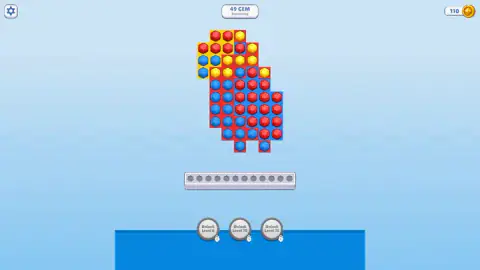
Because the generosity is fixed. The rail does not grow. The next board we reached holds forty-nine gems, and the rail beneath it still has twelve slots: not half the board any more, but under a quarter of it. The puzzle gets bigger and the waiting room stays the same size, which means that sooner or later the question stops being which gem goes where and becomes which gems can I afford to have in the air at once. That is a real puzzle, and it is the one this game is actually selling.
Forty-nine gems, three colours, and where our session stopped
The board after the tutorial is a different animal and the screen says so immediately. The neat rectangle is gone, replaced by an irregular staircase of gems stepping down from upper left to lower right. There are forty-nine of them, and three colours now, red and blue joined by yellow, with the floor beneath split into a yellow patch at the top left, a big red one through the middle and a blue one down the right. Every gem we could make out was on the wrong patch, exactly as before.
Three locked grey medals sit along the bottom of that screen, reading Unlock Level 6, Unlock Level 10 and Unlock Level 15, each wearing a small padlock. We take those as the game pointing at what is ahead rather than as anything we can describe, because we never got near them.
Here is the honest part. We did not solve that board. The counter sat on 49 for the rest of our session and four of our captures from it are identical, pixel for pixel, across more than two minutes. Whether that is the board being genuinely hard, or us failing to work out what it wanted after the tutorial stopped holding our hand, we cannot tell you from one sitting — and the difference matters enough that we would rather say we do not know than guess. What we can tell you is the shape of the step: twice the gems, one more colour, an outline with no straight edges to work along, and the same twelve places to put things down.
More puzzles worth the sorting
If arranging coloured blocks into the right places is the itch, Sand Blocks and Block Crush are the nearest neighbours we have on the shelf. Hero Rescue Puzzle swaps colour-matching for the other kind of thinking, where the order you do things in is the whole answer, and Draw Couple asks for a line rather than a plan. None of those three got the sitting this one got, so treat them as suggestions from the same shelf rather than as judgements. The rest of that shelf is puzzle games.
Screenshots
How to play Jewel Gem Puzzle
- Look at the floor, not at the gems. The painted patches under the sockets are the targets; the gems on top of them are the problem. A level is over when every gem matches the colour it is standing on.
- On the opening board, follow the pointing hand. The game names each step in a banner across the middle — Put gem on tray, then Take red gem on the tray, then Put them on the blue slot — and a white cartoon finger shows you the exact gem or slot it means.
- Empty one colour out onto the tray first. That is what frees the sockets underneath, and it is what the opening board walks you through: the twelve blue gems go to the rail, which leaves twelve bare sockets for the twelve red gems to come home to.
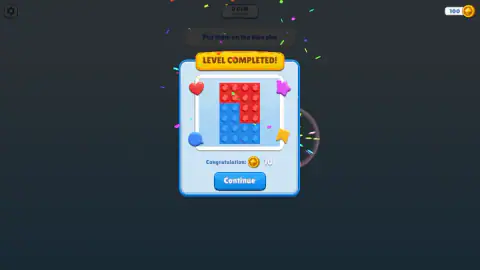
- Put the parked gems back down on their own colour. When the counter reaches zero you get a card reading LEVEL COMPLETED, your finished board framed like a small picture, ten coins and a Continue button.
What we only found out by being there:
- The tray is exactly twelve slots, on every board we saw. On the opening board that is precisely one colour's worth, with nothing to spare. Plan on filling it completely.
- Nothing hurries you. No clock, no lives, no move counter, no fail screen. We sat on one board for minutes at a stretch and the game simply waited.
- The keyboard is not wired to anything. Space, Escape, Enter and letter keys all left the screen exactly as it was.
- Coins arrive and then sit there. Ten per level, 100 to 110 in our case, and nothing we reached offered us anything to buy.
- The first board is a lesson, not a level. What comes after it is roughly twice the size and adds a third colour, while the tray stays the same.
Controls
| Mouse, or a finger on a touch screen | The only input the game asks for. There is no key prompt anywhere on screen and no on-screen arrows |
|---|---|
| Click or tap a gem | Picks it up. On the opening board the game puts a white hand on the exact gem it wants next, so you can learn the game by following the finger |
| Click or tap a tray slot | Parks the gem you are holding on the rail at the bottom. The rail has twelve slots and no more |
| Click or tap an empty socket | Puts a gem down. The sockets you want are the ones whose floor is the colour of the gem |
| Drag from a gem to a slot | Also moved things along for us. We could not tell click-to-click and drag apart in one session, and the game never says which it prefers |
| Keyboard | Nothing we could detect. We tried the space bar, Escape, Enter and letter keys, and the screen did not change once |
| The gear, top left | Some kind of options button, present on every screen. We pressed it and cannot tell you what it opened |
Features
- Every gem on the opening board starts on the wrong colour: twelve blue gems sitting on red floor, twelve red gems sitting on blue, with nothing already in place
- The counter at the top is not a timer and not a move limit. It counts the gems that are not home yet, and it reads 0 exactly when the level ends
- One tray of twelve slots, and that is the entire working space. It does not grow when the boards do
- The opening board is twenty-four gems in two colours; the next one we reached is forty-nine in three, on the same twelve-slot tray
- Finishing a level pays ten coins. Ours took the purse from 100 to 110, and nothing in our session offered us anything to spend them on
- Three locked medals sit along the bottom of the screen reading Unlock Level 6, Unlock Level 10 and Unlock Level 15
- No timer, no lives, no move counter, no fail state we ever hit. Nothing on screen punishes you for thinking
Game details
- Developer
- 29Studio
- Release date
- August 2026
- Last updated
- October 23, 2026
- Added here
- July 2026
- Technology
- HTML5
- Platforms
- Browser (desktop), Browser (mobile & tablet, touch)
- Saved progress
- Saving, when available, is managed by this game. Mava cannot confirm your level.
FAQ
What is the goal in Jewel Gem Puzzle?
Every gem has to end up standing on floor of its own colour. The board is a block of hexagonal sockets, the floor under those sockets is painted in patches of red, blue and yellow, and the gems begin on the wrong patches. When the last one is home the counter at the top reaches zero and the level ends.
What does the GEM Remaining counter mean?
It counts the gems that are not home yet, and it only ever goes down. Our first board opened at 24, which is exactly how many gems it holds; it read 12 once half of them were sorted, and 0 on the screen that announced the level complete. There is no clock and no move limit attached to it.
What is the tray at the bottom of the screen for?
It is your only spare space. You cannot put a gem where another gem is already standing, so the tray is where you park gems while you clear the sockets underneath them. It has twelve slots, which on the opening board is exactly one colour's worth.
How many gems are on a board in Jewel Gem Puzzle?
The opening board is a neat rectangle of twenty-four gems in two colours. The next one we reached is an irregular stepped shape of forty-nine gems in three colours, red, blue and yellow, and the tray underneath it still has the same twelve slots. We did not get past that board, so we cannot tell you how large they grow after it.
What do you get for finishing a level?
A card headed LEVEL COMPLETED that shows your finished board framed like a small picture, and ten coins. Our purse went from 100 to 110 on the way out of the first level. We never reached a shop or any other use for the coins in our session, so what they buy is an open question.
Does Jewel Gem Puzzle have a timer or a way to lose?
Nothing we saw. There is no clock, no move counter, no lives and no fail screen, and we spent several minutes sitting on one board without being penalised for it. The pressure in this game comes from the twelve-slot tray, not from the clock.
Who made Jewel Gem Puzzle and when did it come out?
The listing credits 29Studio and gives the release as August 2026.
Can you play Jewel Gem Puzzle on a phone?
It is free, it runs in the browser on this page with nothing to install, and the listing marks it as a portrait game for phone and tablet as well as desktop. That matches what we saw: played in a wide window, everything sits in a narrow column down the middle with empty sky on both sides. We used a mouse, so how the dragging feels under a thumb is the listing's claim rather than ours.