About Hero Rescue Puzzle
For most of 2020 the most widely seen puzzle in mobile gaming was one almost nobody could play. It ran in adverts: a hero trapped between a lava pool and a chest of gold, three or four pins holding everything in place, a timer daring you to work out which one to pull first. Then you installed the game and found a match-three board. Hero Rescue Puzzle is the other side of that story — a game built as the thing the advert promised, where pulling the pins is the whole product.
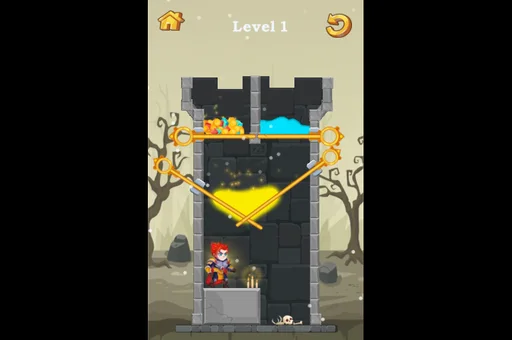
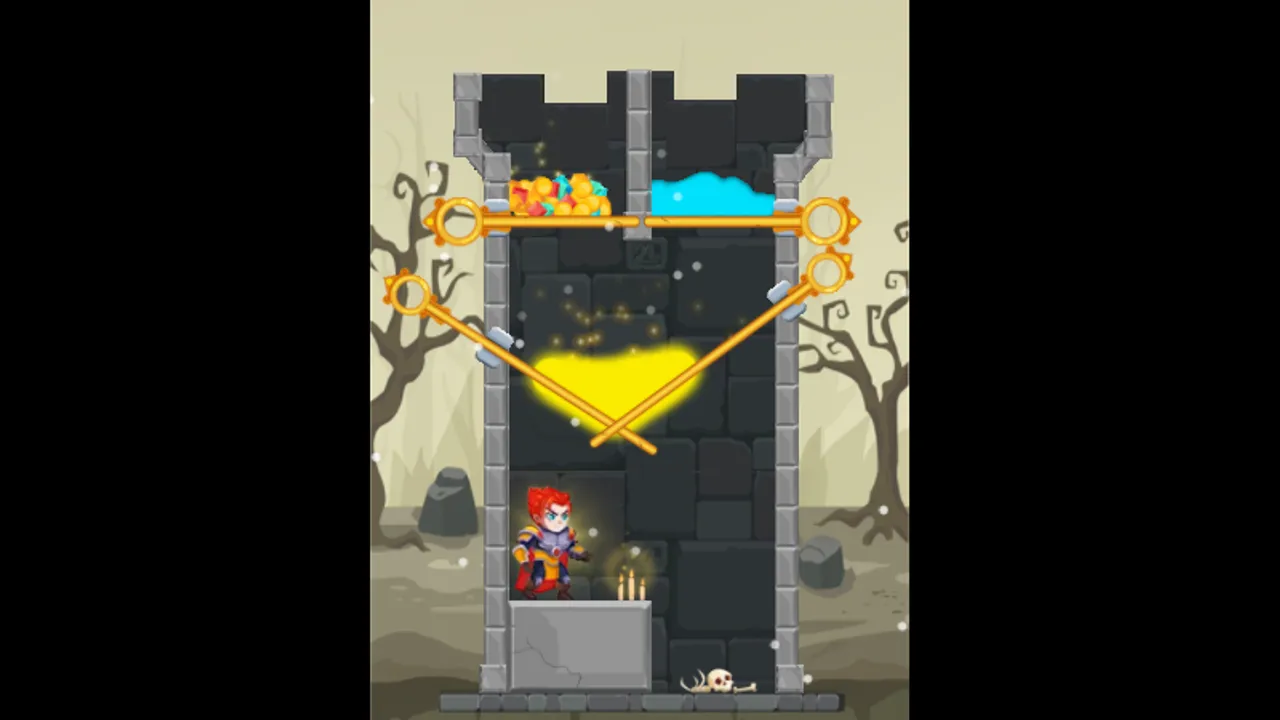
The tower in front of you is a stack of sealed chambers. One holds water, one holds lava, one holds a cart of gold, one holds goblins, and a knight waits at the bottom. Each pin is a metal bar wedged through a wall, and dragging it along its slot opens whatever it was holding. From there it is physics rather than animation: liquids pool where the geometry lets them, the cart follows whatever slope you have just opened, goblins fall wherever gravity takes them. Pull the water pin above the lava and the two meet in the corridor, the lava sets into cold rock, the route is safe. Pull the gold pin first and the cart drops into molten stone.
It was published on 25 August 2020 by Codo Studio, a small outfit whose entire visible output is six HTML5 games on GameMonetize and no website of its own. The day before, the same studio put out Hero Rescue, a near-identical sibling filed under action rather than puzzle; portals that host that build describe it as forty stages unlocked in order, and this one is structured the same way. Neither announces a level total in-game. You get a grid that fills in as you clear stages, and a coin counter that climbs by roughly ten per win.
Two honest notes. It is short-session by design, and there is no shop or unlockable character for the coins to buy, so that counter is a score rather than an economy. And it is ad-supported in the usual way here: a pre-roll, then skippable spots between levels. The trap in those is covered in the tips below.
The pull-the-pin puzzle was an advert before it was a game
The pin-pulling puzzle did not grow out of a hit game and then get advertised. It went the other way round: the mechanic was devised as advertising creative, spread through campaigns for games that did not really contain it, and only afterwards did studios start shipping genuine pull-the-pin games to meet the demand the ads had built. The clearest documentation is academic — Zdenko Mago's paper "Fake-vertising and Mobile Games: Case Study of 'Pull the Pin' Ads", in Communication Today (2020), treats these campaigns as a case study in fake gameplay footage.
The best-known example is Hero Wars, an idle RPG with automated battles whose adverts presented it as a drag-and-pull physics puzzle. The mechanic did exist in the game — as an occasional bonus mini-game, not as the thing you spend an evening doing. That gap is what got a rival publisher into trouble. In October 2020, two months after this game went up, the UK's Advertising Standards Authority ruled on seven complaints about Facebook ads for Playrix's Homescapes and Gardenscapes. Playrix's own submission is the detail worth keeping: Homescapes had 4,160 levels and around ten of these pin mini-games in total, they only began appearing after level 20, and the company acknowledged that a vanishingly small share of players — it put the figure at 0.03% — ever reach the end content. The ASA found the ads misleading and exaggerated under the CAP code, and banned them.
Which makes Hero Rescue Puzzle a small artefact of that moment: a complete, playable version of the advert, released in the same season the advert was being banned. The distributor's own listing name-checks the genre's origin, calling it a "hero wars game". And in two separate sessions checking this build, the pre-roll served over it was, with a straight face, a Hero Wars advert showing a pin puzzle.
Why the obvious pin is almost always the wrong one
There is a reason these levels feel harder than they look, and it is not the physics. The pin your eye goes to first is the one touching the goal: the treasure is what you want, so you reach for the pin holding the treasure. That instinct is precisely what the level design is built to punish.
The technique that works is backward reasoning. Start from the state you want at the end — knight alive, lava cold, gold in the corridor — and ask what must already be true for that to happen. The lava has to be set before the gold falls. The water has to be released before the lava can be set. Only then do you know what the first pull is, and by that point it is usually a pin you had not been looking at.
This is not a gaming invention. George Pólya's How to Solve It (1945) lists working backwards among the standard problem-solving heuristics, tracing it to the ancient method of analysis described by Pappus of Alexandria: assume the result is achieved, then reason backwards to something you already know how to do. A pull-the-pin level is that method with a lava pool attached.
Playing Hero Rescue Puzzle unblocked at school
Pull-the-pin games are perennial "unblocked" searches, and the reason is structural rather than sneaky: this is a single HTML5 page. No Flash, no plugin, no installer, no account, no saved profile. It runs on the sort of locked-down Chromebook school districts hand out, because there is nothing here for a device policy to object to.
Whether it opens for you depends on your network's domain filter, not on the game. And because it is portrait and touch-driven, it works as well on a phone in a corridor as on a school laptop: the 405×720 canvas keeps the pins finger-sized instead of scaling them into a landscape sliver.
Levels are genuinely short, so you can finish one between other things and come back to the grid later. The ads are the only part that asks for patience, and the skip button is worth waiting for.
The other pull-the-pin games here, and how they differ
If this one lands, the closest thing in the catalogue is Hero Rescue — the sibling Codo Studio published one day earlier, with the same tower, the same pins and a slightly more combat-flavoured framing. Play them back to back and you can watch a studio try the same idea twice inside forty-eight hours.
Pull Him Out Online is the same genre with a different cast: a treasure hunter rather than a knight, sticks rather than pins, and levels that lean harder on trapping enemies than on moving liquids around. It is the better pick if what you enjoy here is the sequencing rather than the lava.
Two adjacent games are worth naming for contrast, because they are rescues that are not puzzles. Save the Kitten asks for reflexes instead of planning — you bounce falling kittens to safety in real time, with no pausing to think. Hunter Assassin keeps the "work out the order, then commit" feeling but drops the physics: you route a silhouette between patrolling guards. All of them sit in or a step sideways from the puzzle category.
Screenshots
How to play Hero Rescue Puzzle
- Read the whole tower before touching anything. Find the knight, the treasure, the lava and the water. The puzzle is not which pin to pull — it is the order in which those four are allowed to meet.
- Water before lava, nearly always. If a water pocket sits above or beside lava, that pin goes first: the water sets the lava into safe rock. Reverse it and the level is over before you can react.
- Treasure last. Release the gold or the cart only once the route down to the knight is clear and cold. Gold that lands in lava is gone.
- Send the goblins somewhere else. Open a goblin chamber onto lava, onto spikes, or off the edge of the map — never onto the corridor the knight is standing in.
- Restart without guilt. The top-right icon resets the level instantly and there is no life system, so a wrong guess costs about four seconds. The home icon at the top left returns to the grid.
Four things you only learn by playing:
- Drag along the slot, not away from the wall. Pins slide out lengthways. A flick in the wrong direction registers as no input, which reads as the game ignoring you rather than as a miss.
- When two pins look equivalent, pull the higher one. Gravity does the ordering for you, and a chamber emptied from above cannot surprise you later.
- Lava that has been cooled stays cooled. Once water has set it, that corridor is permanently safe — which is why flooding early beats flooding precisely.
- If an ad appears right after a pull, wait for the skip button rather than tapping. A tap opens the advertiser's page in a new tab and drops you out of the game. It caught me twice while checking this build.
Controls
| Click / tap and drag a pin | Pull the pin out of its slot — whatever it was holding (water, lava, treasure, goblins) drops or flows |
|---|---|
| Drag along the slot, not across it | Pins slide out lengthways; pulling sideways reads as no input at all |
| Restart icon (top right) | Reset the current level instantly if the order went wrong |
| Home icon (top left) | Back to the level grid to replay any stage you have cleared |
Features
- Pull-the-pin logic in a stone tower — every chamber is a small physics problem you can read in a second and still get wrong
- [object Object]
- Treasure carts and goblins that have to be released in sequence, never onto the knight's corridor
- About ten coins for every level cleared, tracked by a counter that stays on screen the whole time
- No lives and no fail penalty — the restart icon resets a level in one tap, so experimenting costs nothing
- Portrait canvas of 405×720, so it plays one-handed on a phone and loads in seconds on a school Chromebook
- Skippable ads placed between levels rather than inside a puzzle
Game details
- Developer
- Codo Studio
- Release date
- August 2020
- Last updated
- August 25, 2020
- Added here
- April 2023
- Technology
- HTML5 (2D physics, 405×720 portrait)
- Platforms
- Browser (desktop), Browser (mobile & tablet, touch), Chromebook
- Classification
- Puzzle
FAQ
Is Hero Rescue Puzzle free to play?
Yes. It runs in your browser with nothing to download and no account. It is funded by short ads before the game and between levels, which become skippable after a few seconds.
How do you play Hero Rescue Puzzle?
Drag a pin along its slot to pull it out, and everything it was holding falls or flows. Pull the water pin first so it cools the lava, release the treasure only once the path below is cold, and never open a goblin chamber above the knight.
Why do I keep losing the level?
Almost always the order rather than the timing. If lava reached the knight, the water pin should have gone first. If the treasure landed in lava, the lava needed flooding before the cart was released. Tap the restart icon and try a different sequence — there is no life system, so retries are free.
How many levels does Hero Rescue Puzzle have?
The game does not announce a total; it fills in a level grid as you clear stages. Portal listings for Codo Studio's near-identical sibling build, Hero Rescue, put that one at 40 stages unlocked in order, and this build is structured the same way.
Does Hero Rescue Puzzle work on mobile?
Yes. The canvas is portrait at 405×720 and the pins are large enough to drag with a thumb, so it plays the same in an iPhone or Android browser as it does on a desktop.
Can I play Hero Rescue Puzzle unblocked at school?
It is one HTML5 page with no plugin, no installer and no login, so it loads on a locked-down school Chromebook the same way it loads anywhere else. Whether it opens depends on your network filter, not on the game.
Who made Hero Rescue Puzzle?
Codo Studio, credited on the GameMonetize listing, which published the game on 25 August 2020. The studio has six games on that platform but no traceable website of its own, so there is no developer page to link to.
Why does this puzzle look like a mobile game advert?
Because the format started as one. Pull-the-pin scenes were built for advertising campaigns before they were built as games, and in October 2020 the UK Advertising Standards Authority banned two Playrix ads for showing pin puzzles that the advertised games barely contained.