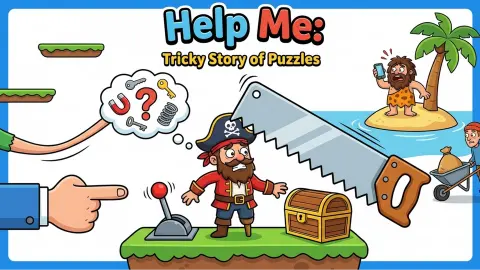


About Help Me: Tricky Story of Puzzles
Most trick puzzles ask you to spot the odd thing out, or to tap every item in a scene until one of them gives. Help Me: Tricky Story of Puzzles asks for a single stroke, and then judges everything that stroke touched on the way.
Each level is one hand-drawn scene on cream paper: a character, the thing they need, and from the second level on, something in between. Next to the character floats a white gloved hand. It is the only thing on screen you can move. Drag it and the character's arm follows it, drawn as a thick red line that is as long as you care to pull. Let go in the right place and a yellow VICTORY banner drops in. Let go on the wrong thing and a grey LOSE banner does, with the scene redrawn to show what went wrong.
We have now sat down with this one twice, both times on a desktop computer with a mouse, most recently for about ten minutes. Both times we won the first two levels in a handful of drags. Both times the third beat us. The game's own menu says there are 56 levels, and we have seen three, so this page tells you what those three are made of and where our evidence stops.
The game is credited to Ivan Popenya.
The three levels we have played
Level 1 is the tutorial and it has no obstacle at all. A brown mouse stands at the bottom left; a wedge of yellow cheese sits at the top right. Pull the hand straight to the cheese, the red arm stretches diagonally across an empty page, and the VICTORY card arrives with the bar at a quarter. This is the only level that shows two buttons instead of three: the hint does not exist yet.
Level 2 introduces the idea that the scene can stop you. Two brown brick blocks hang in the middle of the screen with a narrow vertical gap between them, and in that gap sits a small white object with a yellow glint on top. Below it stands a blonde fairy in a pink dress, wings out, holding a round teal-rimmed glass up to her face. A winged fairy and a small white tooth-shaped thing is a pairing with an obvious reading, though the game never says so. Pull her hand straight up into the gap and the level is won, with the bar at a half. The hint button appears here and stays.
Level 3 is a winter scene and it is where both our sessions ended. A boy in a blue hooded puffer coat and teal mittens stands beside a grey metal bin, its lid off and leaning against the side. Below him runs a wooden fence of eight short posts. Below the fence lies a dark grey bundle, tied off at the top. The scene reads as plainly as the first two: that bundle belongs in that bin. The fence is in the way.
Why level 3 beat us, twice
The first time, we lost it on two straight attempts, both of which put the arm on the fence. The second time we lost it once and then spent the rest of the session failing to find a second idea.
The game draws the failure rather than announcing it. The banner turns grey and reads LOSE, the bin is lying on its side, and the boy stares at it with his mouth open.
The things that do nothing are as useful to know as the things that lose. The bundle will not move. Pulling the hand onto the open bin did nothing either. Clicking on the boy or on the level banner changed nothing. The level is simply waiting for one correct stroke and ignoring everything else.
One detail we keep coming back to: the fence reaches the right edge of the screen but stops well short of the left, leaving an open strip of empty page. We never managed to run the arm round that end. That is where we would look next, and we cannot promise it is the answer.
The buttons that cost an advert
Three circles sit under each level from the second one on. The pink one restarts and is free. The yellow lightbulb and the blue double arrow each carry a small video badge in the bottom corner, the mark this kind of game uses for a button paid for by watching an advert. The skip button on the LOSE card carries the same badge. So the only free way out of a level you cannot solve is to try it again yourself.
We never pressed either of the paid buttons, which means we cannot tell you whether the hint shows you the whole stroke or just points at the object.
There is also a break between levels. After we won the second one the screen went black and the advert slot came up; what appeared in it was the listing's own notice saying the advert had been skipped that time, with a button to carry on playing. Expect that pause after a win, and expect it to show you something on a day when it is not skipped.
Fifty-six levels, and a bar that is not measuring them
The menu card is the most informative screen in the game. A cartoon shark with a doughnut sits above a yellow banner that gives your place as a level out of 56, and ours read three. Below it, a round red Play button drops you back where you left off; below that, a SKINS button we did not open, so we cannot say what it changes or how it is paid for.
That number also settles what the progress bar on the VICTORY card is not. It moved up a quarter after each win, so at that pace it would fill after four levels. The game holds far more than that, so the bar is measuring a short stretch and starting again, not the whole run.
Two more things we did not establish. We only played with a mouse, on a screen where the game sits as a tall portrait strip in the middle of the window, so we cannot vouch for it on a touch screen. And apart from the sound it makes when it opens, our ten minutes were silent: no fanfare on VICTORY, no sting on LOSE.
Who it is for
This suits anyone who likes short brain teasers with no clock running. There is nothing to read beyond the level number, no timer in any level we saw, and a wrong answer costs a restart and a few seconds. A child who can drag a mouse or a finger can play the first two levels without help.
If you want long levels, a story with dialogue, or a puzzle that rewards grinding, this is not that. Each level we beat took one stroke, once we knew where to put it. Each level we lost took one stroke too.
More games by Ivan Popenya and other trick puzzles
Ivan Popenya also made Draw Bridge: Puzzle Challenge, where a single drawn line has to carry a stickman on a dirt bike across a gap, and Cat Puzzle: Draw to Kitten, which asks for a safe line from each cat to its kitten. If you came here looking for one of the near-namesakes, Help Me: Tricky Puzzle Games and Help Tricky Story: A Complicated Story are different games with the same taste for comic rescues. For more scenes to think your way through, browse the puzzle games.
Screenshots
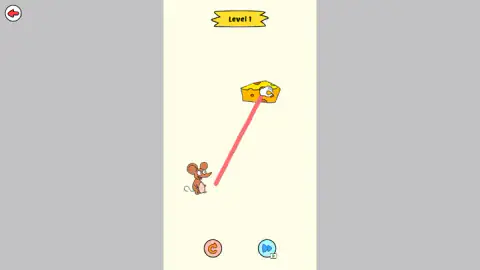
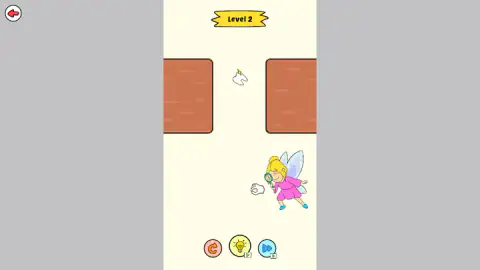
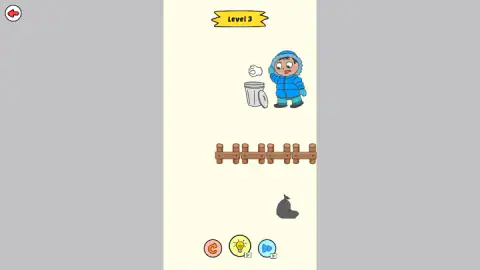
Taken by opening the game ourselves and letting it run — not supplied by the publisher, and not the same picture every other site shows.
How to play Help Me: Tricky Story of Puzzles
- Look at the whole scene before you touch anything. Work out which object helps the character, and then work out what sits between them.
- Find the gloved hand. It hovers beside the character, and it is the only thing that responds to a drag.
- Pull it to the object. The arm stretches behind your pointer as a red line, and the line is judged along its whole length, not just where it ends.
- Let go. On the VICTORY card the blue double arrow takes you to the next level; on the LOSE card the pink circular arrow puts you back at the start of the same one.
Tips from our sessions
- Only the hand moves. We spent most of our second session trying to drag the bundle in level 3, from several angles. Nothing happened, ever. If a thing in the scene will not budge, it is waiting for the arm to reach it.
- The route matters more than the target. A straight pull won levels 1 and 2 because nothing was in the line. In level 3 a straight pull is exactly what loses.
- Restarting is free. The hint is not. The pink button under the level has no badge on it. The lightbulb and the skip button both do.
- If the game goes still, click it. It pauses itself the moment the window loses focus and waits behind a grey Click to keep playing panel. One click and it carries on.
- Reloading costs nothing. We reloaded the page twice while stuck, and the menu came back offering level 3 both times.
Controls
| Drag the white gloved hand | Stretches the character's arm after it, drawn as a thick red line, to wherever you let go |
|---|---|
| Pink circular arrow | Restarts the level, and is the only button under the level that costs nothing |
| Yellow lightbulb (from level 2 on) | The hint. It carries a small video badge, so it is paid for by watching an advert |
| Blue double arrow | Skips the level, also behind a video badge; on the VICTORY card the same button takes you to the next level |
| Red arrow, top left | Leaves the level and goes back to the menu |
| Round red Play button on the menu | Starts you at the level you had reached, which the menu shows above it |
Features
- 56 levels, counted by the game itself: the menu card read Level 3 of 56 while we were stuck on the third
- One drag per attempt. You move a white gloved hand and the character's arm follows it as a long red line
- Every level is a single hand-drawn scene on cream paper, with a character, the thing they need and something in the way
- A yellow VICTORY banner with a bar that moved up a quarter per level, and a grey LOSE banner that draws the failure instead of announcing it
- A hint button and a skip button that both carry a video badge, so both are paid for with an advert; restarting is free
- An advert slot between levels, and a pause overlay that stops the game whenever the window loses focus
- Your place is kept: we reloaded the page twice while stuck and the menu still offered level 3
Game details
- Developer
- Ivan Popenya
- Release date
- July 2026
- Last updated
- July 29, 2026
- Added here
- June 2026
- Technology
- HTML5 (2D)
- Platforms
- Browser (desktop), Browser (mobile & tablet)
- Classification
- Puzzle
- Saved progress
- Saving, when available, is managed by this game. Mava cannot confirm your level.
FAQ
How do you play Help Me: Tricky Story of Puzzles?
Each level is one drawn scene with a character, an object they need and, from level 2 on, something in between. A white gloved hand floats next to the character, and it is the only thing on screen you can move. Drag it and the arm stretches after it as a thick red line; let go on the right object and a yellow VICTORY banner appears, let go on the wrong thing and a grey LOSE banner does.
How many levels does Help Me: Tricky Story of Puzzles have?
56. The menu card shows your place as a level out of 56, and it read level 3 of 56 for us. The progress bar on the VICTORY card is a separate thing: it moved up a quarter for each level we won, so it measures a short stretch rather than the whole game.
How do you beat level 1 of Help Me: Tricky Story of Puzzles?
Drag the gloved hand from the mouse at the bottom left up to the wedge of cheese at the top right. Nothing stands in the way, so a straight pull is enough. It is the tutorial, and it is the only level that shows no hint button.
How do you beat level 2 of Help Me: Tricky Story of Puzzles?
Two brick walls leave a narrow vertical gap, and a small white object with a yellow glint sits in it. Pull the fairy's gloved hand straight up into that gap. We won it that way in both of our sessions; the walls decide the route, so the arm has to go between them rather than around.
How do you beat level 3 of Help Me: Tricky Story of Puzzles?
We have not solved it. A boy in a blue hooded coat stands by an open metal bin, a wooden fence runs below him and a dark grey tied bundle sits beyond the fence. Every attempt we made that touched the fence ended in a LOSE banner with the bin tipped over, and the bundle itself cannot be dragged. The fence stops short of the left edge of the screen, which is where we would look next.
Do the hint and skip buttons cost anything in Help Me: Tricky Story of Puzzles?
Both carry a small video badge in the corner, which is how this kind of game marks a button that is paid for by watching an advert. The pink restart button has no badge and costs nothing. We never pressed the paid ones, so we cannot say how much the hint gives away.
Is Help Me: Tricky Story of Puzzles the same game as Help Tricky Story or Help Me Tricky Puzzle?
No. Several browser puzzle games share almost the same name and they are different games. This is the one credited to Ivan Popenya in which you stretch a character's arm across the scene to an object.
Who made Help Me: Tricky Story of Puzzles?
It is credited to Ivan Popenya. It was published in July 2026.