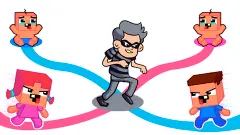



About Draw path to home
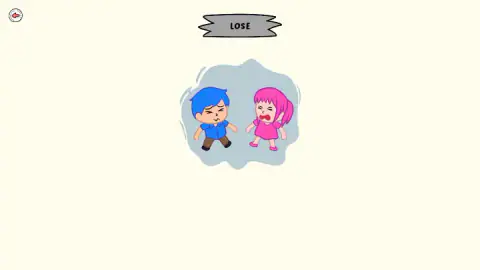
Draw a line from the first child to the house of its colour and nothing happens. Nobody moves, no counter ticks, no sound. Draw the second line and everything happens at once — and on the second board, all that happened to us was a grey banner reading LOSE.
That silence is the rule the game never states. Every character needs a route before anyone takes a step. One finished line on a board with two children is half an answer, and the game will wait as long as you like for the other half.
What the second line starts is not a victory lap. Both children set off together, at the same speed, each along the line you gave them, and the buttons under the board disappear while they walk. Either they reach their doors, or they run into each other.
That second outcome is the game. Level 2 swaps the children so the two obvious routes cross, and both of them reach the crossing at the same moment. We drew that X four times in a ten-minute sitting and lost four times, the grey cloud landing each time right where the two lines met.
The game is credited to Ivan Popenya. It has been available since July 2026.
Level 1 is two straight lines, and the first time anyone walks
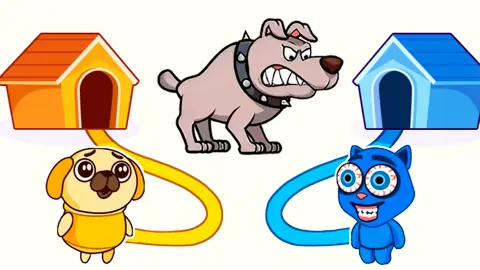
The first board is as plain as a puzzle gets: a cream sheet, the words "Level 1" at the top and four drawings. The pink house is on the left with the girl below it, the blue house on the right with the boy below it. Nothing stands in the way.
We dragged from the boy up to the blue door and a blue line appeared, almost vertical. He did not move. We drew the girl's pink line a few seconds later, and that is when the board finally came alive: both children started climbing their own lines at the same moment. A few seconds later the victory card arrived.
It is a tutorial without a word of tutorial, and it teaches one thing while hiding the other. You learn the gesture. You do not learn that two walkers can ruin each other.
Level 2 swaps the children, and the crossing is the whole puzzle
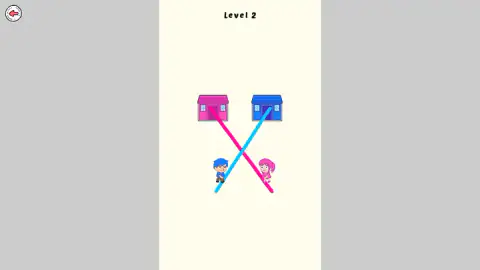
The second board looks identical at first glance. The houses have not moved. The children have: the boy now stands on the left, under the pink house, and the girl on the right, under the blue one.
So the shortest route for each of them is a diagonal, and the two diagonals cross near the middle of the board. Draw them and you get a neat X with a child climbing each arm. Both arms are the same length and both children walk at the same speed, so they arrive at the crossing together. The screen cuts to the grey card, and the cloud with the two of them inside it is drawn right over the spot where the lines met, with the two stubs of blue and pink still poking out from under it.
We did this four times, with different drags each time, and got the same crossing and the same result. There is no timer running and a loss costs you nothing but the walk you just watched.
Which makes the real puzzle clear, and it is not the one the first board sets up. Getting a child to its door is trivial. Getting both of them there without putting them in the same place at the same instant is the job. Two things are worth trying, and we are honest that neither is tested: send one child the long way round, outside the other's route, so the paths never touch at all; or keep the crossing and make one route much longer than the other, so the two of them pass through it at different moments.
The two end screens, and the bar that fills while you watch
Winning and losing use the same layout in opposite colours. VICTORY is a yellow ribbon over both children cheering on a bright blue splash. LOSE is a grey ribbon over the same two, scowling inside a grey-blue cloud.
The victory card carries something the losing card does not: a long bar under the children with a small blue figure riding on its left end, and a percentage printed beneath it. We watched that number climb. Moments after the banner appeared it read 4%, and by the time it settled it stood at 25% — and only then did the Replay and Next buttons fade in, so the bar is also what makes you wait.
A quarter of the bar for one level means four levels to fill it, and presumably something new for the little figure riding on top. That is our reading of a bar with no label, not a promise the game makes.
The losing card offers two buttons instead. Red Replay gave us the same level with the board wiped clean. Blue Skip level sits to its left with a small green play badge in the corner, which normally means a video advert stands between you and the favour. We took Replay every time, so we cannot say what skipping costs.
The buttons under the board come and go
The row of round buttons beneath the board is not fixed, and watching it is the closest thing to feedback the game offers.
A level opens with two: an orange circular arrow, the usual sign for starting again, and a blue double arrow carrying the same little video badge as Skip level. Stay on the board without solving it and a yellow light bulb fades in between them, growing brighter the longer you are stuck. Press Replay and it is gone again, and you have to earn it back by failing for a while.
The bulb is the one button we cannot report on. We have pressed it, and no route was ever sketched and no arrow pointed anywhere. And while the children are walking the row is not there at all, which is the clearest signal in the game that your turn is over.
44 levels, a gift and a skins button
The title screen has a round orange play button and a yellow banner above it reading "Level: 2/44", which is how we know the size of the game — and, since it still said so when we stopped, how little of it we saw. Two smaller buttons sit below: a wrapped gift with a red alert mark, and a button labelled SKINS whose artwork is a pair of cartoon creatures. The same kind of figure rides the reward bar on the victory card.
We opened neither, so what the gift holds and what the skins change are not ours to say.
Who it is for
Young players, and anyone who wants a puzzle with no reading in it. The first board needs no instructions, there is no timer and no life counter, and you can fail the same level as often as you like.
It is less suited to players who want the game to explain itself. Nothing tells you the board is waiting for a second line, nothing warns you that the routes you just drew will put two children in the same place, and the hint button refused to help. And if 44 levels sounds generous, bear in mind we can vouch for two of them.
More drawing puzzles
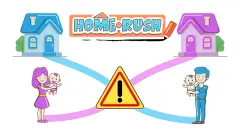
Home Rush is the closest relative: lines from each parent to a baby of the same colour, with fences and holes in the way. In Save The Pets: Draw to Save the line is a shield with limited ink and a clock to outlast. Draw Bridge - Brain Game and Draw The Road give your line weight, and a vehicle has to cross it. The rest are under puzzle games.
Screenshots
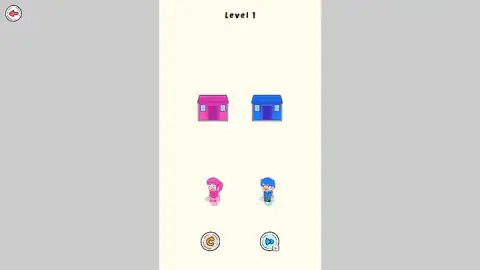
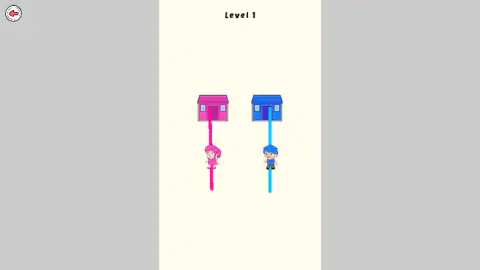
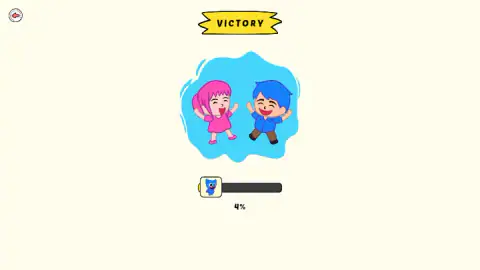
Taken by opening the game ourselves and letting it run — not supplied by the publisher, and not the same picture every other site shows.
How to play Draw path to home
- Look at the board. Characters stand near the bottom, houses sit above them, and each house matches one character's colour.
- Press on a character, hold the button down and drag towards the house of the same colour. A thick line follows the pointer.
- Let go on the house. The line stays on the board and the character stays where it is.
- Do the same for every other character. When the last line is down they all start walking at once, and you cannot touch anything until they stop.
- If they all get home, a yellow VICTORY card appears and the blue Next button takes you on. If two of them meet, a grey LOSE card appears and the red Replay gives you the board back empty.
What our run taught us:
- Nobody walks until every character has a line. A board with one route drawn is not stuck or broken. It is waiting for you.
- The last line commits you to the whole plan. Everything moves at once, nothing can be redrawn and no button is left on screen.
- Match the colour, not the position. On the first board each house sits right above its owner. On the second it does not.
- A click is not a drag. Tapping a character does nothing; the line only starts when you hold and pull.
- Leave the keyboard alone. Enter and Escape changed nothing. The game is one gesture with the mouse.
Controls
| Click and drag from a character | Draws that character's route in its own colour; let go on the house of the same colour |
|---|---|
| Nothing, once the last route is down | Everyone walks at once and the buttons disappear; you cannot steer, stop or redraw |
| Replay (red, on both end screens) | Starts the level again with an empty board |
| Skip level (blue, on the losing screen) | Offers to move on without solving it; it carries a small video badge |
| Orange circular arrow, bottom left | The usual sign for starting the level again; we cannot confirm what it clears |
| Light bulb, bottom centre | The hint button; it is not there when a level starts and it has never shown us a route |
| Red arrow, top left | Leaves the level and returns to the title screen |
| Keyboard | Enter, Escape and the letter keys did nothing we could see |
Features
- 44 levels, counted on the title screen, which read 2/44 at both ends of our session
- One route per character, drawn freehand in that character's colour
- Nobody walks until every character has a line, and then everybody walks at once
- Two children who meet on the way lose the level, with no lives lost and no penalty
- A losing screen that offers Replay or Skip level, and a winning one that offers Replay or Next
- A reward bar on the victory card that climbs on screen and stood at 25% after one level
- A hint button that only appears once you have been stuck for a while
Game details
- Developer
- Ivan Popenya
- Release date
- July 2026
- Added here
- June 2026
- Technology
- HTML5
- Platforms
- Browser (desktop)
- Classification
- Puzzle
- Saved progress
- Saving, when available, is managed by this game. Mava cannot confirm your level.
FAQ
How do you play Draw path to home?
Each level shows characters at the bottom of the board and houses above them. Press on a character, drag a line to the house of the same colour and let go. Do that for every character. Only then does anyone move, and a solved board ends with a yellow "VICTORY" banner.
Why does nothing happen after I draw a line in Draw path to home?
Because one line is not enough. A character waits until every other character on the board has a route as well. Nothing on screen tells you this, and a board with one line drawn looks exactly like a board that is stuck.
Why do I lose in Draw path to home?
Because your characters run into each other. Once the last route is down they all set off at the same moment, and if two of them reach the same point together the level ends with a grey "LOSE" card and the two of them standing in a cloud. We lost level 2 four times that way, always where the two routes crossed.
What is different about level 2 in Draw path to home?
The houses stay where they were and the two children swap sides, so the boy stands under the pink house and the girl under the blue one. The two obvious routes are diagonals that cross in the middle of the board, both children reach that crossing at the same time, and the level is lost there.
How many levels does Draw path to home have?
The title screen counts them, and after our first solved level it counted us as being on level 2 of 44. We solved the first, never got past the second, and cannot describe the other 42.
What happens when you lose a level in Draw path to home?
A grey "LOSE" ribbon appears with both children in a cloud, and two buttons follow, a red "Replay" and a blue "Skip level". Replay gave us the same board with nothing drawn on it. There are no lives and no timer, so losing costs you only the walk you just watched.
Can you play Draw path to home on a phone?
It is listed for PC, Android and iOS, and the board is laid out upright like a phone screen. We played on a desktop with a mouse only, so the phone version is the listing's word and not something we tested.
Who made Draw path to home?
The game's listing credits Ivan Popenya. The game was published in July 2026.