



About Draw The Snake
The snake everybody remembers is a reflex game. A line slides forward whether you want it to or not, you steer it a fraction of a second before it hits something, and the tail trailing behind you is the thing most likely to finish you off. Draw The Snake keeps the snake and the fruit, then removes the part that made all of it a test of reflexes: the moving.
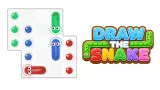
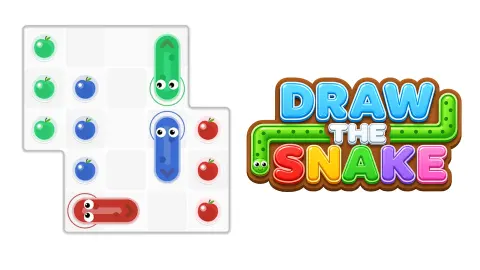
Nothing on this board moves until you move it. A five-by-five checkerboard of cream and beige squares sits in the middle of the screen with wide empty margins around it. Fruit is laid out on little pale plates, and two short snakes with cartoon eyes at the head end sit among them doing nothing whatsoever. There is no clock anywhere. Above the board a card says, in plain words, Drag a snake and eat the fruit.
What a bite does is worth understanding before you start, because it is a straight exchange. One piece of fruit buys exactly one square of snake, added at the head, and nothing in this game ever gives a square back.
We checked that against the board rather than taking anyone's word for it. Our second run at level 1 opened with ten pieces of fruit. Six were gone by the end of the session, and the snakes had grown by six squares between them. The sums matched at every step.
The game is credited to Drivix Games. It has been available since June 2026. We spent ten minutes on it across two attempts at level 1 and cleared neither, which is an honest way of saying this is a puzzle and we have not solved it yet.
Level 1 is not the same board twice
We opened level 1 twice in one sitting and got two different puzzles under the same heading.
The first had an orange snake upright in the bottom-left corner and a purple one in the middle, with nine pieces of fruit round them on their plates — purple apples and oranges.
The second had a blue snake lying flat near the top and a pink one standing beside it, with ten pieces of fruit this time, pink apples and blue ones. Different colours, different count, different squares.
That matters more than it sounds. There is nothing to memorise and no walkthrough worth reading, because the board you open will not be the one anyone else is describing. It also makes each attempt partly luck: a snake lying flat against the top edge has a different problem from one standing in a corner.
Between the two, the game plays its one piece of showmanship: a wipe of thick diagonal bars in green, blue, yellow and red sweeps over everything, the same motif that wallpapers the title screen in pale ghost snakes.
Fifty years of snake, with the running taken out
The whole genre starts with a two-player arcade cabinet from November 1976 called Blockade, made by Gremlin Industries and designed by Lane Hauck. Players each steered an arrow that turned only at right angles and left a solid line behind it. The lines never faded, and you lost by running into one — your opponent's, the wall, or your own. The same idea is why the light cycles in Tron look the way they do.
Two decades later Taneli Armanto adapted the shape for the Nokia 6110, and that 1997 version is the one most people mean when they say snake. He made it single-player and changed the trail: the tail follows the head around the screen and only gets longer when you eat. It stopped being a wall you leave behind and became a length you carry.
Draw The Snake sits on the Nokia side of that split, with the clock torn out. The body is a length, not a trail: move a snake without feeding it and it simply arrives somewhere else, leaving nothing on the squares it crossed. We watched one cross most of the board in a single drag and leave it as clean as it found it. What a snake cannot do is get shorter.
Take out the forward movement and you change what kind of game it is. In the phone version the tail is a problem you outrun; you are always half a second ahead of your own mistake. Here nothing runs. Every square you have earned is a square you must now park somewhere on a board of twenty-five, so the level you have nearly finished is the level with almost nowhere left to stand.
The exchange is one fruit for one square, and it never runs backwards
By the end of our session the blue snake had eaten five times and stood seven squares long, bent into a long J down one column and hooked round the bottom-left corner. The pink one had eaten once. Every step there had balanced: a fruit vanished, a square appeared at a head, and the snake kept everything it already had.
Then it stopped. The survivors sat round the top row and the right-hand edge, the J lay across the middle, and the rest of our time went on drags that parked the snake somewhere just as unhelpful. There is a reset arrow for that feeling, although we never pressed it, so whether it undoes one move or wipes the board is something we cannot tell you.
Two padlocks and a coin counter that never moved
The most useful thing the game says about its own size sits under the board the whole time, and it says it without words. Two round buttons, each wearing a padlock: one reads Lvl. 8, the other Lvl. 16.
That is a promise of at least sixteen levels and of something held back until you reach them. It does not say what.
The coin pill in the top-right corner stayed at zero throughout, on the title screen and in both attempts. With the padlocks it suggests the usual arrangement — finish levels, earn coins, spend them on whatever the locks are hiding — but that is a guess, and we would rather label it as one.
More puzzles you draw rather than play
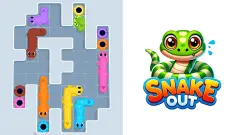
The same studio has the version with a stopwatch bolted on: Snake Out also asks you to drag snakes, but each one has to reach a hole of its own colour before a clock runs out, which is the opposite bargain to the one here. The Fill is the closest relative in spirit — a single line dragged through every grey square, each visited exactly once, with no timer and no lives. Connect Line swaps dragging for rotation, turning each piece a quarter at a time until two ends meet. Draw One Line Bridge Puzzle comes from outside the studio with the same demand: one unbroken route, worked out before you commit. More in puzzle games.
Screenshots
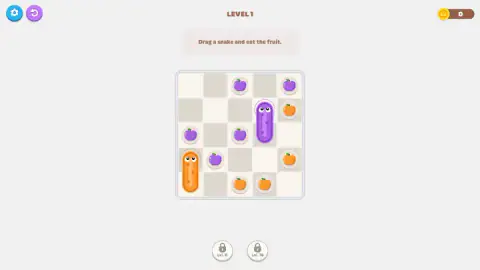
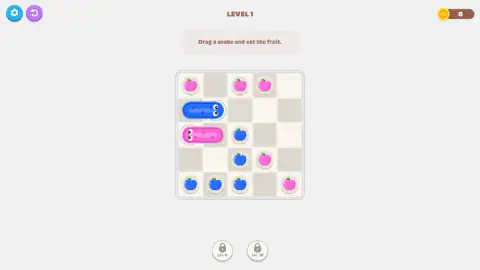
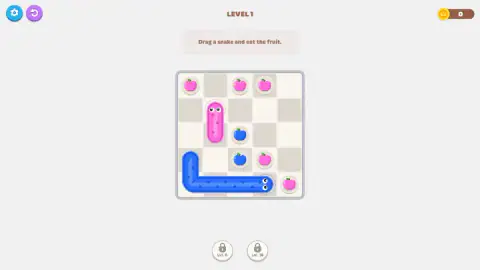
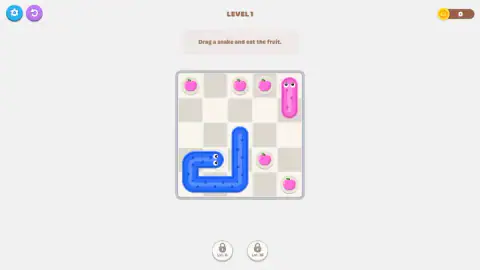
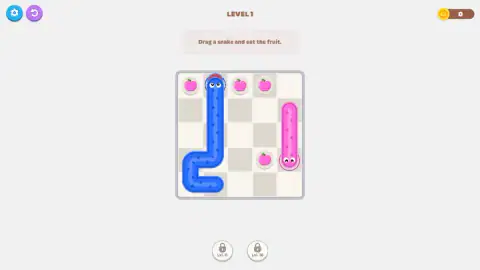
Taken by opening the game ourselves and letting it run — not supplied by the publisher, and not the same picture every other site shows.
How to play Draw The Snake
- Press the green LEVEL 1 button. It is the only thing on the title screen besides the logo and a settings gear, and there is no level map. A curtain of fat diagonal stripes sweeps across the screen, and the board is waiting behind it.
- Drag. Do not click, and do not touch the keyboard. Put the pointer on a snake and pull it the way you want its head to travel. We pressed all four arrow keys, several times each, and clicked on snakes, fruit and empty squares. Not one square moved.
- Pull from whichever end you want to lead with. The eyes mark the head, but they are not nailed to one end of the body. We watched the same seven-square snake wearing its eyes at the top of its column and then, with no fruit eaten in between, at the far end of its tail.
- Finish the drag on a piece of fruit if you want to grow. A drag that stops short is not wasted — the snake still arrives somewhere new — but it leaves you no longer than you were.
- If you seal yourself in, the purple circular arrow at the top left is the way out. It appears the moment a level opens, next to the gear; the title screen does not have it.
What ten minutes with it taught us:
- Count the fruit before you drag anything. Our board held ten pieces on twenty-five squares, and the snakes stood on four more. Eat the lot and over half the board is snake, so the room to manoeuvre is at its worst exactly when you are closest to finishing.
- The last fruit is the hard one, not the first. Four pieces were still out there when our session ran out, and they had been sitting there for its final two minutes. Every bite before that had quietly shortened the list of routes still open.
- Both snakes are yours. The second is not scenery and not something in your way. Ours crossed most of the board without eating a thing, then took a fruit in the bottom corner and grew just as the first one had.
- Nothing is on a timer, so there is no cost to staring. Reading the whole board before the first drag is free, and on a game this small that is most of the skill.
- The coin counter did not move once. It read zero before we started and zero when we stopped, so fruit is not what pays.
Controls
| Drag with the mouse | The only control that did anything. Put the pointer on a snake and pull it towards the fruit you want its head to reach |
|---|---|
| Drag from either end | The eyes mark the head, but they are not fixed to one end. Pull the blunt end and the eyes move there instead |
| Green LEVEL 1 button | Starts the level. It is the only button on the title screen, and no other level is offered |
| Purple circular arrow (top left, in-level) | The reset sign. It is not on the title screen and appears as soon as a level is open, beside the gear |
| Gear (top left) | Settings. It is the one button that is on screen from the first second |
| Arrow keys | Nothing. We pressed all four, several times, and the board did not move a square |
| A plain click | Also nothing. Clicking a snake, a fruit or an empty square left everything where it was |
Features
- A five-by-five checkerboard of cream and beige squares, square and centred, with the whole level visible at once
- Level 1 is dealt differently each time you open it — we got an orange and a purple snake among nine fruits, then a blue and a pink one among ten
- Both snakes are yours to drag, and both of them eat; neither is an obstacle
- Each snake starts two squares long with a pair of cartoon eyes at the head end, and either end can be made the head
- Eating adds exactly one square at the head and nothing ever takes a square back, but a snake that eats nothing still moves and leaves no trail
- No clock, no lives and no score during a level: nothing on the board moves until you drag something
- Two round padlocked buttons under the board, labelled Lvl. 8 and Lvl. 16, so there are at least sixteen levels
Game details
- Developer
- Drivix Games
- Release date
- June 2026
- Last updated
- June 22, 2026
- Added here
- May 2026
- Technology
- HTML5 (2D)
- Platforms
- Browser (desktop), Browser (mobile & tablet, touch)
- Saved progress
- Saving, when available, is managed by this game. Mava cannot confirm your level.
FAQ
How do you play Draw The Snake?
You drag a snake across a five-by-five board so that its head finishes on a piece of fruit. The snake eats it and grows one square longer at the head. The card above the board says it in four words: drag a snake and eat the fruit. Arrow keys and plain clicks do nothing at all.
Is Draw The Snake the same as the old Nokia snake game?
No, and the difference is the whole point. In the phone game the line slides forward on its own, so it is a test of reflexes. Here nothing moves until you move it and there is no clock, which makes it a puzzle you think through before you touch anything. The eating and the growing are the same idea; the hurry is gone.
Does the snake leave a trail behind it?
No, and this is the thing we got wrong on a shorter session and corrected on a longer one. Drag a snake to an empty square and it simply arrives there, with nothing left on the squares it crossed. What it cannot do is get shorter: the length it has earned by eating stays with it for the rest of the level.
Is level 1 the same board every time in Draw The Snake?
No. We opened level 1 twice in one sitting and got two different puzzles under the same heading — first an orange snake and a purple one among nine pieces of fruit, then a blue one and a pink one among ten, in different squares. There is no layout to memorise and no walkthrough that would help you.
What is the second snake in Draw The Snake for?
It is yours as well. Both snakes answer to the same drag, both can cross the board, and both eat: ours spent most of the session moving without feeding, then took a fruit in the bottom corner and grew a square like the first one. Having two of them is the puzzle, because each one you lengthen is more board the other has to work around.
How many levels does Draw The Snake have?
At least sixteen. Two round buttons sit under the board with padlocks on them, one labelled Lvl. 8 and the other Lvl. 16, which is the game telling you both that those levels exist and that it is holding something back until you reach them. It does not say what, and it does not say where the levels stop.
What are the coins in the corner of Draw The Snake for?
We cannot tell you. A coin counter sits in the top-right corner and it read zero on the title screen and zero in the last frame of our session, so coins are not handed out for eating fruit. They most likely come from finishing a level, which we did not manage.
Who made Draw The Snake and can you play it on a phone?
It is credited to Drivix Games. It has been available since June 2026. It is listed for desktop, mobile and tablet. We played it on a desktop with a mouse, so we can describe the dragging but not how it answers to a thumb.