





About Paint Sponges Puzzle
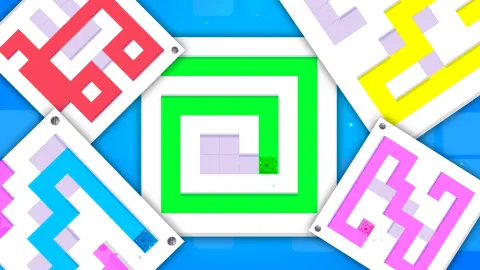
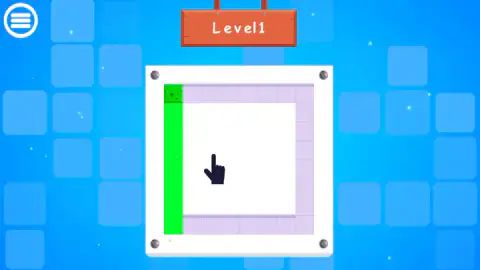
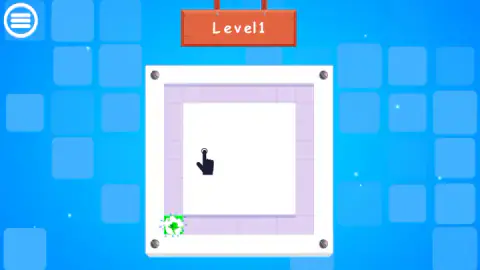
Level 1 of Paint Sponges Puzzle is a picture frame. The board is a white panel with a screw at each corner, holding a grid eight squares across — except that only the outside ring of that grid counts. Pale lilac tiles run round the edge, the middle is blank white and nothing you do there registers, and a small green sponge sits in the bottom-left corner. Tiles turn green behind it as it goes.
So the level is one lap. That ought to be ten seconds of work, and the reason it is not is the way the sponge travels. It does not step square by square. Drag it upwards and it goes all the way up: one pull took ours from the bottom-left corner to the top-left one and left the whole left side solid green behind it. You are not drawing a line so much as sliding a puck, and the shape of the track decides where it stops.
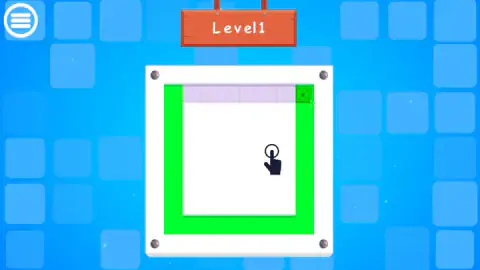
That rule is the entire game. Four drags in the same rotation — up, across, down, back — close the frame. Four drags in the wrong order leave you parked in a corner you have already painted, facing a side you cannot reach from there.
CrazyTea built it. This one was published in January 2025.
We played it on a desktop in late October: four minutes, 28 drags, all of them on the first level, and we did not finish it. That is worth saying out loud, because the reason we failed is the most useful thing on this page.
The pointing hand sits on the one place you cannot paint
The moment level 1 opens, a black hand with its index finger raised appears in the dead centre of the board. It is the standard tutorial cursor, the "do something here" icon that mobile puzzle games have used for a decade, and here it is in the wrong place twice over.
First, the centre of this level is the white area inside the frame: the only part of the board that is not a tile. Second, it never moves. It was still floating in exactly the same spot four minutes later, with three sides of the frame painted green around it.
If you are stuck on the first level, that is very likely why. We spent most of our run starting drags near the hand and pulling outwards towards the middle of a side, which is not how you cover a ring — the sponge is at a corner, and a corner is where a drag has to begin. Ignore the hand. Put your pointer on the green blob, pull along the edge, and the frame closes itself in four moves.
A route that paints every square has a name, and it was a Victorian board game first
What this game asks you to do — get one moving piece over every square of a grid — is one of the oldest questions in puzzle mathematics. A route that calls at every point of a shape exactly once is a Hamiltonian path, named after the Irish mathematician William Rowan Hamilton.
Hamilton showed his version at a scientific meeting in Dublin in 1857. It was not a grid but a dodecahedron, the twelve-sided solid, with a peg at every corner standing for a city; you threaded a cord from peg to peg and tried to visit all of them without calling anywhere twice. He sold the rights to Jaques of London, the game maker, who put it on sale as Around the World. It flopped. Barely a handful of copies are known to survive. The name stuck anyway — though Hamilton did not invent the idea, since chess players had been hunting for knight's tours that cover every square of a board for centuries before him.
Two things come out of that history that are directly useful on this board. The first is a trick you can do in your head: colour a grid like a chessboard, and any route between neighbouring squares has to alternate between the two colours. A circuit that returns to where it started therefore needs an even number of squares. The ring on level 1 has 28 of them. Even — so the lap closes, and you end where you began.
The second is why these puzzles get hard so quickly. A loop is the easy case because every square has exactly two neighbours, so once you pick a direction the route writes itself. Add junctions and the choices multiply, and for grid shapes in general, deciding whether a covering route exists at all is a problem that Alon Itai, Christos Papadimitriou and Jayme Szwarcfiter showed in 1982 to be genuinely hard: no clever shortcut is known that beats trying routes out.
One honest caveat, because it changes the puzzle. The strict version of this idea forbids crossing a square twice, and this game does not. We slid back over our own green and nothing objected. What it asks is that every tile is painted at least once — a softer rule, and the reason a mistake here costs moves rather than the level.
What the game says about itself, and what we saw
Its own description calls the sponge "colorful", calls the board a "maze", and says the challenges grow as you advance. On the level we played there is one colour — green on lilac — and no maze worth the word: a ring has no junctions, no dead ends and no wrong turnings, only a wrong direction. Everything about later levels is the game's claim and not ours, because we never left the first one.
Where the provider is exactly right is the short version in its instructions: the sponge moves with a swipe, and the level is over when every square is painted. That is the game, and it is more interesting than the blurb makes it sound, because of the sliding.
It is listed for desktop, mobile and tablet, and a swipe is the control its instructions name, which suggests a phone is what it was designed around. We played with a mouse, so the touch feel is still its word rather than ours.
More grid puzzles worth your time
Color Fall and Happy Jelly are the other two CrazyTea puzzles in our catalogue, both built on the same taste for one clear rule and no instructions. Single Line Drawing Puzzle is the strict version of the idea in the section above: one unbroken stroke, no retracing allowed. Snake Out keeps the sliding and gives you a body that trails behind you, so your own past moves become the obstacle. Connect Line swaps the moving piece for segments you rotate until the whole network joins up. The rest are in puzzle games.
Screenshots
How to play Paint Sponges Puzzle
- Click the middle of the screen to get in. Ours needed two clicks before the board appeared.
- Find the sponge — on level 1 it is the small green blob in the bottom-left corner of the frame, the only thing on the board with sparkles around it.
- Drag it in the direction you want it to travel. It slides until the track ends, painting every tile it crosses.
- Keep turning the same way. On a loop, one rotation covers everything; changing your mind halfway sends you back over green you already own.
- Carry on until there is no lilac left. Covering every square is the whole win condition.
Things we only found out by doing them:
- One drag is one whole run. Think in corners, not in squares, and a level stops looking like a maze and starts looking like a short list of turns.
- The middle is scenery. The white area inside the frame is not made of tiles and cannot be painted. Dragging into it achieves nothing.
- Your own green is not a wall. We slid straight back down a side we had just finished, so a wrong turn is recoverable.
- The keyboard is not the way in. We tried the arrow keys and nothing moved; every move we made came from a drag.
- Nothing is counting. No clock, no move counter, no score — just a wooden sign telling you which level you are on. You can sit and look at the board for as long as you like.
Controls
| Drag with the mouse, or swipe | Move the sponge. It does not step one tile; it slides until the track runs out, painting everything it crosses |
|---|---|
| Click the middle of the screen | Get past the opening screen into the level. Two clicks did it for us |
| Arrow keys | Nothing moved for us when we pressed them. Every move in our run came from a drag |
| The button in the top-left corner | The only control on the playing screen besides the board itself. We left it closed |
Features
- Level 1 is the outer ring of a grid eight squares across: 28 tiles of track around a white middle that is not part of the puzzle
- Every drag sends the sponge to the end of its run, so a move is measured in corners rather than in squares
- Painted tiles stay open: we slid back down a side we had already coloured, so a wrong turn costs moves and nothing else
- One colour on the first level — a green sponge, pale lilac tiles and a solid green trail behind it
- No clock, no move counter and no score anywhere on screen; a wooden sign names the level and that is the whole interface
- The tutorial hand points at the middle of the board, which is the one area that cannot be painted
- Listed for desktop, mobile and tablet, with a swipe as the control its own instructions name
Game details
- Developer
- CrazyTea
- Release date
- January 2025
- Last updated
- October 23, 2026
- Added here
- April 2025
- Technology
- HTML5 (Construct)
- Platforms
- Browser (desktop), Browser (mobile & tablet, touch)
- Classification
- Puzzle
- Saved progress
- Saving, when available, is managed by this game. Mava cannot confirm your level.
FAQ
How do you play Paint Sponges Puzzle?
You move a sponge around a track of squares and every square it crosses turns green. The level is finished when no unpainted square is left. On a desktop you drag the sponge with the mouse; the game's own instructions tell phone players to swipe. There is nothing to dodge and nothing timing you, so the whole puzzle is the order you cover the track in.
How does the sponge move in Paint Sponges Puzzle?
It slides. A drag does not advance it one square — it sends the sponge off in that direction until the track runs out. One upward drag took ours from the bottom-left corner of level 1 all the way to the top-left corner and painted the entire left side on the way. That is why it helps to plan in corners instead of in steps.
Can you go back over squares you have already painted?
Yes. We slid the sponge back down a side we had just painted and nothing stopped it, and the green stayed green. So a wrong turn in this game costs you moves rather than the level, and there is no penalty for retracing your route.
What is level 1 of Paint Sponges Puzzle?
It is a picture frame. The board is a grid eight squares across, but only the outer ring of it is track: 28 pale lilac tiles around a white middle that is not a tile at all. The sponge starts in the bottom-left corner, and four drags in the same rotation — up, across, down, back — would close the frame.
Why is there a hand in the middle of the board?
It is the game's tutorial cursor, and it is the single most misleading thing on the screen. It sits in the dead centre of the board, which on level 1 is the white area inside the frame — the one part you cannot paint. It did not move once in four minutes of play, so treat it as decoration and put your finger on the sponge instead.
Who made Paint Sponges Puzzle?
This one was published in January 2025 and was last updated in August 2026.
Is Paint Sponges Puzzle hard?
The first level is the gentlest shape this kind of puzzle can take — a closed loop, where every square has exactly two neighbours and one lap covers everything. We still spent four minutes on it, because we kept dragging from the middle of the board instead of from the sponge. The game says the challenges grow as you advance; we did not get past the first level, so that part is its word and not ours.
Can you play Paint Sponges Puzzle on a phone?
It is listed for desktop, mobile and tablet, and its own instructions describe the control as a swipe, which suggests touch is what it was built around. We played with a mouse on a desktop and did not test it on a small screen, so we cannot tell you how the sliding feels under a finger.