









About Paint & Roll
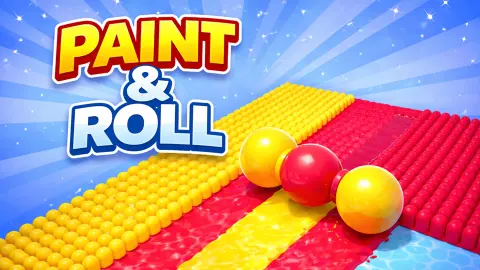
Colouring games normally hand you a brush and a palette and let you tap whichever square takes your fancy. Paint & Roll hands you two rollers that are already turning, on a raft of beads floating in open sea, and the only bead you can colour is the one you are rolling over. There is no brush, no undo and no skip. Everything you want painted, you have to drive across.
The raft is a rectangle of rounded studs packed like eggs in a tray, and nothing holds it up. Water runs right to the edge on all four sides. Put a roller into it and the level ends on the spot — a crying face, the words TRY AGAIN, a purple CONTINUE button — and in our whole session it ended in silence. No warning tone, no thud, nothing. You lose this game with your eyes, not your ears.
The two rollers are joined by a thin line, and they do not take turns. A tap moves your attention from one to the other; the one you left keeps doing whatever you last sent it to do. That single decision is what turns a painting toy into a puzzle. One roller would be a driving game. Two, tied together, mean that everywhere you send one is somewhere the other is not covering.
Paint & Roll comes from John Hany. The platform dates its page to January 2026, with an update that August.
The badge that says "Level 1" is also your progress bar
This is the detail the screenshots give away and nobody mentions, and it changes how you play.
The pill at the top centre of the screen carries the level number, so at a glance it looks like a label. It is not. It is a meter, and it fills from left to right in the exact colour you are currently laying down. On our first attempt it sat empty and dark while the mat was white; a minute later it was a quarter full of fuchsia. On the attempt after that it crept across in orange as the black board went yellow, and by the end it was within a sliver of the right-hand end.
The consequence is that you never have to count beads or squint at the far corner of the raft. The board tells you how much is left in one glance upwards — and more usefully, it tells you whether the patch you are currently grinding away at is actually worth anything. A long careful crawl that barely moves the bar is a sign you are repainting ground you already covered, which is the single easiest mistake to make here, because fresh paint and old paint are the same colour.
A roller is the one painting tool you cannot lift
The reason this works as a puzzle rather than as a toy is that the game has copied the real constraint of the real tool, and copied it honestly.
Anyone who has painted a wall knows a roller is nothing like a brush. You cannot dab with it and you cannot pick out a corner with it. It lays colour in a wide stripe wherever it travels and nowhere else, so decorators plan the journey before they start: the standard move is to roll a rough W across a patch of wall, then fill the gaps in without taking the roller off the surface, and to keep working into the wet edge — the still-damp border of what you just did. Go back over a section that has already dried and the overlap shows as a stripe for the life of the paint job. That is also why a painter cuts in the awkward edges with a brush first, before the roller ever comes out: the roller is the tool that cannot be trusted near a boundary.
Paint & Roll is that problem with the brush taken away. You get the roller and you get the boundary, and the boundary is water. There is no cutting in, no touching up, no second pass that costs you nothing. A path that covers the whole mat exists on every board; a path you have already half-walked may well not. When a level fails here it is almost never because the steering was too twitchy. It is because somewhere a minute earlier the easy ground got painted first and the only beads left were the ones along the edge.
Fall in and the board comes back a different colour
We dropped a roller into the sea on a white mat we had got about two thirds pink. The retry did not hand that board back. It came back black, with orange rollers, laying yellow — and the pillars standing in the water behind it had gone from grey to brown along with it.
That is worth a sentence of warning, because the palettes are not equally kind. Yellow paint on a black mat is about as legible as a board game: the beads you have not reached yet are obvious from across the screen, and our best attempt of the day came on that combination, with only a short line of black left in one corner. White beads on a fuchsia board are much harder work, because the unpainted part and the glare off the water sit at a similar brightness and the gaps stop announcing themselves.
So if a board looks washed out, that is not your eyes. Lean harder on the progress bar at the top, which is the same colour on every palette, and trust it over what you think you can see on the raft.
What four minutes actually got us
Honesty, since this is the part most pages skip. We played a full session and the badge at the top never once read anything other than Level 1.
The gentleness is a trap. Nothing chases you, nothing times you, the rollers move at a sensible pace, and the whole thing looks like something you would put on to calm down. Then you notice you have painted a neat block in the middle of a raft and both of your rollers are standing in the one place they are no use. Above the mat there is a huddle of dark pillars with a small red block floating in front of them, visible in every shot we kept and never once within reach — whatever is up there, we did not earn it.
That is the recommendation and the caveat in one. If you want a game with a clear, fair, visible goal and a failure state that is entirely your own fault, this one delivers on all three. If you want to feel competent in the first five minutes, bring patience.
More games by John Hany
The same developer's Picture Shift works the opposite way round — a picture hidden in a pile of blocks that you sort out instead of cover up — and Liquid Sort keeps the colours but moves them between tubes rather than across a floor. Matching Tiles 3D is the calmest of the set, Bouncy Ball the twitchiest, and Draw & Save is the one where a line you draw has to be right first time, which is a feeling this game will have taught you by then. The rest are in arcade games.
Screenshots
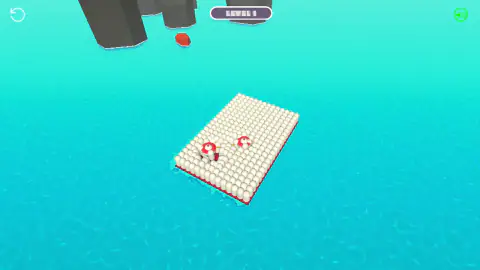
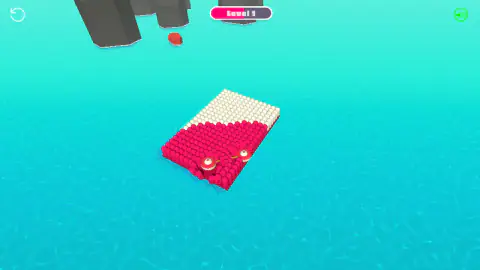
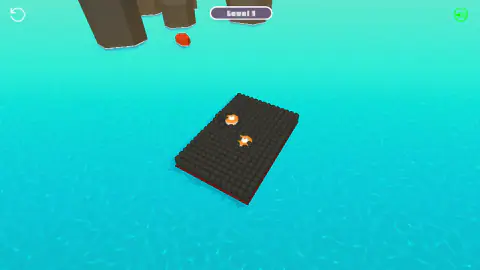
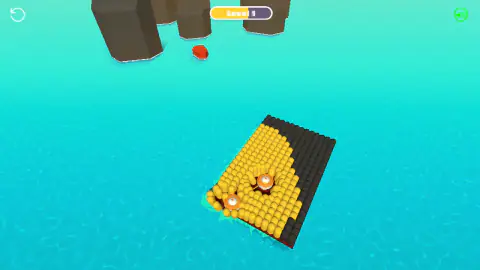
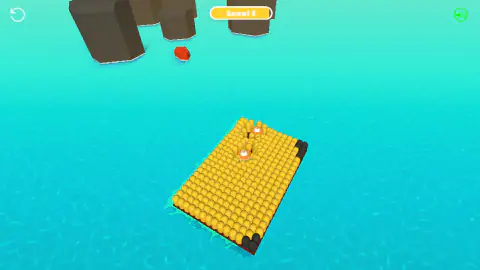
How to play Paint & Roll
- Clear the opening card. It shows two little diagrams, one marked right and one crossed out, with a START button underneath. That card is the only instruction the game ever gives you.
- Learn the three things at the top. A circular arrow on the left restarts the level. A green speaker on the right mutes it. The badge in the middle, the one with the level number on it, is the piece that matters — see below.
- Tap to change roller. Your tap does not paint anything. It decides which of the two rollers you are responsible for at that moment, which means it also decides which one you have stopped watching.
- Do the water's edge first. The outside ring of beads is the only part of the board where a mistake is fatal. The middle will still be there in thirty seconds; a roller halfway over the lip will not.
- Restart without guilt. The circular arrow is free and instant. A board you have painted into an awkward shape costs more to rescue than to begin again.
What our session taught us:
- The paint is the colour of your rollers. Look at the rollers and you know what the finished board is supposed to look like, which matters more than it sounds, because the beads you have missed are only as visible as the contrast allows.
- Nothing is in a hurry but you. We found no clock anywhere on screen and nothing counting down while we stood still and thought. The pressure in this game is entirely self-inflicted.
- There is no pause and no confirmation step. The rollers keep turning while you decide.
- A grey strip reading "Click to keep playing" turns up now and then across the top of the picture. One click puts you straight back; nothing is lost.
- We could not make the keyboard do anything. The arrow keys got long presses out of us and gave nothing back.
Controls
| Tap / click | Switches which of the two linked rollers you are steering. The other one does not stop; it keeps doing whatever you last sent it to do |
|---|---|
| Restart (circular arrow, top left) | Wipes the paint and puts both rollers back at the start of the level. It costs nothing and it is faster than painting your way out of trouble |
| Speaker (green, top right) | Mutes the game. It is the only setting on screen |
| Arrow keys | We leaned on them for long stretches and got nothing we could see or hear. This is a game you play with a pointer or a thumb; we cannot swear the keys are dead, only that nothing answered |
| Pause | None we found. There is also no clock, so the rollers are the only thing in a hurry |
Features
- A floating mat of rounded beads that you repaint one roller-width at a time, with no brush, no undo and no way to skip a patch
- Two rollers joined by a line: a tap moves your attention between them, and the one you are not watching is the one that falls in
- The badge at the top that reads Level 1 doubles as the progress bar, filling left to right in the colour you are laying
- Open water on all four sides and no railing: one roller in the sea ends the level instantly, with no warning sound at all
- A new palette on the retry — our white board and pink paint came back as a black board and yellow paint, which is far easier to read
- Free in the browser on desktop, phone and tablet, with nothing to install
- Made by John Hany
Game details
- Developer
- John Hany
- Release date
- January 2026
- Last updated
- August 10, 2026
- Added here
- November 2025
- Technology
- HTML5 (3D)
- Platforms
- Browser (desktop), Browser (mobile & tablet, touch)
- Saved progress
- Saving, when available, is managed by this game. Mava cannot confirm your level.
FAQ
What is Paint & Roll?
It is a free browser game about covering a surface with paint. You steer two linked paint rollers around a rectangular mat of beads that floats on open water, and the level is finished when every bead has changed colour. It is single-player, works on desktop and on a phone, and needs no download or account.
How do you play Paint & Roll?
You tap or click to switch which of the two rollers you are steering, and you cover ground by rolling over it. There is no brush, no undo and no way to colour a bead from a distance: anything you want painted, a roller has to physically cross. The rollers are joined, so sending one somewhere always leaves the other unattended.
How do you win a level in Paint & Roll?
By repainting every bead on the mat without dropping a roller into the water. You can check how close you are without counting anything: the badge at the top of the screen that shows the level number fills up from left to right in the colour you are laying, so a glance upwards tells you how much of the board is still bare.
What happens if a roller falls in the water?
The level ends immediately. A crying face comes up with the words TRY AGAIN and a purple CONTINUE button under it, and the paint you had already laid does not carry over. In our session it happened without any sound at all, which is worth knowing: nothing warns you that you are about to go over the edge.
Does Paint & Roll work on a phone?
Yes. The whole game is one gesture — a tap — so a touchscreen loses nothing, and it is listed for desktop, mobile and tablet. On a computer a mouse click does the same job. We could not get the arrow keys to do anything during a run.
Why does the colour change between attempts?
It changed on us mid-session. Our first attempts were a white mat being turned fuchsia by red rollers; after a fall, the board came back black with orange rollers laying yellow. The paint always matches the colour of your rollers, and some pairings are far kinder than others, because unpainted beads on a dark board stand out and white beads on a pink one barely do.
Who made Paint & Roll?
The game was published in January 2026 with an update that August. We found no site of the studio's own to check those dates against.
Is Paint & Roll hard?
Harder than it looks from a screenshot. We played a full session and the badge never read anything but Level 1. The difficulty is not in the steering, which is gentle; it is that the board has no edges to lean on, the two rollers are never in the same place, and the bit you have left over is almost always the bit along the water.