




About Match Story: Weapons
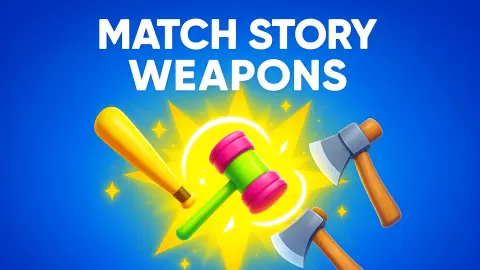
Most match-3 games hand you a grid. Rows, columns, a wall of coloured shapes, and the promise that lining three of them up will make something burst. Match Story: Weapons has no grid at all. It has a loose cluster of axes and mallets turning slowly in mid-air over flat blue, and a row of seven empty slots along the bottom of the screen.
Those slots are the game. You take a weapon out of the pile and it goes into the row, and the game's own instructions say that three identical weapons meeting there clear and vanish. The row holds seven, and everything that makes this difficult follows from that number: fill it with singles and there is nowhere left to put the weapon you actually needed.
A clock counts down from one minute in the top centre, with a thin green bar underneath that drains as the seconds go. In the opposite corner, under a banner reading Level 1, sit two small cards: an axe with a 3 beneath it, a pink mallet with a 3 beneath that. That is the tally of what the board still holds. The honest news is that across several attempts we never got either number below 2.
Grus Games made it, a studio whose catalogue is this game and one other, Match Story: Animals, which is the same design with wildlife in place of weapons. It has been available since September 2025.
Seven slots is the whole difficulty
The clock gets your attention. The row deserves it more.
Think of the seven slots as a budget rather than a container. Every weapon you click spends one of them, and the only way to get any back is to complete a set of three, which returns three at once. A set you are two thirds of the way through is not progress sitting safely in the bank: it is two slots you no longer have.
That turns the obvious strategy inside out. Clicking whatever is nearest feels productive and is the fastest route to a jammed row, because a pile with several kinds of weapon in it will hand you singles far quicker than it hands you thirds. The cheaper habit is to pick a kind, find all three of them in the heap first, and only then start clicking. The cards in the corner are there to help you do exactly that, which is why they tell you how many of each remain instead of how many you have collected.
We should be straight about the limit of our own experience here: we never filled the row, so we cannot tell you what the game does when the seventh slot goes. We can tell you what the number means while you are playing, and that it is the number worth watching.
Why a pile is harder to read than a grid of gems
There is a reason this feels harder than a board of coloured jewels, and it is not the countdown.
In 1980 two psychologists, Anne Treisman and Garry Gelade, published work on how people hunt for things in a cluttered scene. When the thing you want differs from everything around it by a single obvious feature — the one red dot among blue dots — it jumps out at you, and you find it about as fast among thirty distractions as among six. When it is defined by a combination instead — the red dot among red squares and blue dots — that effect disappears, and you end up checking items more or less one at a time, so every extra object on the screen costs you a little more time. Researchers have argued ever since about exactly what the brain is doing in the second case, but nobody disputes that it is slower.
A grid of gems is the first kind of search. Colour alone tells you everything, which is why you can scan one almost without thinking. A floating heap of weapons is the second kind, several times over. Axes and mallets are both handle-with-a-lump-on-top shapes. The mallets and the dynamite share the same pink. The models turn as they drift, so the same axe shows you a broad blade one moment and a thin brown line the next, and anything at the back is half-hidden behind what is in front of it. Nothing pops out. You are scanning item by item against a sixty-second clock.
That is also the honest answer to anyone who wonders why a weapons game is filed under brain training. The weapons are set dressing. The work is visual search, and the game makes it hard in the way the research says it gets hard: by refusing to let any single feature do the identifying for you.
What we did not get to see
One level that we never finished is a thin slice of a game, so here is the ledger. We never watched three weapons meet in the row, which means we have not seen the clear animation, heard what it sounds like, or found out whether it adds time. We never reached a level-complete screen, so we cannot tell you how levels are scored or whether stars are involved. We do not know the total number of levels, only that the ladder runs past the four tiles the menu shows at once.
We also cannot tell you what the blue lightning bolt on the menu is for. It sat at 5 beside a coin counter at 0 the whole time, and two of the three tabs along the bottom of the menu were padlocked, so whatever economy this game has stayed shut to us. Our attempts were short enough that we cannot say anything useful about how often ad breaks come either. And we played on a desktop with a mouse: the touch controls on a phone, where this game clearly wants to be, are untested by us.
Where to go next
If you want the grid back, Vegetables Match 3 and Jewel Monsters are the straightforward version of this idea, where colour does the identifying and your eyes can move at full speed. Mahjong 3 is the closer cousin to what Match Story: Weapons is really asking of you, since it also buries the piece you want underneath the ones you do not. And Chicken Merge takes the other road out of the grid, combining pieces into better pieces instead of clearing them away. The rest live in strategy games.
Screenshots
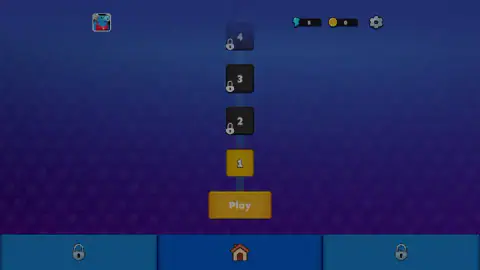
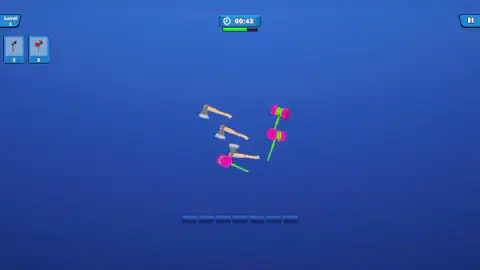
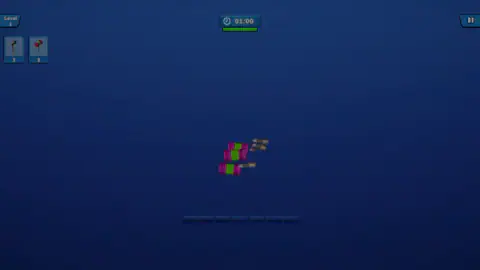
Taken by opening the game ourselves and letting it run — not supplied by the publisher, and not the same picture every other site shows.
How to play Match Story: Weapons
- Press Play under the ladder of levels. The levels climb the screen in a vertical line, and only the first was open for us; the three above it carried padlocks.
- Read the two cards under the Level banner before you touch anything. They name the kinds of weapon this board is made of and how many of each are still loose.
- Click, or tap, a weapon in the pile. It leaves the cluster and travels down to the row of slots.
- Gather three of the same kind. They clear out of the row together, which is how you get the space back.
- Empty the board before the clock reaches zero. Miss, and a Failed card drops over everything with a Retry button that puts you at the top of a fresh minute.
Things we only found out by sitting in front of it:
- Tap, do not drag. This is the tip that would have saved our session. We pulled weapons toward the row perhaps twenty times, from several angles and distances, and nothing moved; both counters sat at 3 the whole while. The first time we simply clicked a weapon instead, the number under the axe dropped to 2. The pile behaves like a set of buttons, not like objects you can pick up and carry.
- Look before you click. The weapons overlap and rotate as they drift, so the axe you are reaching for is often the handle of the one behind it. A second of looking is cheaper than a slot spent on the wrong piece.
- The pile changes between attempts. One try gave us grey axes and pink mallets. The next put golden pistols in the mix, and later ones threw in a saw and a stick of dynamite. Whatever you worked out about the last board does not carry over to this one.
- The green bar is the clock again, not your progress. It sits directly under the timer and empties in step with it. We read it as a completion meter at first, which is an easy and expensive mistake.
- It is a portrait game in a wide window. On a desktop the action lives in a narrow column down the middle with empty blue either side. The game is listed for phones in portrait, where that column is the entire screen.
Controls
| Click or tap a weapon in the pile | It leaves the cluster and travels to the row of slots at the bottom. This is the whole move, and dragging it there does not work |
|---|---|
| Click the numbered tile on the ladder, then Play | Opens that level, if it is not one of the padlocked ones |
| Pause button, top right | Holds the level and the countdown with it |
| Retry, on the Failed card | Restarts the same level with a fresh minute on the clock |
| Gear, top right of the menu | Opens the settings |
Features
- A row of seven slots along the bottom of the screen is the only place a weapon can go
- Each attempt at level 1 starts the clock at one minute, with a green bar under it that drains as you play
- Two cards under the Level banner tally what the board still holds, and both read 3 when the level opens
- The weapons are 3D models that drift and turn: grey axes on wooden handles, pink mallets on green shafts, golden pistols
- Levels climb a vertical ladder, and only the first was open for us, with the next three padlocked
- The menu keeps two counters, a blue lightning bolt at 5 and a gold coin at 0, and two of its three bottom tabs are locked
- Run out of time and a Failed card drops over the board with a Retry button that starts the minute again
Game details
- Developer
- Grus Games
- Release date
- September 2025
- Last updated
- August 10, 2026
- Added here
- July 2025
- Technology
- HTML5 (3D)
- Platforms
- Browser (desktop), Browser (mobile & tablet, touch)
- Classification
- Puzzle
- Saved progress
- Saving, when available, is managed by this game. Mava cannot confirm your level.
FAQ
How do you play Match Story: Weapons?
You click weapons out of a floating pile and they travel to a row of slots along the bottom of the screen. The game's instructions say that three identical weapons meeting in that row clear and disappear, and the level is done when the board is empty. A clock counts down from one minute while you work, and two cards in the top-left corner tally what is still out there.
Why does nothing happen when I drag a weapon in Match Story: Weapons?
Because it is not a drag-and-drop game, which took us most of a session to work out. We pulled weapons toward the row from every angle and the counters never moved. A single plain click on a weapon sent one on its way immediately. Treat the pile as a set of buttons rather than objects you can pick up.
How long do you get for a level in Match Story: Weapons?
One minute. The clock sits in the top centre with a thin green bar beneath it, and the bar empties at the same rate as the numbers, so it is a second view of the time rather than a progress meter. When it reaches zero a Failed card drops over the board with a Retry button, and Retry gives you the full minute again.
How many slots are in the row at the bottom?
Seven. That number is the real difficulty of the game. Every weapon you click takes one of the seven until a third of its kind arrives to clear the set, so a minute spent clicking whatever is nearest fills the row with singles and leaves you no room for the weapon you actually need.
How many levels does Match Story: Weapons have?
We cannot give you a total. The levels climb a vertical ladder on the menu, four of them visible at once, and only the first was open to us, with padlocks on the rest. The game's own description says later levels add more kinds of weapon and busier arrangements, which fits a ladder that keeps going past what we could see.
Is Match Story: Weapons hard?
Harder than its subject suggests. We spent four minutes on level 1 across several attempts and failed every one of them, mostly because we were using the wrong input, but also because a heap of overlapping 3D objects is genuinely slow to read. Once you know to click rather than drag, the clock is the opponent.
Can you play Match Story: Weapons on a phone?
It is listed for PC, Android and iOS in portrait, so a phone held upright should suit it better than a desktop does. On a wide monitor the action sits in a narrow column down the middle with empty blue either side. We played it on a desktop with a mouse and have not tested the touch controls ourselves.
Who made Match Story: Weapons?
Grus Games. The game is credited to the studio and also made Match Story: Animals, the same design with wildlife in place of weapons. The game has been available since September 2025.