








About Tile Farm Story
Most tile-matching games are only the board. You clear a level, the next one loads, and nothing in between asks you to care. Tile Farm Story puts a run-down farmhouse between the levels, and a family mystery behind the farmhouse.
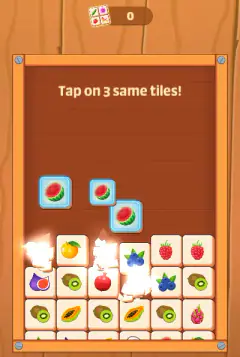
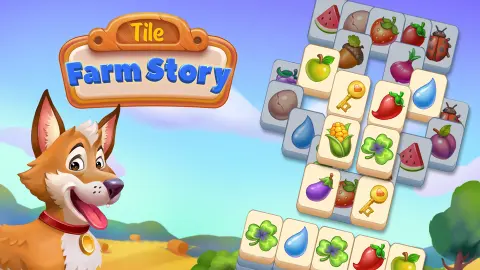
The puzzle itself is the triple-tile kind. Fruit and vegetable tiles sit on a board floating over a green field with a wooden fence and purple lilacs behind it. You tap them into a tray at the bottom, and any three that match vanish. The tray has seven slots, and if it fills with tiles that cannot be paired, the attempt is over.
What all that is in aid of, the game states plainly. Its own How to play screen draws a circle of three steps and labels them "Complete Levels!", "Earn Stars" and "Improve your Farm!". Everything below is that loop, seen from the inside.
The game's listing credits Rainbow Games, dates the game to December 2024. The game itself names no studio.
We played it twice. The second visit, on 22 October 2026, ran ten minutes at a desktop with a mouse, and this page is built on it: two levels cleared, the first repair paid for, the first animal offered and the first helper unlocked.
Two levels, 27 coins and a house that changes colour
The farm screen keeps three counters along the top: coins, hearts, stars.
Clear a board and a banner drops in with the word "Excellent!" over a gold star, the coins you just earned, and a green Next button. Our first level paid twelve. Our second paid fifteen, and the purse on the farm screen then read exactly 27 — the two payouts, nothing added and nothing skimmed.
The star is the part that does the work. After the first level Olivia pointed at the house and said, "Excellent! We can now repair the house. To do this, press the Hammer icon." A sign reading "Renovate the House" appeared above the porch, priced at one star, which was precisely what we had.
Pay it and the change is not a tick on a list. The house we had been looking at was a pale blue-grey wreck with a sagging porch. The house that came back was painted red with a fresh grey roof and white railings, and the row of buttons along the bottom of the screen, greyed out until then, lit up in colour. One level of tile-matching bought that.
After the second level the next job was already waiting: a paw print glowing on the lawn and Britney saying, "We can now buy a dog!"
The chest in the corner counts to twenty
High in the right-hand corner of the farm there is a treasure chest with a padlock on it, and a little number plate underneath.
After our first level it read 1/20. After our second it read 2/20. That is the clearest piece of pacing information the game gives you, and it is easy to miss: twenty levels is what the chest waits for, so twenty levels is roughly the chapter you are in.
The hearts sit between coins and stars and never moved for us, holding at five with the word "Max" beside them. The pause menu says one of them is what quitting a level costs. Whether losing a board costs one as well, we cannot tell you, because we never lost one.
Grandpa Jacob's letter: the story behind the board
The game opens on a dialogue rather than a menu. The two characters are Olivia, who wears glasses and a pink scarf, and Britney, red-haired and in dungarees. The listing calls them the Stone sisters. Britney hosts the tutorial; Olivia takes over on the farm.
After the first repair, a letter turns up in the big blue mailbox at the foot of the screen. It is signed only "J.S." and promises help finding a treasure to whoever is not afraid of a challenge and will "breathe life into this little corner of serenity".
Britney's reaction is the honest one: "Secrets and mysteries? Finding answers? What treasure?" Olivia's is quieter. She recognises the handwriting as her grandfather Jacob's and remembers that he loved riddles like this. He died a year ago. Her conclusion is that he planned the whole thing.
It is gentle material. Nobody is in danger, the jokes are sisterly, and the mystery is a treasure hunt left behind by a grandfather who liked puzzles. If you would rather not have it, every conversation screen has a fast-forward button in the top-right corner.
Not quite mahjong: pairs, triples and the seven-slot tray
The tiles look like mahjong tiles, with thick cream edges and a picture on each face. The rules come from somewhere else.
Mahjong solitaire, the version most people know from computers, was popularised by Shanghai, an Activision game from 1986. You remove tiles from a stacked layout in matching pairs, and the only way to lose is to run out of free pairs.
Triple-tile games such as this one change two things. You match in threes, and every tile you pick goes into a shared tray first. That tray is the whole difficulty. A pair game never punishes a pick; a tray game punishes every pick that does not lead to a trio, because it occupies a slot until its partners arrive.
What the second level adds on top is the one thing the genres share: stacking. Once tiles lie over each other, the question stops being which three match and becomes which three you can actually reach, and a trio you can see but not touch is worth nothing until you dig it out.
Why a farm sits between the levels
Pairing puzzles with a house to restore is a design made famous on phones by Playrix, with Gardenscapes and Homescapes. There too, each level pays a star, and stars buy one renovation task at a time.
The point is pacing. A string of tile boards blurs together; a half-repaired house gives each board a reason to exist. Tile Farm Story runs that structure with a grandfather's riddle in place of a butler, and it is strict about the exchange rate: one level, one star, one job.
Who it is for, and what we still have not seen
Players who like calm puzzles with no clock. We saw no timer on any board we played, and the opening level is short enough to learn the rules in under a minute. It suits children who can read short speech bubbles, and adults who want a slow puzzle with a light story attached. Nothing in it is violent or frightening; the darkest note is that the grandfather has died.
Between them our two sessions covered the first handful of levels. We never lost a board, never spent a heart, never used a booster other than the free undo, never bought the dog, and never reached the other locations the listing describes. Treat anything about the later game as unconfirmed.
More triple-tile puzzles
Tile Valley uses the same seven-slot tray with food tiles and stacked layers. Master of 3 Tiles adds three boosters to help when the tray gets tight, and Happy Zoo: Mahjong Triple Match swaps the fruit for animals. If you want the older rules instead, Tile Pair Jam: Mahjong Master clears tiles in pairs with no tray at all. For more games about spotting and matching, see the puzzle games.
Screenshots
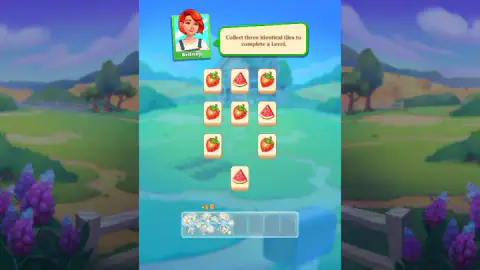
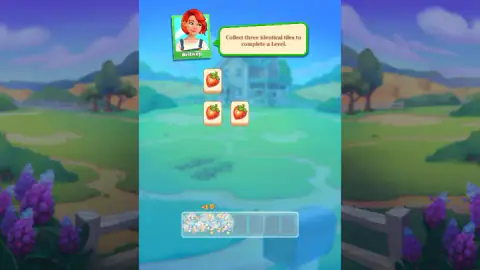
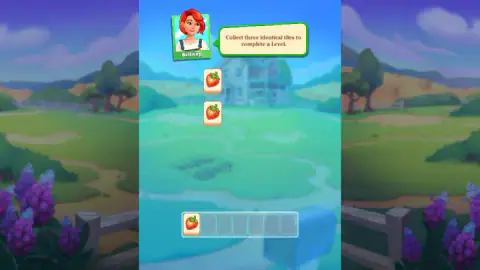
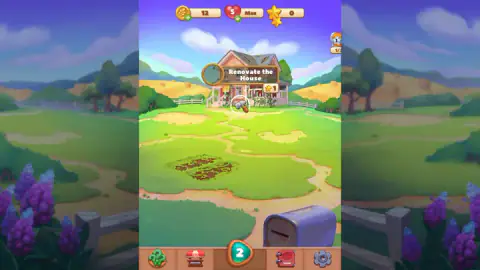
Taken by opening the game ourselves and letting it run — not supplied by the publisher, and not the same picture every other site shows.
How to play Tile Farm Story
- Tap or click any tile on the board. It slides into the first free slot of the tray.
- Collect three of the same fruit in the tray. They clear on their own and free up the slots.
- Empty the board to win the level. A full tray with no trio in it ends the attempt.
- Back on the farm, press the glowing circle over the house to spend your star on the job inside it.
- Read or skip the conversation that follows, then press the numbered button in the middle of the bottom bar to start the next level.
What our longer session taught us:
- Count before you tap. The opening board is twelve tiles: four trios and nothing spare. Taking a whole set of three in a row keeps the tray close to empty, and an empty tray is the only safety net you get.
- From the second level, the board has depth. Tiles start lying on top of each other, and anything underneath is drawn greyed out. A grey tile will not go into the tray however often you click it, which cost us a run of wasted taps before we understood why. Clear the lid first.
- The undo arrow never runs out. A few levels in, a green arrow flies into the row of buttons under the tray and Britney says, "Let's use this Booster to see how it works." Its badge is an infinity symbol, not a number. The other four buttons beside it carry a green plus, which is the game telling you that you have none.
- Do not leave through the pause menu. The pause window has switches for Music and Sounds, and one button at the bottom reading "Quit -1" with a heart. That is the only use for hearts we managed to confirm, and it is a bad one.
- Leave the keyboard alone. Arrow keys and Space produced no response in either session. Everything here is one finger or one mouse button.
Controls
| Mouse click or tap on a tile | Moves that tile from the board into the first free slot of the tray |
|---|---|
| Covered tile (shown greyed out) | Cannot be taken until the tile lying on top of it is gone |
| Booster buttons under the tray | Five of them; the undo arrow is unlimited from the moment the game hands it to you |
| Pause button, top right of a level | Music and Sounds switches, and a Quit button that costs one heart |
| Hammer or task circle on the farm | Spends a star on the job shown beside it |
| Continue button and "Tap to Continue" | Moves the story dialogue on one line at a time |
| Fast-forward button (top right of a dialogue) | Skips the rest of the conversation |
| Arrow keys and Space | Tried during both sessions; no response we could hear or see |
Features
- A seven-slot tray under the board where three matching tiles clear themselves
- Stacked boards from the second level on, where a covered tile is greyed out until the one above it goes
- Five helper buttons under the tray; the undo arrow carries an infinity badge, the other four a green plus
- A star for every level won, spent on one renovation job at a time
- A padlocked chest in the corner that moves a notch per level, counting towards twenty
- A running story between two sisters, Olivia and Britney, told in dialogue cards between puzzles
Game details
- Developer
- Partner studio
- Release date
- December 2024
- Added here
- April 2025
- Technology
- HTML5 (2D)
- Platforms
- Browser (desktop)
- Saved progress
- Saving, when available, is managed by this game. Mava cannot confirm your level.
FAQ
How do you play Tile Farm Story?
Click or tap a tile on the board and it drops into the tray at the bottom. When three identical tiles sit in the tray they clear. Empty the board to win the level, and do not let the tray fill up with tiles that cannot pair, because a full tray ends the attempt.
How many slots does the tray have in Tile Farm Story?
Seven. That is enough room for two unfinished pairs and a few strays, but not much more. The safest habit is to pick tiles in threes you can already see, so the tray empties as often as it fills.
What are stars for in Tile Farm Story?
Each level you win pays one star, and renovation jobs on the farm cost stars. Our first level earned a star and the first job, "Renovate the House", cost exactly one; the weather-beaten house was repainted red the moment we paid. Coins are a separate purse that builds up alongside, twelve from our first level and fifteen from the second.
What are the hearts for in Tile Farm Story?
They are the currency for giving up. Open the pause menu during a level and the only button is marked "Quit -1" with a heart beside it, so backing out of a board costs you one. Our counter read five and "Max" for the whole session, because we never quit and never lost a board.
Can you undo a move in Tile Farm Story?
Yes. A few levels in, the game hands you a green undo arrow and says it cancels your last move. It sits first in the row of five helper buttons under the tray and carries an infinity symbol rather than a number, so it does not run out. The other four buttons all showed a green plus instead of a count, meaning we had none of them.
What is the story in Tile Farm Story?
Olivia and Britney arrive at the farm of Olivia's grandfather Jacob, who died a year earlier. A letter signed J.S. promises a treasure to whoever will "breathe life into this little corner of serenity", and Olivia recognises his handwriting. The repairs you buy with stars are how the story moves on.
Is Tile Farm Story mahjong?
It borrows mahjong-style tiles but not the rules. Classic mahjong solitaire removes tiles in pairs straight from the board; here you collect them in threes in a shared tray, and the tray filling up is how you lose.
Who made Tile Farm Story?
The game does not show a studio name on screen. It was published in December 2024.