







About Mahjong Tower: Puzzles
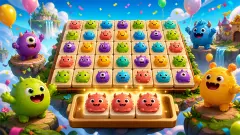
Open almost any browser game with mahjong in its name and the job is the same: a pile of tiles is already sitting there, you find two that match, you take them away, and you keep going until the pile is gone. Mahjong Tower: Puzzles runs the other way round. The board starts nearly empty, and the tiles keep arriving.
They come along a dispenser line, the long wooden capsule above the board. One tile at a time drops out of it and lands in a slot at the bottom left of the screen, right next to the score. That is the current tile, and placing it is your whole turn: drag it onto an empty square and let go. Three matching tiles that touch each other clear away, and the game's own card shows two ways for them to touch, under the headings NEAR and ON TOP.
The board is not the sprawling turtle of mahjong solitaire. It is a tall frame three columns wide, and we never had more than a dozen tiles in it. A thin red line is drawn across the top of that frame. We never pushed a stack up to it, so we cannot tell you what crossing it costs.
The game is credited to faraonovvit. It was published in March 2026, in English and Russian.
We should be plain about how far we got. We played for about four minutes, and a good half of that went on the tutorial, which starts on its own and works through its cards one at a time. Then the main menu appeared with three modes, and we opened the first of them. We did not play Board Clearing or Arcade, and we did not finish a puzzle. This page covers the rules and the feel of the thing, and stops where our session did.
One special tile paid more than everything before it
The clearest number in our session came from the tile we were told to click.
The counter read 130 when a card said "ACTIVATE special TILE!" and a hand pointed at a dark red tile in the middle of the board. Eight tiles were standing. We clicked it, and all eight went at once, each flashing its own value where it had been.
Seven of them ran from 50 up to 110, in steps of ten. The one in the middle, printed in white rather than yellow, was the special tile itself, and it was worth 250.
Those eight add up to 810. The counter spun upwards and settled on 940, which is exactly the 130 we had plus the blast.
That arithmetic is what makes the game worth playing properly. Ordinary clears pay in tens. One special tile, set off while the board is still crowded around it, pays in hundreds, and the tile at the centre of it is worth more than several ordinary clears put together. The temptation is to shift a red tile out of the way; the better instinct is to build around it and wait.
Mahjong is a game of threes. Browser mahjong usually is not
Three different things share this name, and it is worth keeping them apart.
Mahjong was developed in China in the 19th century, late in the Qing period, and is played by up to four people with a set of 144 tiles. Players draw and discard one tile at a time, and a winning hand is four sets plus a pair.
A set can be a pung, which is three identical tiles, or a chow, three in a run of the same suit. The pair that finishes the hand even has a name of its own: the eyes.
Mahjong solitaire is the one-player game that almost every browser calls mahjong, and it is neither Chinese nor old. Brodie Lockard wrote it in 1981 on the PLATO computer system, and Activision published it as Shanghai in 1986. It stacks the tiles into a pile and asks you to remove pairs that are free on one side.
So the browser version quietly turned a game of threes into a game of twos, and the thing it removes is the part of a real hand that counts for least.
Mahjong Tower: Puzzles goes back to threes. Three identical tiles touching each other is a pung, and here it is the only thing that clears the board. In that one respect this little game is closer to the original than most of the mahjong on the internet.
It also does something neither of the others does. In mahjong you discard, and in solitaire you dig a pile down. Here you build one up. The tiles come whether you have a plan or not, and the way to lose is to let the board fill.
The bird on the tile is the one of bamboo
Every tile we saw came from a single suit. The green ones are bundles of sticks: two, three and four of them. The odd one out is a red and green bird with a crest and a long red tail, and it reads as decoration until you know what it is.
It is the one of bamboo. In a real set that tile is drawn as a bird instead of a single stick. It is usually called the sparrow, and Japanese sets tend to make it a peacock. Nobody is certain why the bird is there at all.
The suit's name is a mistake, too. Those green sticks were never bamboo. They are strings of copper coins, tied through the square holes in their middles, and the repeated bumps along each stick are the coins themselves. Joseph Park Babcock, who introduced the game to English speakers, read the bumps as knots on a bamboo stalk, and the name stuck.
None of that changes how you play. It does change what you are looking at. When three birds line up on this narrow board, you are matching a pung of one-of-bamboo, drawn the way it has been drawn for a century.
Three modes, and we started one
The main menu offers Puzzles, Board Clearing and Arcade on three wooden signs, with a speaker and a music note in the bottom corners and a language flag in the top right. The publisher describes the three as spatial puzzles with a limited number of tiles, a race to clear the board inside a time limit, and an endless mode that gets steadily harder.
We opened Puzzles, and that is where our session ended. We cannot tell you how many puzzles there are, how hard they get, or what the hint key shows you. The description claims more than sixty levels; we did not check.
What we can say is that the rules are learned in under two minutes and that the board is small enough to read at a glance. It suits a few minutes at a time rather than an evening, and it suits anyone who finds the usual tile pile too passive, because here the tiles do not wait for you.
More tile-matching games
If it is the classic pile you came for, Mahjong Classic is the pairs game with the Turtle, Fort and Crab layouts, and Mahjong Chef strips the same idea back to its basics. Mahjong Puzzle: Tile Match links identical tiles along rows and columns instead, and Mahjong Magic Islands, by Rainbow Games, wraps the connecting version in an adventure. The rest are under puzzle games.
Screenshots
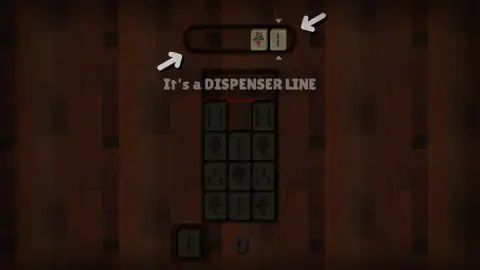
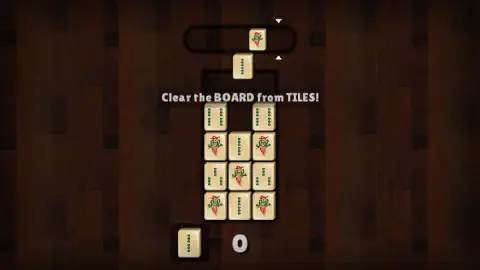
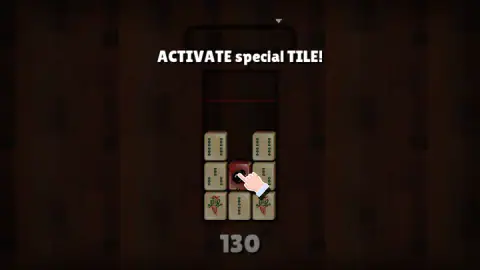
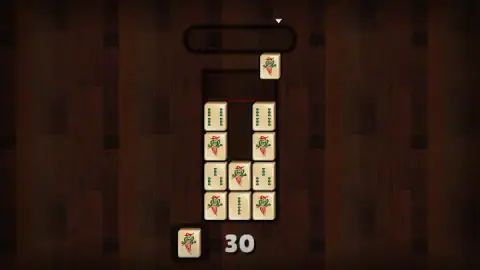
Taken by opening the game ourselves and letting it run — not supplied by the publisher, and not the same picture every other site shows.
How to play Mahjong Tower: Puzzles
- Watch the dispenser line. The capsule above the board holds the tiles that are coming. The next one drops into the slot beside your score.
- Pick up the current tile. It sits at the bottom left, lit up, next to the number. Hold the left mouse button on it.
- Drop it on an empty square. Drag it onto the board and release. It stays exactly where you put it.
- Make threes. Three of the same tile clear away, whether they are side by side or stacked on one another.
- Click the red ones. A dark red tile is a special tile, and the tutorial has you click it rather than drag anything onto it.
What we picked up while playing:
- The board is three columns wide and nothing more. Every placement is a choice among a dozen squares at most, so there is no quiet corner to hide a mistake in. A tile you cannot match stays in your way.
- The slot does the choosing, not you. You never pick which tile to place, only where it goes. Planning here means leaving room for tiles you have not seen yet.
- A red tile is a bank, not an obstacle. One of them turned a modest board into the best score of our session, as below.
- The tutorial cannot be skimmed. It runs card by card from the first screen and dims everything except the one thing it is pointing at. Slow the first time, and the reason the game needs no instructions page.
Controls
| Left mouse button (drag) | Picks up the current tile from the slot beside the score and drops it on an empty square of the board |
|---|---|
| Click on a dark red tile | Activates a special tile; the one in the tutorial cleared every tile around it |
| Circular arrow (bottom left) | Restarts the board |
| Wooden arrow (bottom right) | Moves on to the next tutorial card |
| R / H / Esc | Listed by the publisher as restart, hint and pause; we played with the mouse and did not use them |
Features
- Tiles arrive one at a time along a dispenser line above the board: you choose the square, never the tile
- Three of a kind clear, either side by side or stacked, as the game's own NEAR and ON TOP card explains
- The board is a tall frame three columns wide, with a thin red line drawn across the top
- Dark red special tiles are clicked, not dragged: ours cleared eight tiles worth 810 points between them
- Three modes on the main menu: Puzzles, Board Clearing and Arcade
- A tutorial runs before anything else, card by card, and ends with the board clear at 940 points
- Credited to faraonovvit, in English and Russian
Game details
- Developer
- faraonovvit
- Release date
- March 2026
- Last updated
- August 10, 2026
- Added here
- December 2025
- Technology
- HTML5
- Platforms
- Browser (desktop, mouse), Browser (mobile & tablet, touch)
- Classification
- Cards & Board , Puzzle
- Saved progress
- Saving, when available, is managed by this game. Mava cannot confirm your level.
FAQ
How do you play Mahjong Tower: Puzzles?
A dispenser line above the board feeds you one tile at a time. The tile waiting for you sits in a slot at the bottom left, next to the score, and you drag it onto an empty square of the board. Three matching tiles touching each other clear away, either side by side or stacked.
Is Mahjong Tower: Puzzles the same as mahjong solitaire?
No, and it is close to the opposite. Mahjong solitaire gives you a full pile and asks you to remove pairs from it. Here the board starts nearly empty, tiles keep arriving whether you are ready or not, and you clear them three at a time.
What do the red tiles do in Mahjong Tower: Puzzles?
They are special tiles, and you click them instead of dragging something onto them. The one the tutorial pointed us at wiped out all eight tiles left on the board at once. Those eight were worth 810 points between them, with 250 of that for the special tile itself.
What game modes does Mahjong Tower: Puzzles have?
Three, shown on wooden signs on the main menu: Puzzles, Board Clearing and Arcade. The publisher describes them as spatial puzzles with a limited number of tiles, a race to clear the board against a clock, and an endless mode that gets harder as it goes. We only opened Puzzles.
How many levels does Mahjong Tower: Puzzles have?
We cannot say from play. Our session ended shortly after the tutorial, with the Puzzles mode just opened and no level finished. The publisher's description claims more than sixty levels of varying difficulty, which we did not verify.
What are the controls for Mahjong Tower: Puzzles?
On a desktop it is a drag with the left mouse button, plus a click on a special tile. The publisher also lists R to restart a level, H for a hint and Esc for the pause menu; we played with the mouse only. On phones and tablets it is listed as tap and drag.
Who made Mahjong Tower: Puzzles?
It is credited to faraonovvit. It was published in March 2026, in English and Russian, for PC, Android and iOS. We found no studio site or second source for that credit.
Why is there a bird on one of the mahjong tiles?
That tile is the one of bamboo. In a real mahjong set it is drawn as a bird rather than a single stick, usually called the sparrow, and Japanese sets tend to draw a peacock. The other tiles on this board are the two, three and four of the same suit.