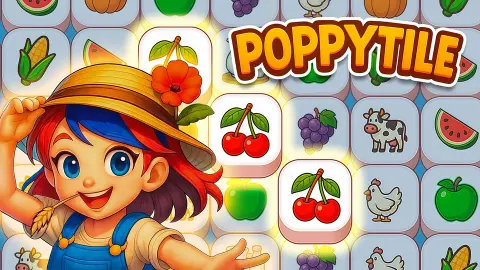





About PoppyTile
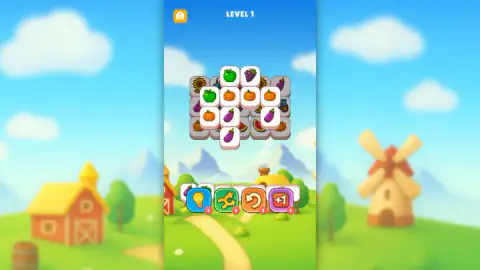
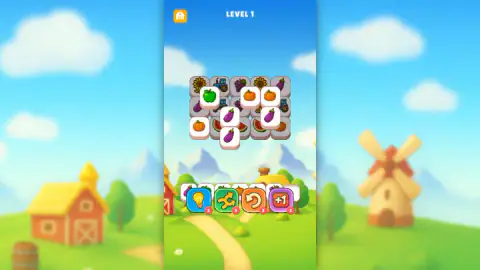
Most tile puzzles make you work out which pieces you are allowed to touch. PoppyTile just colours them in. Every tile that is free to take is bright white with a sharp little drawing on it; every tile with something lying on top of it is washed out to a flat grey, almost the colour of the hillside behind. There is no legend for this and no line of text that mentions it. You learn it by tapping a grey one, watching nothing happen, and then tapping it twice more to be sure.
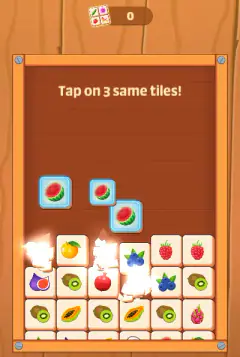
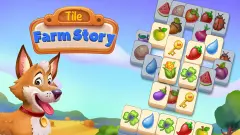
What you are tapping towards is a row of slots along the bottom of the screen. A white tile you touch leaves the pile and lands in the next free slot. Get three of the same picture into that row and they merge and go, and the slots they were using come back. That is the whole game: a farmyard set of apples, grapes, pumpkins, aubergines, watermelons, sunflowers, hens, blue tractors and wooden windmills, stacked a few deep, and a short row of places to hold them while you hunt for the third one.
The tutorial teaches it in two screens and about ten seconds. The first says Welcome over Clear the game field and puts three green apples above three jars. Tap an apple and it drops into the first slot. Tap the other two and all three vanish together, the row is empty again, and the banner changes to Great over Let's merge 3 other tiles. A Skip sits in the top right the whole time, in case you would rather find out the hard way.
The game is credited to LUCKY TRY. The listing gives August 2026 for the release and for the last update alike.
Our own session ran about four minutes and never left the first level. We will be specific about that, because how a puzzle treats you in its first four minutes is the most useful thing anyone can tell you about it.
Grey means locked, and the rule behind it is forty-five years old
The one rule PoppyTile never explains is the one it inherited, and it is worth knowing where it comes from, because knowing makes the board readable.
Mahjong solitaire — the patience game played on a stacked pile of tiles, the one on every hotel lobby screen — is not the game of mahjong. It borrows the tiles and nothing else. Mahjong proper is a draw-and-discard game for a table of people. The solitaire is a computer game, and a fairly datable one: Brodie Lockard wrote a version called Mah-Jongg on the PLATO education system in 1981 and gave it away for nothing, and Activision's Shanghai, five years later, is the version that put it on home computers.
Its central rule is about freedom. A tile can only be taken if nothing is covering it and at least one of its long sides is clear. That second half is what makes classic mahjong solitaire hard to read: a tile in plain sight, uncovered, can still be untouchable because the tiles beside it have it pinned.
PoppyTile keeps the first half and throws away the second. Nothing covering it, and you can have it. We watched four free tiles sit side by side in the middle row, touching each other on both sides, all four of them bright white and all four takeable. That is a deliberate simplification and it shows in how the game feels: here, what you can see you can usually have, and the difficulty has to come from somewhere else.
It comes from the row. Which is the other half of the design.
Seven slots, and the slots are the whole of the difficulty
Count them on the welcome screen, where the row sits by itself with nothing in front of it: there are seven. During a level you cannot count them, because the four booster buttons are drawn on top of the row and hide parts of it. You read your own slots through the gaps between buttons, which is an odd thing for a puzzle to do when that row is the only resource you have.
Seven sounds generous until you work out what it is for. In mahjong solitaire, matching happens on the board: you find two of a kind, they go, and nothing accumulates. You can get stuck, but you cannot fill up. PoppyTile moves the matching into the row, and the moment it does, the row becomes something you can run out of.
Here is the arithmetic that decides a board, and it is short. A kind of tile you have only one of costs you a slot and gives nothing back. A pair costs two and still gives nothing back. Only the tap that completes a trio pays, and when it pays it hands back three slots at once.
Which means the row holds two unfinished pairs and a loose single, and then the choosing is over: the next tile you take has to finish something. We did not manage it. At our worst the row held an aubergine, two green apples, a pumpkin and a bunch of grapes — and the third apple was sitting on the pile in plain sight, white, free, one tap away, and we spent that tap on something else. What happened next is in the pictures: the board we were playing is gone, and a new, completely full one has replaced it, with a single tractor in the row. A run had ended and another had started. We never saw a second level either way: the header read LEVEL 1 in every capture we took, start to finish.
Say the honest version of that out loud and it is the most useful sentence on this page. The first level of PoppyTile beat us twice in four minutes, and both times it was not the pile that did it. It was the row.
More games by LUCKY TRY
The same studio builds the same number into most of what it makes. PopSortica is three of a colour in a tube rather than three of a picture in a row, and Candy Pop Mania is three in a line in the old board-sweeping sense. If what drew you here is the pile rather than the trio, Tile Match and Mahjong Alchemy both start from a stack of tiles and ask different questions of it. We have not played those four down to a lost board the way we played this one, so take them as signposts and nothing firmer. The rest of the shelf is in puzzle games.
Screenshots
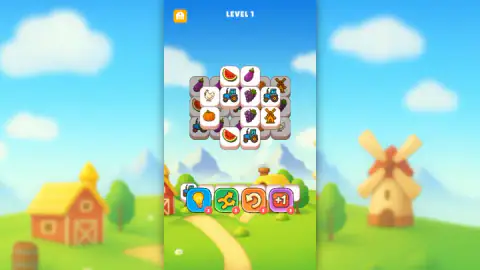
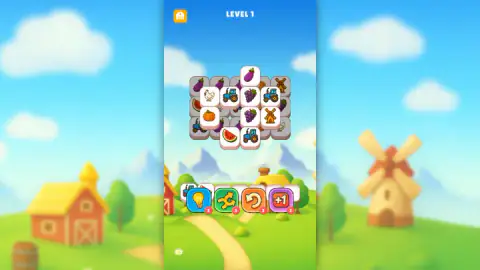
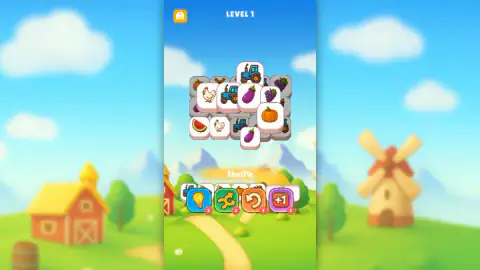
How to play PoppyTile
- Find the bright white tiles. They are the only ones that will answer you. Anything greyed out has a tile sitting on top of it.
- Tap a white tile. It leaves the pile and lands in the next free slot in the row along the bottom of the screen.
- Get three tiles with the same picture into that row. They merge on their own, disappear together, and hand the slots back.
- Taking a tile off the top uncovers whatever was underneath it. That is how a grey tile turns into a white one and how the pile comes apart.
- Keep the row short. Every tile sitting in it that is not on its way to being a trio is one place fewer to put the next tile.
What we only learned by being there:
- Count before you tap. On our boards there were usually three or four free tiles of the same kind already on show. If the third one is visible, take all three now; if you can only see one of something, you are about to spend a slot on a promise.
- Most of our taps did nothing at all. We lost a good part of the opening minute clicking on greyed-out tiles and wondering why the board would not move. The grey is not decoration and it is not a mood, it is the rule.
- The row is the clock. There is no timer on this screen and no move counter. The only thing that gets worse while you play is the row filling with singletons, and it is easy to miss because the buttons sit over the top of it.
- The boosters count down. Each of the four carries a small red badge. We pressed the shuffle once, the pile rearranged itself, the word Shuffle printed above the buttons, and that badge went from three to two. The other three kept their three all session, because we never touched them.
Controls
| Tap or click a bright white tile | Lifts it off the pile and drops it into the next free slot in the row along the bottom. This is the only move in the game |
|---|---|
| Tap or click a greyed-out tile | Nothing. A grey tile has another tile lying on top of it and will not answer. Most of our taps in the first minute were this |
| Three tiles with the same picture in the row | They merge and vanish together, and the slots they were using come back empty. You do not press anything to make it happen |
| The green button with crossed arrows, bottom row | Shuffle. We pressed it once: the pile rearranged itself, the word Shuffle printed above the buttons, and the red badge on that button dropped from 3 to 2 |
| The blue lightbulb, the orange back-arrow and the purple plus-one buttons | Three more boosters, each with a red 3 on it. We never pressed any of the three, so we are not going to tell you what they do |
| The orange barn button, top left | Unconfirmed. It is there in every frame and we never opened it |
| Skip, top right of the tutorial | Leaves the two welcome screens and goes straight to the first level |
| Keyboard | We played the whole session with a pointer on the tiles. We are not claiming the keyboard does nothing, only that we did not test it properly |
Features
- A row of exactly seven slots along the bottom holds the tiles you lift, and three of a kind merge out of that row and give the slots back
- Nothing has to be next to anything: the tile you take and the two that match it can be anywhere on the pile, because the matching happens in the row and not on the board
- Free and locked are told apart by colour alone — bright white means you can take it, flat grey means something is lying on top of it
- A tile is locked only by what covers it, never by its neighbours: we saw four takeable tiles sitting side by side and touching
- Farmyard tile set, read off the boards we played: apples, grapes, pumpkins, aubergines, watermelons, sunflowers, hens, blue tractors and wooden windmills
- Four boosters with three uses each, counted down on a red badge; the shuffle rearranges the pile and prints its own name above the buttons when it fires
- No score, no timer and no move counter anywhere on the play screen — the header carries the level number and nothing else
Game details
- Developer
- LUCKY TRY
- Release date
- August 2026
- Last updated
- October 24, 2026
- Added here
- June 2026
- Technology
- HTML5
- Platforms
- Browser (desktop), Browser (mobile & tablet, touch)
- Classification
- Puzzle
- Saved progress
- Saving, when available, is managed by this game. Mava cannot confirm your level.
FAQ
What kind of game is PoppyTile?
It is a free browser tile puzzle with a farmyard set of pictures. Tiles are stacked a few layers deep in the middle of the screen, and you lift them one at a time into a row of seven slots along the bottom. Three tiles with the same picture in that row merge and disappear together. The aim is to take the pile apart, and the tutorial states it plainly as clearing the field.
How do you play PoppyTile?
You tap or click one tile at a time, and that is the whole of the input. A tile you tap leaves the pile and lands in the next free slot in the row at the bottom of the screen. When three of the same picture are sitting in that row they merge on their own and hand the slots back. You never drag anything and you never match two tiles against each other on the board.
Why do some tiles not respond when you tap them?
Because they are covered. Every tile with another tile lying on top of it is drawn in flat grey instead of bright white, and a grey tile cannot be taken. The game never says this anywhere, so the usual way to learn it is to tap a grey tile several times and notice that nothing moves. Once you only tap the white ones the board starts coming apart.
How many slots does the tray in PoppyTile have?
Seven. They are easiest to count on the welcome screen, where the row sits on its own with nothing in front of it. During a level the four booster buttons are drawn on top of that same row and cover parts of it, so you can only read the slots in the gaps between the buttons. Seven is the whole of your working space, and every tile in it that is not part of a trio is one slot fewer.
What are the four buttons at the bottom of PoppyTile?
They are boosters, and each one starts with a red badge reading 3. From left to right they are a blue lightbulb, a green pair of crossed arrows, an orange arrow curving backwards and a purple plus one. We pressed the green one once: the pile rearranged itself, the word Shuffle appeared above the row and that badge dropped to 2. We never pressed the other three and we will not guess at them.
Is PoppyTile the same as mahjong?
No, and it is not the four-player game of mahjong either. What it borrows is the rule from mahjong solitaire, the patience game played on a stack of tiles: you can only take a tile that has nothing on top of it. PoppyTile keeps that and drops the rest. In mahjong solitaire you match pairs on the board itself, and a tile with neighbours on both sides is locked. Here you match threes in a tray, and we saw four takeable tiles sitting in a row touching each other.
How far did you get in PoppyTile?
Not far, and we would rather say so than round it up. The header read LEVEL 1 in every single one of our captures. We finished the two tutorial screens, played the first level, lost it, started it again, and lost it again, all inside about four minutes. We never cleared a board and never saw a second level, so nothing on this page describes what comes after the first one.
Who made PoppyTile and when did it come out?
It is credited to LUCKY TRY, a studio with eight games on the same platform. The listing gives August 2026 both for the release and for the most recent update. Only the month is printed anywhere we could find, never a day, which is why this page does not claim a precise date.