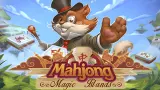





About Mahjong Magic Islands
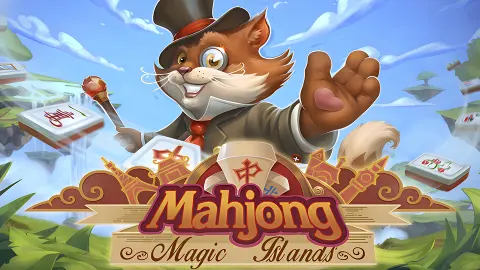
Most mahjong games open with a big pile of tiles and wish you luck. Mahjong Magic Islands opens with eighteen tiles, a fox in a top hat, and a single rule. "You can only match identical tiles that have an open side," he says, leaning on his walking staff below the board. Then he waits for you to try.
The board he hands you is a hollow rectangle: a full row along the top, another along the bottom, a short column down each side and a loose pair in the middle. Look closely and some tiles are bright white while others are a dull grey. That is the game showing you its rule. The grey ones are boxed in by neighbours on both sides, and you cannot take them yet.
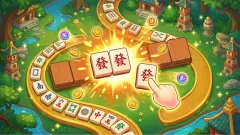
Around those boards sits a light fantasy frame. You travel a map of floating islands, starting at a castle labelled Magic school, and each level opens in a storybook with three items you can find inside. Coins, hearts and a star counter sit along the top.
The game is by Rainbow Games, the studio listed for it, and it has been available since December 2024. Our own session was short and never got past the first board, so this page tells you exactly how far that is.
Mahjong solitaire was born on a computer
The four-player game of mahjong comes from China, where it took shape in the late 1800s. You draw and discard tiles to build a winning hand, a little like rummy. Mahjong Magic Islands is not that game. It is mahjong solitaire, sometimes called Shanghai, and despite the ancient-looking tiles it is a computer-age invention.
The first version was written in 1981 by Brodie Lockard for PLATO, an early network of teaching computers based at the University of Illinois. He called it Mah-Jongg. Activision turned it into a commercial game called Shanghai in 1986, and that version is the one that spread. Lockard said his idea came from an old Chinese tile game called the Turtle, which is why the classic big pyramid layout is still known by that name. Nobody has confirmed that older game existed, so treat it as his story.
What Lockard designed is the rule the fox teaches you. A tile is only playable when it is not covered and one of its long sides is open. That single rule makes the game. It means the order matters: take the wrong pair early and you can trap the twin of a tile you need under a stack you cannot reach. Mahjong Magic Islands softens that by greying out what is blocked, but the logic is the same one from 1981.
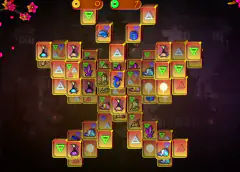
The tiles themselves come from the real set. Most on the first board are the dots suit, circles in red, green and blue, counted out from two up to nine. Mixed in are picture tiles with a Chinese character in the corner. One pair shows a man carrying a pole and the character for fishing. Another shows a man with a rake and the character for ploughing.
Hearts, coins and the island map
The map screen carries three counters. A star badge reads 0/30, which looks like a running total of stars across the levels. A heart counter started at five, marked Max. A coin purse held 50 from the start, with a green plus sign beside it.
The hearts are the ones to watch. We started the first level, reloaded the page, and came back to four hearts with a timer of about twelve minutes ticking down beside them. We did it again and came back to three. Whether a heart is spent when you start a level or only when you leave without finishing, we cannot say for sure. Either way, every walk-away costs you.
Inside a level the top bar changes. A lightning badge marked x1 sits next to a score that stayed at zero in our run, and a brown bar holds three empty stars. The x1 suggests a multiplier for quick pairs, but we never removed a pair to see it move.
The level book for the first stage, called Beginning, lists three things you can find: a blue crystal, a golden amulet and a torch-like item. The game's description talks about collecting ingredients for magic spells and meeting creatures who need help. In our session the fox was the only creature we met, and we saw no spells.
What we played and what we did not
We reached the island map, opened the level book, and played the tutorial board three times, reloading the page twice. We selected tiles and watched them glow, but in our run no pair left the board, so we never finished the first level, earned a star or spent a coin.
We did not see a second level, a second island beyond the arrow on the right of the map, a spell, a shop or any ending. The ad screens came up a few times between the map and the board. All our play was with a mouse on a computer, where the game sits in a tall column with the island background blurred on both sides.
Who it is for
Mahjong Magic Islands suits players who want mahjong solitaire with someone holding their hand at the start: the fox explains the rule, the dimmed tiles show it, and the first board has only eighteen pieces. It is a calm game with no visible clock on the board, and younger players can follow it without reading much beyond the fox's lines. It is not an adventure in the action sense; the islands are the road between puzzles.
Rainbow Games also makes Magic Tri Peaks Solitaire, a card solitaire, and Tile Farm Story, another tile game with a story around it. For mahjong with a twist, Mahjong Alchemy swaps tiles for alchemy cards across shaped boards, and Mahjong Tower: Puzzles clears tiles three at a time. More boards are in puzzle games.
Screenshots
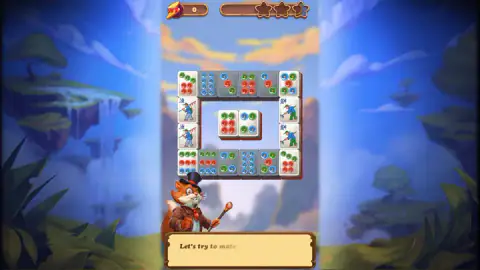
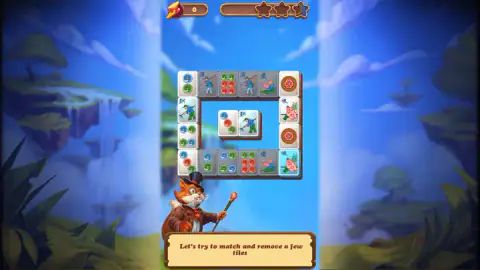
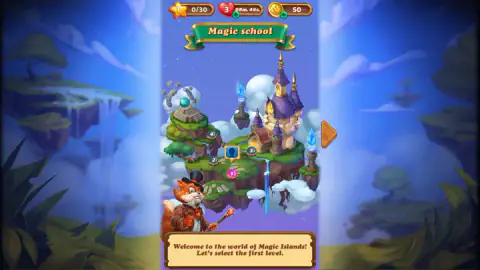
Taken by opening the game ourselves and letting it run — not supplied by the publisher, and not the same picture every other site shows.
How to play Mahjong Magic Islands
- On the island map, pick the first level dot. A book opens with the level's name, three empty stars and a preview of the board. Press the green Play button.
- Read the fox's lines in the cream strip at the bottom; click the strip to move his text along.
- Click or tap a tile, then click another with exactly the same picture. If both are free, they leave the board together.
- Only bright tiles are free. A tile is free when nothing touches its left side or its right side. Grey tiles become free once a neighbour goes.
- Clear the board to finish the level and fill the stars on the bar at the top.
Tips from our session:
- Trust the colours. The game does the hard part of mahjong solitaire for you by dimming blocked tiles. On a busy board, scan only the white ones for twins.
- Start from the corners and the middle. On the first board, the corner tiles, the side columns and the two loose tiles in the centre were all free from the start. The middle of the top and bottom rows was not.
- Watch for the blue glow. A tile you have selected lights up blue. If it stays lit, your second click did not make a pair.
- Do not leave a level half done. Hearts went down each time we abandoned the board.
- The deal changes. We reloaded twice, and the same first board came back with different tiles each time. Learning one layout by heart will not help.
Controls
| Click or tap a tile, then its twin | Selects the first tile (it lights up blue) and removes the pair if both match and both are free |
|---|---|
| Click the cream strip at the bottom | Moves the fox's tutorial text on to the next line |
| Level dots on the island map, then Play in the level book | Opens a level and starts it |
Features
- Mahjong solitaire, not the four-player table game: clear the board two identical tiles at a time
- Free tiles are drawn bright white and blocked ones are dimmed grey, so you can see what is playable at a glance
- A fox narrator in a top hat with a walking staff teaches the rules on the first board
- An island map that opens at the Magic school, with numbered level dots and a book for each level
- Each level book lists three items you can find on that board
- Hearts, coins and a stars counter on the map; we lost a heart each time we left a level unfinished
- A tall portrait layout that fills a phone screen and sits in a column on a computer
Game details
- Developer
- Rainbow Games
- Release date
- December 2024
- Last updated
- August 10, 2026
- Added here
- April 2025
- Technology
- HTML5 (Unity WebGL)
- Platforms
- Browser (desktop, mouse), Browser (mobile & tablet, touch)
- Classification
- Puzzle
- Download size
- 56.4 MB
- Ad requests
- 2 (few)
- Has a save
- Yes
- Saved progress
- Saving, when available, is managed by this game. Mava cannot confirm your level.
Measured by opening the game ourselves on 2026-09-11, not taken from the feed. Twelve seconds on a phone-sized screen, with ad requests counted and blocked rather than loaded.
FAQ
How do you play Mahjong Magic Islands?
Click or tap two identical tiles, one after the other, to remove them as a pair. You can only take a tile that has an open side, meaning nothing next to it on the left or on the right. Clear the board to finish the level. The game dims the tiles you cannot take, so the bright ones are your options.
What does an open side mean in mahjong solitaire?
A tile is free when its left or its right edge is not touching another tile. In Mahjong Magic Islands the fox narrator says you can only match identical tiles that have an open side. On the first board, the tiles in the middle of the top and bottom rows are boxed in by their neighbours and show up grey until a neighbour is gone.
Why did I lose a heart in Mahjong Magic Islands?
In our session the heart counter dropped by one each time we started a level and left it unfinished. It went from five to four, then to three, and a countdown timer appeared next to it showing when the next heart comes back. If you are low on hearts, finish the level you are on rather than restarting.
Is Mahjong Magic Islands an adventure game?
Not in the usual sense. Some portals file it under adventure because of its island map and story, but every level is played as classic mahjong solitaire. The adventure is the setting around the boards: islands to travel, a fox who talks you through it, and items to find.
Who made Mahjong Magic Islands?
It is credited to Rainbow Games, a studio that also makes card solitaire and tile-matching games such as Magic Tri Peaks Solitaire and Tile Farm Story. It has been available since December 2024.
Can you play Mahjong Magic Islands on a phone?
Yes. It is free in the browser on computers, phones and tablets. The screen is built tall, like a phone held upright, so on a computer it plays in a column in the middle of the window. We played with a mouse.