



About Magic Water Sort
Every water sort puzzle you have ever played works the same way. A rack of glass tubes, each one holding a stack of colours in the wrong order, and exactly one move available: pour this tube into that tube. You win by getting every colour alone.
Magic Water Sort will not let you do that. You cannot pour one container into another. You cannot choose where anything goes.
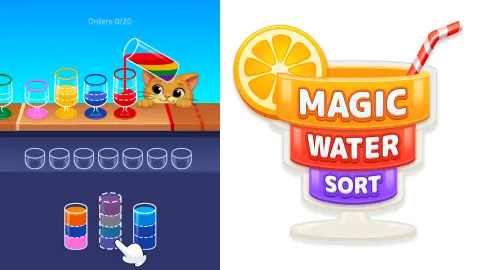
What you get instead is a counter. Along the top stand glasses, each one drawn as a dashed outline tinted with a single colour at its foot — that is the colour it is waiting for. Under the counter sits a row of small cups. Below that, on two wooden shelves, stands a board of flasks with their liquid stacked in bands, blue over yellow over blue, each band separated from the next by a thin white line. You tap one flask. It lifts into the air, tips over, and empties from its top band down while you watch where each band lands: into a glass that wanted that colour, or, if no glass up there did, into a cup under the counter.
So the whole game comes down to one decision made over and over. Which flask, and when.
It is credited to Drivix Games and has been available since June 2026. Our own session ran about four minutes on a desktop: level 1 held our hand, level 2 ended with a card reading "Complete! Level 2" and a choice of Next or Replay, and level 3 was still in front of us when we stopped. No ending came into view, and nothing below suggests one did.
You never choose where the liquid goes
This is the line that separates this game from the three hundred tube puzzles it sits next to, and it is worth spelling out, because the name buries it.
In a tube sorter, the destination is your move. You point at one tube and then at another, and the whole puzzle lives in that pairing. Take the pairing away and you would have nothing left to do.
Magic Water Sort takes it away and replaces it with timing. The glasses on the counter are not yours to arrange; they arrive, they wait, and according to the game's description a fresh one rolls in after every pour, with a preview of what is coming next. Your flask will pour its blue into a blue glass if one happens to be standing there at that moment. If none is, the blue goes under the counter and stays there. Same flask, same tap, completely different result depending on when you did it.
That turns a sorting puzzle into a queueing problem, which is a different shape of thinking. You are not tidying a shelf. You are deciding what to serve while the order list changes under you.
Why nothing in this game ever turns green
Watch a flask pour blue into a glass that already has yellow in it and you will notice something that would never happen on a real counter: it does not happen. Every glass in the three levels we played wanted exactly one colour, and every band either found that colour or went downstairs to a cup of its own. Two liquids never meet.
In a real glass they would, and quickly. Pour blue syrup onto yellow syrup and you get a few seconds of swirl and then green, permanently.
Bartenders beat that every day, and the drink they use to show off about it is the layered pousse-café: three, five, sometimes seven spirits standing in visible stripes in a narrow glass. There is no trick to the glass. The trick is density. Sugar makes a liquid heavier, so the sweetest, syrupiest thing goes in first and the lightest spirit last, and each one is poured slowly over the back of a bar spoon so it spreads out and settles rather than punching down into the layer below. Get the order wrong, or pour hard, and the whole thing turns the colour of a puddle.
The flasks in this game look exactly like that — bands held apart by a crisp line, heaviest at the bottom. And the game is honest about one real detail: tip a layered bottle and the top layer is what comes out first. The part it quietly rewrites is mixing. By giving every colour its own destination, it gets the look of a pousse-café without ever having to simulate the one thing that makes a pousse-café hard. Which, for a puzzle you are meant to play in a queue at a bus stop, is the right call.
The seven cups under the counter are the real clock
There is no timer, so the difficulty has to live somewhere, and it lives on the middle shelf.
Seven small cups sit under the counter in a row. Every band of liquid that no glass wanted goes into one of them, and in our session they filled quietly while we were busy congratulating ourselves on the glasses above. By the time we noticed, two of them were holding blue, and the blue we actually needed was still sitting at the bottom of a flask behind a band of yellow.
Two of those seven are not plain cups. They carry a plus sign and a small round green tag reading AD, which is the universal sign for more room, in exchange for your attention. We did not take the offer, so we cannot tell you how long the video runs or how much space it buys. There is a second button with the same green tag up in the top-right corner, and we left that alone too. What matters for play is that five cups are what you start with, and that running out of them is the failure state this game has instead of a clock.
It also explains the shape of a good move. You are not looking for the flask that fills the most glasses. You are looking for the one that puts the least liquid into those cups.
More sorting puzzles on Mava Games
If what you actually wanted was the tube version, Aqua Sort: Water Color Puzzle is the straight one — pour flask into flask until each holds a single colour, destination entirely yours. Ball Sort Puzzle runs the same rules with solid balls instead of liquid, which makes every move easier to count and harder to undo in your head.
For the same drinks-counter dressing, Color Sort Puzzle Milk Tea Sorting stacks its colours in takeaway cups, and Juice Tycoon goes all the way to a shop with customers waiting. Marble Color Sort swaps the layers for physics and lets everything roll. Everything else of the kind sits in puzzle games.
Screenshots
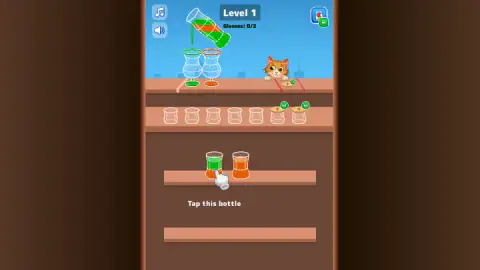
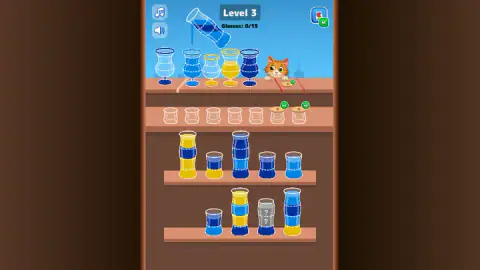
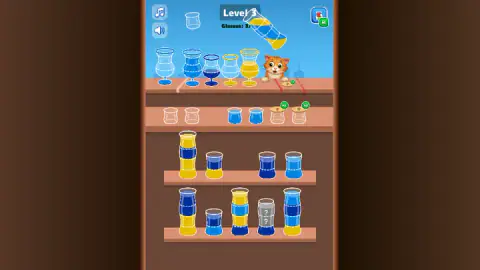
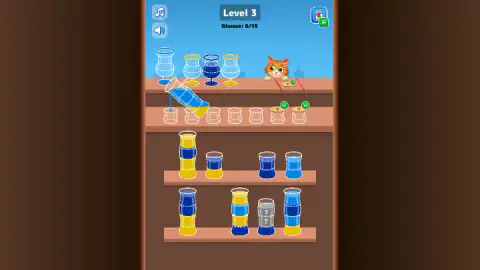
Taken by opening the game ourselves and letting it run — not supplied by the publisher, and not the same picture every other site shows.
How to play Magic Water Sort
- Read the glasses before you touch anything. Each outline on the counter is tinted with the one colour it will accept. That row is your order list, and it is the only thing worth looking at first.
- Find a flask whose top band matches one of them. The top band leaves first. What sits underneath it is next in line, not next week.
- Tap the flask once. It does the rest by itself — rises, tilts, pours. There is no aiming and no second click, and nothing you can do once it has started.
- Watch the cups under the counter, not the flask. Anything nobody ordered ends up down there, and that shelf does not empty itself.
- Check the counter in the header. It reads something like Glasses: 6/15 — filled, out of wanted. When the two numbers meet, the level is over.
What the session taught us:
- The tutorial is one sentence long, and then it stops. Level 1 puts a pointing hand on a flask and writes Tap this bottle underneath. It asks for two filled glasses. Level 3 asks for fifteen, with no further explanation offered in between.
- The second band is the whole skill. Choosing a flask for its top colour is easy. Choosing it while knowing what the band under it will do to the counter is the actual game.
- A glass is not a tube. Glasses come in different shapes and heights, tumblers and stemmed goblets, which means they do not hold the same amount and a band does not always finish one.
- One flask is deliberately hidden. On level 3 there is a grey bottle whose bands are drawn with question marks instead of colours. We left it alone, which is probably the coward's choice.
- There is no hurry anywhere. No clock, no countdown, no losing sound in four minutes. You can sit on a board as long as you want and think.
Controls
| Click or tap a flask on the two wooden shelves | That flask lifts, tilts and empties itself from the top band down. It is the only move in the game |
|---|---|
| Anywhere else on the board | Nothing. You cannot pick a destination, drag a flask, or stop a pour once it has started |
| Music note and speaker, top left | Music and sound effects, one button each |
| Arrow keys, letter keys and the space bar | Nothing we could see or hear. This is a game for one finger or one mouse button |
Features
- One move only: you choose which flask to empty, never where its liquid goes
- Each glass on the counter is drawn as an outline tinted with the single colour it is waiting for, so the target is never a guess
- A row of seven small cups under the counter catches every band that no glass wanted, and that is where levels are lost
- Two of those seven cups carry a plus and a green AD tag — extra room, offered in exchange for watching something
- A difficulty curve you can read off the header: level 1 asks for two filled glasses, level 3 asks for fifteen
- Glasses come in several shapes and heights, tumblers and stemmed goblets, so they do not all take the same amount
- No timer and no fail buzzer anywhere in our session, and a Replay button sitting next to Next on the completion card
- It has been available since June 2026
Game details
- Developer
- Drivix Games
- Release date
- June 2026
- Last updated
- June 18, 2026
- Added here
- May 2026
- Technology
- HTML5 (2D)
- Platforms
- Browser (desktop), Browser (mobile & tablet, touch)
- Classification
- Puzzle
- Saved progress
- Saving, when available, is managed by this game. Mava cannot confirm your level.
FAQ
How do you play Magic Water Sort?
You tap one of the flasks standing on the wooden shelves at the bottom of the screen. It rises, tips over and empties itself from its top band downwards. Each band of colour goes into a glass on the counter above that was waiting for exactly that colour, and any band nothing wanted drops into the small cups under the counter instead. The level is done when the glass counter in the header reaches its target.
Is Magic Water Sort the same as a classic water sort puzzle?
No, and this is the thing worth knowing before you start. A classic water sort gives you a rack of tubes and lets you pour one into another until each colour sits alone. Here you cannot pour one container into another at all, and you never choose a destination. You pick which flask empties and the game decides where every band of it lands.
What does 'Glasses: 0/15' mean at the top of the screen?
It is the level's target and your progress towards it. The first number is how many glasses you have filled correctly, the second is how many the level wants. We saw it read two on level 1 and fifteen on level 3, which is the whole difficulty curve in one line of text.
What are the small cups under the counter for?
They catch the liquid nobody ordered. When a flask empties and one of its bands has no matching glass on the counter, that band settles into a cup instead. We watched two of them fill with blue on level 3 while we were trying to serve yellow. The game's description gives the same rule, and it is what makes a careless tap expensive rather than harmless.
What is the grey bottle with question marks on it?
On level 3 one flask on the lower shelf is grey, and its two bands carry question marks where the other flasks carry a colour. We never tapped it, so we can tell you it is there and that the game is openly hiding what is inside it, but not what comes out.
Can you play Magic Water Sort with a keyboard?
Not as far as we could tell. We worked through the arrow keys, several letters and the space bar, and nothing on screen moved and nothing played. Every single thing that happened in our session happened because something was clicked.
Is there a timer in Magic Water Sort?
We saw no clock, no countdown and no losing sound in roughly four minutes of play across three levels. The game's listing also sells it as a game with no time limit. The pressure, such as it is, comes from the cups under the counter filling up with colours you poured too early.
Who made Magic Water Sort?
The game is credited to a studio called Drivix Games and has been available since June 2026. No studio name appears on screen while you play, and the game is built in portrait, the shape of a phone held upright.