










About Fun Sorting Through The Shelves
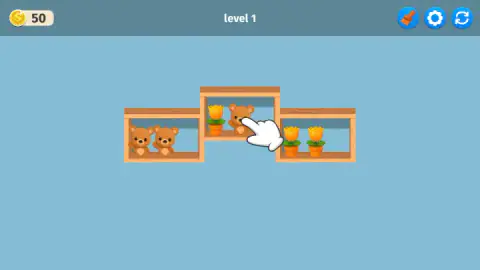
Most match-three games start by burying you: a full grid, a clock, a queue of things waiting to drop. Fun Sorting Through The Shelves opens on six objects. Three teddy bears and three yellow tulips in terracotta pots stand on three small wooden shelves against a plain blue wall, and that is the whole board.
The rule fits in a line. Drag an object to another shelf, and when three of the same kind share one shelf they disappear. The game does not even make you work out the first move: a white pointing hand lifts the odd bear off the middle shelf and carries it to the empty slot beside the pair on the left, which is exactly the drag you wanted.
The game is credited to a developer listed only as Nikita. It was published in August 2025.
Now the honest part. We played for ten minutes on a desktop computer with the mouse. We cleared level 1, took its reward, reached level 2 and then spent the rest of the session pushing objects around that second board without ever landing a trio on it. So this page can tell you what the first level asks, what it pays and what the second one changes. It can tell you nothing about level 3, about how many levels there are, or about what the two padlocks at the top of the screen unlock.
Level 1 is a demonstration. Level 2 is the puzzle.
The opening board is generous on purpose. Six objects, two kinds, three shelves with room to spare, and a hand showing you where to start. Two sensible drags finish it, and the layout is dealt the same way every time: we saw it twice in one session and it was identical both times.
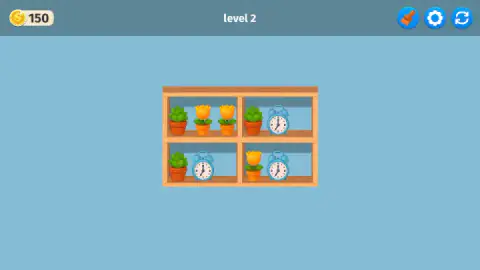
Level 2 drops the three separate shelves and puts up a single unit of four compartments, two over two. Into it go nine objects of three kinds: green succulents in terracotta pots, yellow tulips and pale blue alarm clocks, three of each.
Count the room and you can see where the difficulty comes from. Twelve slots, nine objects, so three gaps to move things through. The compartment at the top left already holds two tulips, which looks like a gift until you notice the succulent wedged in with them and the compartment full. The third tulip has nowhere to land. Before you can finish the obvious trio you have to break it open and find the succulent a home, and every move you make is a move in somebody else's way.
That is the whole design, and it arrives in one step. Level 1 asks you to understand the rule; level 2 asks you to plan three moves ahead. We did not solve it, and we are not going to pretend the ten minutes we spent failing were the game's fault.
What a finished level pays
Clear the shelves and the board is replaced by a small panel with three stars over it. Ours offered 100 coins. Underneath the figure runs a strip of multipliers, from double to quadruple and back down, and under that a green button to collect, marked with a film clapper.
There is a plain refusal below the green button, and we finished the exchange with the flat hundred rather than a multiple of it. The counter in the top left had read 50 all through the level; the moment the panel closed, it read 150.
So the economy is simple enough to work out from one level. You are given a small float at the start, each board you clear adds to it, and nothing we found spends it except the wall behind the shelves.
The brush sells wallpaper, and 150 coins is still not enough
Three round blue buttons sit at the top right. The gear is settings, which we left alone. The circular arrows restart the level. The brush is the shop.
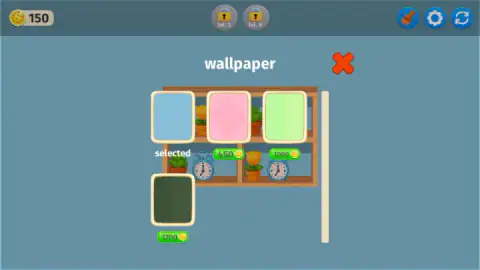
It opens a panel titled wallpaper, and the joke is that the colour samples are displayed on the same wooden shelves you have been tidying, propped up between the succulents and the alarm clocks. The light blue one you started with is marked as selected. Pink costs 450 coins, light green 1,000 and dark green 1,700. A scroll bar runs down the side, so there may be more below. A red cross closes it.
We opened it twice, once at the start and once with a level's winnings in hand, and the cheapest colour was out of reach both times. At a hundred coins a level, the first wall change is a few levels of work rather than a reward you trip over.
The centre of the top bar is worth a glance too. It takes turns: first the name of the level you are on, then two grey padlocked buttons.
Those two are labelled lvl. 5 and lvl. 9, which suggests they open when you reach those levels. We did not reach them, and the game does not say what they are.
Three alike has been the rule since 1994
Games where you make things disappear by matching them have a name and a history. Wikipedia files them under tile-matching games: puzzles where you move pieces so they vanish when they meet a matching rule. It credits a 1994 game called Shariki as the first of what later became known as match-three games, where the goal is a cluster of three or more identical items on a grid. Bejeweled made the idea famous seven years later.
Fun Sorting Through The Shelves has no connection with either, but it keeps their number and throws away their grid. In the classic version you swap two neighbours and the board refills from above, so half the skill is predicting what drops next. Here nothing drops. An object can go to any shelf with a slot free, and the board only changes when you change it.
That is why a stuck board here is always your own work. With no new pieces arriving and no clock counting, every arrangement of the shelves is one you built, and the restart button is there because sooner or later you will build a bad one.
Who it is for
It suits anyone who wants a quiet puzzle with a single rule and no pressure: young children, people who find a ticking clock unpleasant, or someone with a few minutes to spare. The first level asks for two sensible drags and tells you one of them.
Be aware that the step up is abrupt. If you want a gentle slope from level to level, this is not it. And if you hoped the coins would buy help, the only thing we found on sale was the colour of the wall.
More shelf and triple-match games
Goods Sort 3D - Triple Puzzle is the same shelf idea with a shop's worth of stock and a clock running. Flower Merge - Triple Puzzle does it with flowers and pots, also against time. Find Match 3D swaps the shelves for a heap of objects and a tray with seven slots. Tidy Up - Satisfeel ASMR is for players who liked the tidying more than the matching. The rest are under puzzle games.
Screenshots

Taken by opening the game ourselves and letting it run — not supplied by the publisher, and not the same picture every other site shows.
How to play Fun Sorting Through The Shelves
- Look for the pairs. A shelf that already holds two of a kind is where the third one belongs.
- Find the odd one out. It is the object sitting next to something it does not match.
- Make room before you need it. A shelf takes three, no more. If the pair you want to complete is sharing its shelf with a stranger, the stranger has to leave first.
- Drag the single across. Hold the mouse button on the object, carry it to a free slot on the shelf with its pair, and let go.
- Empty the shelves. Three alike vanish on the spot, and the level ends when nothing is left standing.
What ten minutes and a cleared level taught us:
- Three on the board is not three on a shelf. We reached a point where the tulips were the only objects left, one on each shelf, in plain sight of each other. Nothing happened. The game counts a shelf, not a screen.
- Move the single to the pair, never the pair to the single. One drag does the job the first way. The second way takes two and breaks up a pair that was already right.
- Watch the hand. It is not decoration. It picks up an object and carries it to a particular slot, and that is the move the game wants next.
- Nothing rushes you. Neither board had a clock or a move counter. A wrong drag costs you the drag back, and nothing else that we could see.
- The circular arrows are a clean slate. They put the shelves back exactly as they were dealt, including the trios you had already cleared.
Controls
| Drag an object | Carries a bear, a flowerpot or a clock from its shelf to a free slot on another shelf |
|---|---|
| Brush button (top right) | Opens the wallpaper panel, where coins buy a new wall colour |
| Circular arrows (top right) | Puts the level back the way it started |
| Gear (top right) | Settings; we did not open it |
Features
- One rule: three identical objects on the same shelf disappear
- Level 1: six objects of two kinds on three open shelves, with a pointing hand that demonstrates the first drag
- Level 2: nine objects of three kinds in a unit of four compartments, with only three free slots to work in
- Finishing a level pays coins: level 1 took our purse from 50 to 150
- No clock and no move counter on either of the two boards we played
- A restart button that returns the shelves to their starting layout at any time
- A wallpaper shop with four wall colours on its first page: one free, the others at 450, 1,000 and 1,700 coins
Game details
- Developer
- Nikita
- Release date
- August 2025
- Last updated
- August 10, 2026
- Added here
- June 2025
- Technology
- HTML5
- Platforms
- Browser (desktop, mouse), Browser (mobile & tablet, touch)
- Saved progress
- Saving, when available, is managed by this game. Mava cannot confirm your level.
FAQ
How do you play Fun Sorting Through The Shelves?
You drag objects from one wooden shelf to another with the mouse. When three identical objects end up on the same shelf they disappear, and a level ends when the shelves are bare. Level 1 spreads three teddy bears and three tulips over three shelves; level 2 adds a third kind of object and packs everything into four compartments.
Do the three matching objects have to be on the same shelf?
Yes, and the game is strict about it. At one point in our session the three tulips were the only things left on the board, one sitting on each of the three shelves, and nothing happened. They vanished only when all three stood on one shelf.
How many coins do you get for finishing a level?
Level 1 paid 100. A panel appears with three stars and the figure on it, and our purse went from 50 coins to 150. The green button on that panel carries a video icon and a row of multipliers, and there is a plain refusal under it; we came away with the flat hundred rather than a multiple of it.
What is level 2 like in Fun Sorting Through The Shelves?
Harder than level 1 in a specific way. Nine objects of three kinds, succulents, tulips and blue alarm clocks, sit in a shelf unit of four compartments, and only three slots are free. The compartment that already holds two tulips also holds a succulent, so you have to move something out before you can finish anything.
What are coins for in Fun Sorting Through The Shelves?
The one use we found is wallpaper. The brush button opens a panel of wall colours: the light blue one you start with, then pink for 450 coins, light green for 1,000 and dark green for 1,700. You start on 50 coins and one cleared level brings you to 150, so the cheapest colour is still several levels away.
Is there a timer or a move limit in Fun Sorting Through The Shelves?
Not on either of the two levels we played. The top of the screen shows a coin counter, the level name or two padlocked buttons, and three round menu buttons, and no clock or move counter. We made dozens of wasted drags and nothing penalised them.
What do the lvl. 5 and lvl. 9 padlocks mean?
They are two locked round buttons at the top centre of the screen, labelled with a level number each. The labels suggest something opens when you reach levels 5 and 9. We got as far as level 2, so we cannot say what is behind them.
Who made Fun Sorting Through The Shelves?
The game is credited to a developer listed only as Nikita. It was published on 11 August 2025. It is listed for PC, Android and iOS in landscape; we played it on a desktop computer with the mouse.