



About Sorting Cute Animals
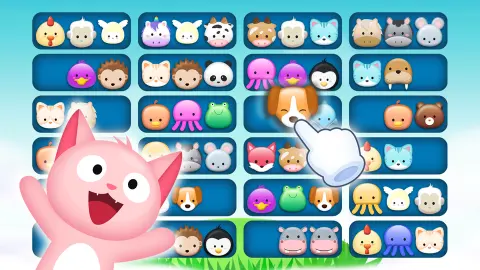
A shelf in Sorting Cute Animals holds three faces and no more. Three of a kind on one shelf is also the rule that makes them vanish. Those two numbers are the same on purpose, and the whole design falls out of it: a shelf you manage to fill with one kind of animal empties itself a second later. The board is never about tidying. It is about getting rid of things.
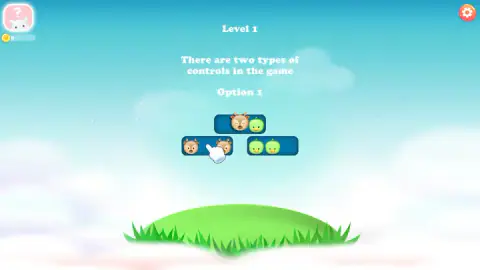
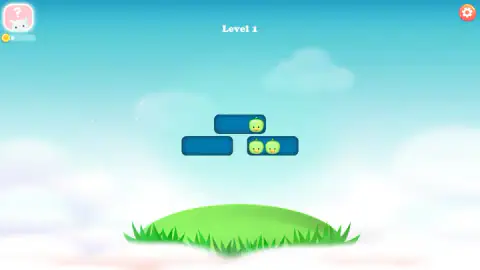
Level 1 teaches that with six pieces on three shelves. A deer face and a round green chick share the top shelf. Two more deer wait below on the left, two more chicks below on the right. Send the lone deer down to its pair and all three go at once, leaving a bare shelf behind. Send the chick across to its own pair and there is nothing left on the board.
Then the game pays you. A pink ribbon reads "Victory!", with a bear, a frog, a cat, a rabbit and a yellow chick crowded behind it, and under it a panel that says "Reward:" with a gold coin and the number 50. The purse in the top-left corner had sat at zero all tutorial. On the next screen it read 50.
We have now spent three sessions with this game, and the latest, ten minutes long, never cleared the tutorial at all. That sounds like a wasted visit and it was not: we spent it prodding every corner of level 1, and that is how we found the screen that says what the coins are actually for.
The game is credited to Mari Games, the studio behind Mahjong 3. It was published in July 2026.
Three slots, three alike: why the board never jams
Most sorting puzzles ask you to fill something, and filling it is the win: a tube of one colour, a tray of one product. Here getting three together is only the trigger. The reward is that they leave, and the shelf goes back to being empty.
That flips how you read the board. Count free slots, not neat groups. The tutorial keeps three of its nine slots open at all times, which is why it is easy. The idea it teaches is the one the rest of the game runs on: clear a set, gain a shelf, use the new shelf to break up the next tangle.
Two controls, taught one after the other
Level 1 opens with a line most games never bother to say: "There are two types of controls in the game". Underneath it the word Option 1 appears, a white hand settles on the shelf with the two deer, and a moment later the same lesson runs again as Option 2.
What that means for you is simple, even if the labels are not: there is more than one gesture for moving a piece, and the game would rather show you both than assume. We will not pretend to know which label belongs to which gesture, because the game never spells that out. What we can tell you is what actually moved pieces with a mouse. Clicking the shelf the hand pointed at sent the deer across, after several drags in a row had changed nothing. Later, a drag dropped squarely into the middle of the chicks' shelf finished the level.
Be warned that this can go badly. Our most recent visit spent ten minutes on this one tutorial board and never finished it: pieces shuffled about, the hand came and went, and most of what we tried simply did not register. Nothing punished us for it, since there is no clock and no counter of wasted moves. But a game that opens by promising two control schemes and then ignores both for minutes at a time is asking a lot of a six-year-old, and it is the one thing we would fix.
What the coins are for: a wardrobe behind the question mark
The corner tile is easy to dismiss. It is a pink square with a question mark over a white cat's face, the coin counter tucked underneath, and it looks like a help button. It is not. Click it and the board dims behind a card headed Customization, with a cat's ears and a bow drawn on top.
Inside are the characters you can play as, under two tabs — one marked with a person, one with a picture. Two faces are already yours: a girl in a white bear hat with the ears still on, and a boy in a blue cap with a paw print, a white rabbit perched at his shoulder. Below them the slots turn grey and grow padlocks, and the first of those carries a price tag: a gold coin and the number 400. A red X hands the board back.
So the economy closes. A cleared level pays 50, and the cheapest locked face asks for eight of them. That is what the counter in the corner is counting towards, and it explains why finishing a board feels like it should be worth something even though no door opens and no new mechanic arrives. Nothing in that card touches the puzzle: it changes who you are on screen, not what the shelves do.
Fifty coins for the tutorial, and a bigger board right after
Press the pink arrow and the difference is immediate. Level 2 doubles the shelves, to six in three rows, and brings in the rest of the cast: brown bears, cream hens with red combs, black-and-white cows and purple octopuses join the deer and the green chicks.
The squeeze is in the free space. Fifteen pieces sit in eighteen slots, which leaves three gaps, exactly what the tutorial gave you with far fewer animals to untangle. Suddenly a careless move costs you, because every kind needs its three to meet somewhere and there are only so many places to put the ones that are in the way.
The interface admits as much. During the tutorial the top-right corner holds a single gear; in level 2 there are three buttons, one of them a looping arrow that was not there before. We did not press it, so we will not swear it is an undo rather than a restart, but a game that offers you one at exactly this point is telling you where the mistakes start. A small crossed-out ADS badge sits above the level number, which is the game's own way of saying it has ads and a way to switch them off.
Who it is for
Sorting Cute Animals suits young children and anyone who wants a puzzle with nothing chasing them. Across every session we played we saw no timer, no move counter and no fail screen, and no wrong move took anything away. The only words on screen are a few tutorial lines, and the art does the rest: round smiling faces on blue shelves, a sky full of soft clouds and a green hill underneath.
Its weak spot is still the controls, and our last visit made that case better than any complaint could. The first level is worth playing together, so that a child who drags a deer and sees nothing happen has someone beside them to try the other gesture. The title screen also offers an Authorization button for signing in; we skipped it and the game played fine. The game is listed for phones as well as computers and described as a portrait game; we only played it with a mouse.
More sorting and matching puzzles
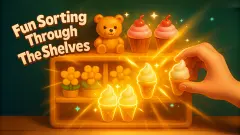
Mahjong 3 is by the same studio and also clears tiles three of a kind at a time, from a tray instead of shelves. Fun Sorting Through The Shelves is the closest relative, with teddy bears and potted flowers on wooden shelves. Goods Sort 3D - Triple Puzzle adds a clock to the same idea, and Happy Zoo: Mahjong Triple Match keeps the animals. The rest are under puzzle games.
Screenshots

How to play Sorting Cute Animals
- Look along the shelves for a character that has two twins sitting somewhere else.
- Move it onto their shelf, either by dragging it there or by clicking the shelf the tutorial hand points at.
- Watch the three vanish together. The shelf they leave behind is now yours to use.
- Keep clearing until no face is left anywhere on the board.
- Take the reward on the "Victory!" screen and press the round pink arrow for the next level.
What our runs taught us:
- An empty shelf is the real prize. Clearing a set matters less for the set than for the space. That gap is where you park a piece while you dig its twins out from under other animals.
- Drop into the middle. Several of our drags did nothing at all. The one that finished the level ended well inside the target shelf, not on its edge.
- Follow the hand, and change the gesture rather than repeating it. The deer only moved once we clicked the shelf the tutorial hand was pointing at. In our last session we sent that same deer at that same shelf for minutes on end and the board never flinched.
- The keyboard is no help. The arrow keys and the space bar did nothing we could see or hear.
- Watch for the grey banner. When "Click to keep playing" sits at the top of the screen, the game is paused. One click and it carries on.
Controls
| Drag an animal onto another shelf | Moves it there; drop it well inside the shelf, not on the edge |
|---|---|
| Click the shelf the tutorial hand points at | Sent the waiting deer across in our first run, after several drags had done nothing |
| The pink question mark tile, top left | Opens the Customization card, where the coins you earn buy new characters |
| The red X on that card | Closes it and gives the board back |
| Pink arrow button | Leaves the Victory! screen and starts the next level |
| Click the "Click to keep playing" banner | Wakes the game up after a pause |
Features
- Blue shelves floating over a grassy hill, each with room for exactly three animal faces
- Three of the same face on one shelf disappear together, leaving the shelf free
- Clearing a level ends on a Victory! ribbon that pays a reward of 50 coins
- A first level that is a tutorial and says outright that the game has two types of controls
- A Customization card behind the corner tile, with two characters unlocked and the next one priced at 400 coins
- Level 2 doubles the shelves and brings in bears, hens, cows and octopuses
- No timer, no move limit and no fail screen in any of the three sessions we played
Game details
- Developer
- Mari Games
- Release date
- July 2026
- Last updated
- July 22, 2026
- Added here
- June 2026
- Technology
- HTML5 (2D)
- Platforms
- Browser (desktop)
- Saved progress
- Saving, when available, is managed by this game. Mava cannot confirm your level.
FAQ
How do you play Sorting Cute Animals?
You move characters between blue shelves until three of the same kind sit together on one shelf. When that happens, all three disappear. Clear every face off the board and the level ends on a Victory! screen.
What do you get for finishing a level in Sorting Cute Animals?
Clearing a level pays coins. Level 1, the tutorial, ends on a pink Victory! ribbon with a reward of 50 coins, and the counter in the top-left corner moved from zero to 50 on the next screen.
What are the coins for in Sorting Cute Animals?
They buy characters. The pink tile in the top-left corner opens a card headed Customization, which holds the faces you can play as. Two are yours from the start and the rest are padlocked, with the first of them priced at 400 coins. Nothing in there changes the puzzle itself.
What are the two types of controls in Sorting Cute Animals?
The first level says there are two and teaches them one after the other, labelled Option 1 and Option 2, with a white hand pointing at the shelf you should be aiming for. In practice that means you can pick the gesture you find comfortable. Two things moved pieces for us with a mouse - clicking the shelf the hand pointed at, and dragging a piece well into the middle of its new shelf.
How many animals fit on one shelf in Sorting Cute Animals?
Three. That is why three alike is the clearing rule: a shelf filled with one kind of animal empties itself immediately, so a full shelf is never a problem, only a passing state.
What is level 2 like in Sorting Cute Animals?
It doubles the board. Six shelves in three rows replace the tutorial's three, and brown bears, cream hens, black-and-white cows and purple octopuses join the deer and the green chicks. Fifteen pieces sit in eighteen slots, so you have three free spaces to work with.
Why can't I move the animals in Sorting Cute Animals?
This is the game's weak point, and it cost us a whole session. If nothing happens when you drag, drop the piece further into the target shelf, or click the shelf the tutorial hand is pointing at. If a grey "Click to keep playing" banner is at the top of the screen, the game is paused, and one click brings it back. Nothing is lost while the board ignores you - there is no clock running.
Is Sorting Cute Animals good for young children?
It is gentle and has almost no reading. Across three sessions we saw no timer, no move counter and no fail screen, and nothing was taken away for a wrong move. Younger players may need help the first time a drag does not register.
Who made Sorting Cute Animals?
The game's listing credits Mari Games, the same studio as Mahjong 3. It was published in July 2026.