







About Mahjong 3
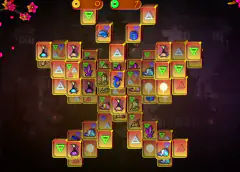
Type "mahjong" into a games portal and you expect a pile of tiles with bamboo and dragons, removed two at a time. Mahjong 3 has the pile. It has none of the rest. The tiles carry apples, cheese and donuts, they leave in threes, and before any of them leaves it has to pass through a tray with room for seven.
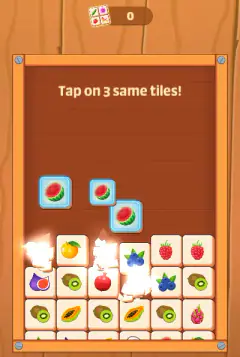
That tray is the game. Tap a tile and it does not look for a partner on the board: it drops into the next free slot under it. Put three of the same picture in the tray and they vanish. Put in seven that do not match and there is nowhere left to go. Every tap is a small bet that the other two tiles of that picture can be reached before the tray runs out.
Mahjong 3 is by Mari Games, and it has been available since July 2026. It is a young game with a small audience so far. We played its tutorial and part of the first level, and this page says plainly where we stopped.
Three of a kind is closer to real mahjong than the pairs are
The pairs that most people know as mahjong belong to mahjong solitaire, a one-player computer game. The table game it borrowed its tiles from is played by four people and works like rummy, and its basic building block is a set of three. Three identical tiles make a pung. A standard winning hand is four sets of three and one pair.
So the rule that looks like the break with tradition here, three tiles instead of two, is the one piece that the four-player game would recognise. What Mahjong 3 takes from the solitaire version is something else: the layered pile, and the rule that a tile with another on top of it is out of play.
It drops one solitaire rule along the way. In mahjong solitaire a tile also needs a free side, left or right, before you can take it. Here we picked tiles from the middle of the board with neighbours on both sides. Only what lies on top counts.
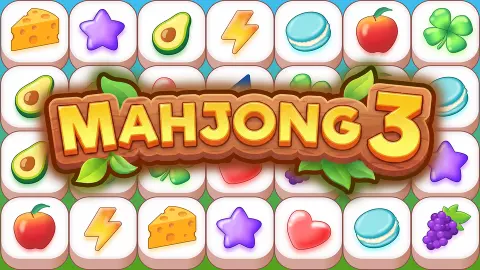
Do not expect the suits either. The tutorial uses apples and cheese, and Level 1 added clovers, donuts, watermelon slices and water drops. Nothing needs to be learned to tell them apart, which makes the game easier to read than a real mahjong set for a child or for anyone new to the tiles.
Seven slots, and the sum behind them
The tray is short on purpose. Seven is one more than two full triples, which sounds generous until you look at how tiles pile up in it.
Think of each picture in the tray as an open job. One open job is safe. With three different pictures open and two tiles of each, six slots are taken, and the seventh tile must finish one of them or the tray is full. A tile of a fourth picture at that point is the one that fills it. Level 1 already has five pictures on the board, so the game lets you get into that trouble from the first screen.
The practical rule we took from it: keep no more than two or three pictures open at once, and close one before opening another. The tutorial teaches the mechanics, with one triple of apples and one of cheese, but it never puts a wrong tile in your tray, so it does not teach this.
We cannot tell you what a full tray looks like. We stopped with one tile in ours, and never saw the game end a level, for better or for worse.
Four boosters, three uses each, and the one we pressed
Under the tray sit four round buttons, each with a small red counter that read 3 when Level 1 began. Their icons are a light bulb, a pair of crossed arrows, a curved arrow and a +1.
We pressed the +1. The tray grew from seven slots to eight, the word "Active" appeared over the button, and its counter went down to 2. An extra slot is the most direct help the game offers, because it changes the sum in the section above: with eight slots you can carry one more stray tile.
The other three we left alone. The icons are the standard ones for a hint, a shuffle of the board and an undo of the last tile, and that is how we read them, but we did not see them work. The game's description says coins are earned as you play and stars are given for finished levels. We saw neither on screen in Level 1, and we do not know whether used boosters come back or how.
How far we got in Mahjong 3
We played for about four minutes. That covered the tutorial and the opening of Level 1, where we cleared one set of three water drops, left a cheese in the tray and switched on the extra slot. We did not finish the level.
That leaves real gaps. We do not know how many levels there are, how fast the boards grow, whether a timer or a move limit appears later, or what the description's "fairytale adventure" amounts to beyond the scenery. The first level plays against a backdrop of mountains and green hills, with no clock anywhere on screen.
Who it is for
Mahjong 3 suits players who like tile-matching but find mahjong suits hard to read, and anyone who wants a puzzle with one rule and no clock in sight. The first level is small enough to study in full before the first tap.
It is not for someone looking for classic mahjong solitaire. There are no pairs, no dragons and no winds. For that, the first two games below are the right door.
More tile games on Mava Games
Mahjong Alchemy is mahjong solitaire proper, with pairs and shaped boards. Mahjong Lines keeps the pairs but joins them with a path across a flat board. Fruits into Baskets is another take on collecting three of a kind, and Vegetables Match 3 is the swap-two-neighbours kind of match-three. The rest are in our puzzle games.
Screenshots




Taken by opening the game ourselves and letting it run — not supplied by the publisher, and not the same picture every other site shows.
How to play Mahjong 3
- Start the game. A short tutorial opens with the words "Welcome" and "Clear the game field"; a SKIP button sits in the top left corner if you already know the genre.
- Tap a bright tile. It moves to the tray under the board. Grey tiles are covered by another tile and cannot be picked yet.
- Send two more tiles with the same picture to the tray. The three disappear and their slots are free again.
- Keep going until the board is empty. That is the whole goal.
- If the tray is getting crowded, the four round buttons under it are your boosters.
Tips from our run
- Count before you tap. Find all three copies of a picture, and check that you can reach them, before sending the first one down.
- Taking a tile is also how you uncover the board. Twice in Level 1, removing a tile turned a grey one under it into a tile we could pick, so a tap that completes nothing can still be the right move.
- The three tiles do not need to arrive together. We held two water drops and a cheese, added the third drop, and the drops cleared around the cheese.
- A stray tile stays in the tray. Our cheese was still there several moves later, taking up one of the seven slots.
- The keyboard does nothing useful. The arrow keys and the space bar got no response from the game when we tried them.
Controls
| Click or tap a bright tile | Sends that tile to the next free slot of the tray under the board |
|---|---|
| Light bulb button | Hint booster, three uses shown at the start of Level 1 (we did not use it) |
| Crossed arrows button | Shuffle booster, three uses shown (we did not use it) |
| Curved arrow button | Undo booster, three uses shown (we did not use it) |
| +1 button | Adds an eighth slot to the tray and takes one use off its counter |
| SKIP (top left, tutorial only) | Skips the opening tutorial |
Features
- A triple-match game under a mahjong name, where tiles leave in threes through a tray and never in pairs
- A tray of seven slots under the board, which is the only place a tile can go when you tap it
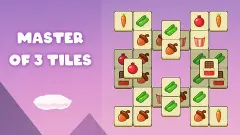
- Boards stacked in layers, with covered tiles shaded grey until the tile above them is taken
- Everyday pictures instead of mahjong suits, with clovers, cheese, donuts, watermelon and water drops in Level 1
- Four boosters with three uses each at the start (hint, shuffle, undo and an extra tray slot)
- A two-step tutorial that can be skipped from its first screen
- Made by Mari Games
Game details
- Developer
- Mari Games
- Release date
- July 2026
- Last updated
- July 29, 2026
- Added here
- June 2026
- Technology
- HTML5 (2D)
- Platforms
- Browser (desktop, mouse), Browser (mobile & tablet, touch)
- Classification
- Cards & Board , Puzzle
- Saved progress
- Saving, when available, is managed by this game. Mava cannot confirm your level.
FAQ
How do you play Mahjong 3?
You tap a tile that has nothing on top of it and it drops into a tray of seven slots under the board. When three tiles with the same picture are in the tray, they disappear. The level is cleared when the board is empty, as the tutorial puts it with the words "Clear the game field".
Is Mahjong 3 a real mahjong solitaire?
No. Mahjong solitaire removes two matching tiles at a time, straight from the board. Mahjong 3 removes three at a time and makes every tile pass through a tray first, and its tiles show food, clovers and water drops, not mahjong suits. What it keeps from mahjong solitaire is the layered board, where a covered tile cannot be picked.
What does the 3 in Mahjong 3 mean?
It reads as the rule of the game and not as a sequel number. Tiles are cleared in groups of three, and the tutorial itself asks you to "merge 3 more tiles".
What do the four buttons under the tray do in Mahjong 3?
They are boosters, and each showed three uses when we started Level 1. The one we pressed, marked +1, added an eighth slot to the tray and its counter dropped to two. The other three carry a light bulb, crossed arrows and a curved arrow, the usual signs for a hint, a shuffle and an undo, but we did not use them.
Do the three matching tiles have to be picked one after another?
No. In our run the tray held two water drops and a cheese, and when we added a third drop the three drops cleared and the cheese moved to the first slot. A triple counts wherever its tiles sit in the tray.
How do you lose in Mahjong 3?
We did not lose a level, so we cannot describe the screen. The tray has seven slots and only a set of three frees space, so the danger is a tray full of tiles that do not match. We stopped before ours filled up.
Who made Mahjong 3?
The game is credited to Mari Games. The game was published on 28 July 2026. The game's listing offers it in English and Russian.
Can you play Mahjong 3 on a phone?
It is listed for PC, Android and iOS, in portrait orientation. We played it on a computer with the mouse, where every action is a single click, and did not test it on a touch screen.