











About Mahjong Puzzle: Tile Match
Most mahjong games online are a pile. Tiles are stacked in a turtle or a tower, and the puzzle is working out which ones are free to lift. Mahjong Puzzle: Tile Match flattens the pile into a single grid and asks a different question: can these two tiles see each other?
Two identical tiles clear when they touch, or when they sit in the same row or column with nothing but empty space between them. When no pair can see its twin, you slide tiles along their lines until one can. That second half is what makes it a puzzle rather than a search. A single drag can open three lines and close two others.
The game is by Orange B, according to the game's listing, and it was published in May 2026. We played the full tutorial and reached the first real board. This page explains the rules as the game teaches them, and what the first board tells you about how to approach it.
The seven tutorial steps, and what each one is really teaching
The tutorial runs on a small board of 14 tiles, and each step adds one rule. It is worth reading the steps as a list, because the order is the logic of the whole game.
The first two steps are the obvious ones: twins side by side, then twins one above the other. The third and fourth introduce distance. Two green dragons sit at opposite edges of a row with empty cells between them, and they clear. Then two blue 七 tiles do the same down a column. Distance is free in this game. What matters is only whether the line is clear.
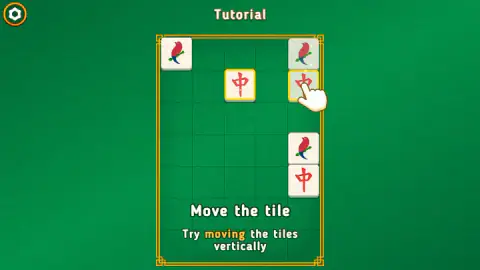
Steps five and six are moving. First a 二 tile is nudged sideways so it lands under the other 二. Then a red dragon is dragged up its column, and the bird above it travels with it. This is the step that confused us longest: the hand points at the tile, and ghost tiles appear above it to show where the pair will settle once you let go.
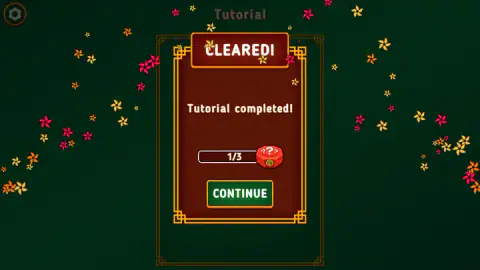
The last step clears the two birds left at opposite ends of the top row, and a red card says CLEARED! Tutorial completed! A bar below it reads 1/3 and ends in a red box with a question mark, which suggests a reward after three cleared boards. We stopped before seeing what it is.
Real mahjong tiles, and why four of each matters
The tiles are drawn from a real mahjong set, simplified. A standard set has three numbered suits, bamboo, circles and characters, plus the honour tiles: the winds and the dragons. Every one of those tiles exists in four identical copies. Flowers and seasons are extras some sets add on top, and this game leaves them out.
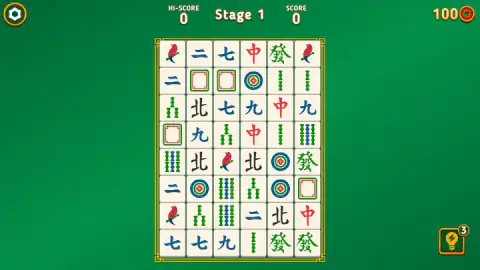
You can see most of that family on the first board. The red 中 is the Red Dragon, the green 發 the Green Dragon, and the empty framed tile is the White Dragon, which in many real sets is a blank tile with a border. The black 北 is the North wind. The blue 二, 七 and 九 are the Chinese numbers two, seven and nine. The bamboo tiles show green sticks, except the 1 of bamboo, which shows a red bird, as many real sets do: the single stick is commonly replaced by a sparrow, or a peacock in Japanese sets.
The four copies are the part that changes how you play. Stage 1 is a full grid of 48 tiles, and we counted 12 designs with exactly four of each. So every design is two pairs, not one. If you clear two birds early in a way that buries the other two behind a wall of tiles, you have made the board harder. The best first pair is often the one whose remaining twins are already close.
Not mahjong solitaire: closer to Shisen-Sho, without the turns
Despite the name, this is not the mahjong solitaire most people know, where tiles are layered and a tile is free when its left or right side is open. Nothing here is stacked.
The real relative is Shisen-Sho, the Japanese tile game also known as Four Rivers, and its many "connect" versions. In Shisen-Sho you remove a pair if a path of straight lines can join them without crossing other tiles, and the path may bend up to two times. That allows paths around obstacles and along the edge of the board.
Mahjong Puzzle: Tile Match keeps the clear-line idea and removes the bends. A pair has to face each other in one straight row or column. To make up for that stricter rule, it gives you something Shisen-Sho does not: you can move the tiles. So instead of searching for a winding path, you build a straight one.
If you prefer the version with turns, Mahjong Lines joins pairs with a path of up to three lines, and Onet Puzzle - Tile Match Game works the same way on an upright board. Tile Pair Jam: Mahjong Master is the closest match to this one: pairs clear across a clear row or column, and you shift tiles to open the line.
What comes after the first board
Everything in this section is from Orange B's description, not from our own play. The studio says layouts get harder as you go and ask you to plan moves ahead. What we saw supports at least the shape of that: the first stage already fills every cell, while the tutorial board was mostly empty, so the slide rule only becomes useful once you have cleared some space.
Two practical notes. Between the end of the tutorial and Stage 1 an advert played, under the distributor's label, before the board appeared. And there is no timer on the first board: the top bar shows only the stage number, your score and your best score.
Who it is for
It suits anyone who likes slow, tidy logic: no clock on the first board, and a rule set you can learn in a few minutes. Young players can follow it because the tiles only need to be recognised as the same, not read. Mahjong players will enjoy spotting the real tiles. If you would rather tap tiles into a tray and clear them in threes, Mahjong Match is that other style. More in puzzle games.
Screenshots
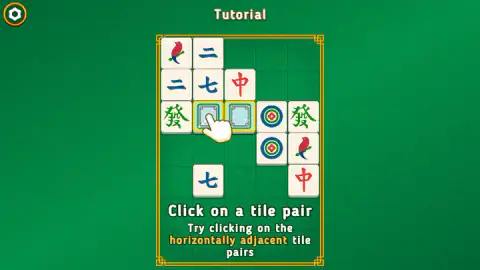
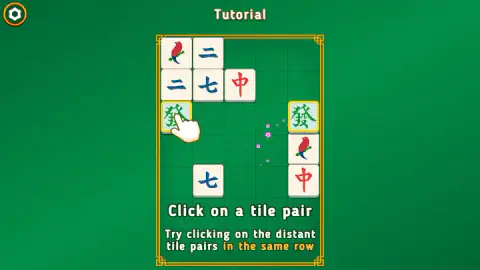
Taken by opening the game ourselves and letting it run — not supplied by the publisher, and not the same picture every other site shows.
How to play Mahjong Puzzle: Tile Match
- Clear touching pairs. Click a tile, then its twin right next to it, side by side or one above the other. Both disappear.
- Clear pairs across empty space. Two twins in the same row or the same column also clear, however far apart, as long as only empty cells separate them. Any tile in between blocks the line, and the line never turns a corner.
- Slide to line them up. Drag a tile up, down, left or right into empty cells. Faded copies show where it will land. Tiles in its path are pushed along with it.
- Empty the board. The stage ends when the last pair is gone. Your score and best score sit at the top, coins at the top right, and a hint bulb at the bottom right.
Tips from our session:
- On a full board you cannot slide anything, because there is nowhere to slide to. Start with pairs that already touch. On Stage 1 we found six: two white dragons and two 2 of bamboo in the second row, two blue 七 and two green dragons in the bottom row, and two stacked pairs further up, circles in the fifth column and bamboo in the third.
- Every design appears four times. Clearing one pair often leaves the other two of the same design with a new clear line between them, so look at the twins of what you just removed.
- When you slide, check the whole line. In the tutorial a red dragon pushed a bird ahead of it, and the single drag set up both the red dragon pair and the bird pair.
- A slide can go either way. One tutorial step moves a tile sideways so it ends up directly under its twin, which turns a sideways move into an up-and-down match.
Controls
| Click or tap a tile, then its twin | Clears the pair if the two tiles touch, or face each other across empty cells in the same row or column |
|---|---|
| Drag a tile along its row or column | Slides it into empty space. Tiles in its path move with it, so one drag can line up more than one pair |
| Bulb button (bottom right) | A hint. Stage 1 starts with 3 |
Features
- Two tiles clear when they are identical and nothing but empty space lies between them, in the same row or the same column
- Tiles can be dragged along their row or column to line up a pair, and the tiles in the way travel with them
- A seven-step tutorial that teaches every rule on a small board before the first stage
- Stage 1 is a full board of 48 tiles: 12 designs, four copies of each, as in a real mahjong set
- Dragons, the North wind, bamboo, circles and blue number characters, with a bird on the 1 of bamboo
- A hint bulb, a coin counter and a reward bar that fills as you clear boards
Game details
- Developer
- Orange B
- Release date
- May 2026
- Last updated
- June 22, 2026
- Added here
- March 2026
- Technology
- HTML5 (2D)
- Platforms
- Browser (desktop, mouse), Browser (mobile & tablet, touch)
- Classification
- Cards & Board , Puzzle
- Saved progress
- Saving, when available, is managed by this game. Mava cannot confirm your level.
FAQ
How do you play Mahjong Puzzle: Tile Match?
Click two identical tiles to remove them. They must touch side by side or top to bottom, or sit in the same row or column with only empty cells between them. When no pair is in line, drag a tile along its row or column to make one. Clear every tile to finish the stage.
Can you match tiles that are far apart in Mahjong Puzzle: Tile Match?
Yes, as long as they share a row or a column and nothing but empty space separates them. The tutorial shows two green dragons at opposite sides of a row clearing in one go. A tile in between blocks the match, and the line cannot turn a corner.
How do you move tiles in Mahjong Puzzle: Tile Match?
Press a tile and drag it up, down, left or right into empty cells. Faded copies show where the tiles will land before you let go. Any tiles in the path move with it, so in the tutorial one upward drag carried a red dragon and a bird together and lined up two pairs at once.
Is Mahjong Puzzle: Tile Match the same as mahjong solitaire?
No. In classic mahjong solitaire the tiles are stacked in layers and a tile is free only when its sides are open. Here everything lies flat on one grid, and what decides a match is a clear straight line between the two tiles. It is closer to Shisen-Sho, without the turns.
How many tiles are on the first board of Mahjong Puzzle: Tile Match?
Stage 1 is a full grid of 48 tiles. There are 12 different designs and each appears exactly four times, like the four copies of every tile in a real mahjong set. Because the board starts full, your first moves can only be pairs that already touch.
Who made Mahjong Puzzle: Tile Match?
The developer is listed as Orange B. The game was published in May 2026 and was last updated in June 2026. It is free to play in the browser on computers, phones and tablets.
What do the coins and the bulb do in Mahjong Puzzle: Tile Match?
The bulb in the bottom corner is a hint button, and it shows 3 when Stage 1 begins. You start with 100 coins in the top corner. We stopped at the start of Stage 1, so we did not see what the coins buy or what the reward box at the end of the 1/3 bar holds.