









About Pirates Tiles Challenge
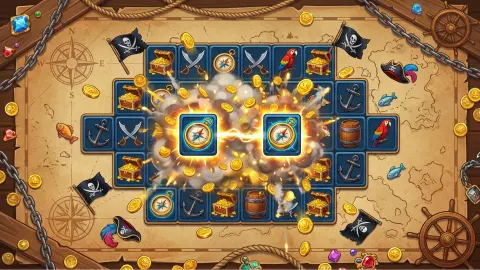
Most tile-matching games care about what is on the tile. Pirates Tiles Challenge cares just as much about what is between the tiles. Two compasses are not a pair because they match. They are a pair because you can draw a line from one to the other that bends no more than twice and does not cross anything else.
That rule turns a picture hunt into a route puzzle. Spotting twins is the easy part. The compass alone turns up again and again on the first board, so the real question is which two compasses can see each other right now, and which ones you should leave for later.
We played Pirates Tiles Challenge on a computer with a mouse in October 2026, for about four minutes. All of it was on level 1, and all of it inside the tutorial. We cleared one pair, the pair the game asked for, and we did not finish the level. Everything below comes from that one board, and the gaps are marked as gaps.
The game is credited to SecGame. It went up in March 2026.
The three-line rule, explained
The game describes it as connecting two tiles with at most three straight lines. Another way to say it: the path may bend twice, but not three times. A straight line is fine. An L shape is fine. A U or a Z shape is fine. Anything that needs a third turn is not.
The path also has to be empty. It can travel through gaps you have already cleared, and in games of this family it can travel around the outside of the board, but it cannot pass through a tile. That is why the board opens up as you play. Every pair you remove makes new corridors, and pairs that were impossible at the start become a simple L later.
So the board is a little like a maze that you dig yourself. Early on, take pairs that open corridors into the crowded middle. Later, the long routes around the rim do most of the work.
Fifty-four pirate tiles on the first board
Level 1 is a grid of six columns and nine rows. The pictures are all pirate gear: compasses, spyglasses, hooks, flintlock pistols, crossed sabres, cannonballs, treasure chests, coin sacks, a pile of gold coins, a ship's wheel, a black Jolly Roger flag, a skull and crossbones in a red bandana, a small pirate ship and a wooden anchor emblem.
They are drawn large and in warm browns, which helps and hurts. The shapes are easy to tell apart once you look. But the pile of gold coins and the coin sack both show spilled coins, and the spyglass and the pistol are both long, brown and drawn on a slant, so a quick glance across the board can mislead you.
Behind the tiles sits a painted coastline with a waterfall, pine trees and grey rocks. As pairs leave, the picture shows through the holes.
Where the connect rule comes from
Matching pairs by drawing a path with two turns is older than it looks. The best-known early version is Shisen-Sho, a Japanese tile game first released for arcades in 1989. Its name means Sichuan Province. It used mahjong tiles laid flat in a single layer, and the rule that a link may bend no more than twice, including around the outside edge.
That makes it a different puzzle from mahjong solitaire, where tiles are stacked and you can only take those that are not covered. In Shisen-Sho everything is visible from the start. Nothing is hidden. The difficulty is all in the routes.
The same idea later spread across Asia under the name Onet, often with animals or fruit on the tiles. Pirates Tiles Challenge is that game with a pirate set of pictures and a clock on top.
Hints, the clock and the buttons at the top
Above the board sit four buttons. The first is a lightbulb marked 2, which reads as two hints. The second shows a camera, the words WATCH AD and a bulb with plus three: three more hints for watching an advert. Then come a paint palette and an orange arrow. We did not press any of these, so we cannot tell you what the palette or the arrow does.
Under them is a stopwatch with a long green bar and three stars on it. That reads as a timer that costs you stars as it runs down. During our session the bar looked full in every screenshot, from the first move of the tutorial to the last, so we cannot say how long a level gives you.
What we did not see
We stayed on level 1, inside its tutorial. We never saw a level select, a win screen, a star result or a fail screen. The game's own description talks about hundreds of levels; we cannot confirm a number. We do not know whether later boards get bigger, add more kinds of tile or tighten the clock.
We also played only on a computer. The game is listed for phones and tablets in both orientations, and tapping two tiles works the same way with a finger.
Who it is for
Pirates Tiles Challenge suits players who like calm, visual puzzles where everything is in plain sight. There is very little to read, the pictures are easy to name, and the cartoon pistols and sabres are props, not fights. Younger players will find side-by-side pairs right away. The longer routes around the edge take some practice to see.
More from SecGame, and other connect-tile puzzles
SecGame also made Mahjong Pirate Plunder Quest, a classic mahjong solitaire with pirate tiles, and Fantasy Fish World Mahjong with an underwater set. From the same studio and the same sea, Pirate Cannon A Mega Battle swaps tiles for cannonballs. If you want the same two-turn connect rule with other pictures, try Onet Puzzle - Tile Match Game. Browse the rest of the puzzle games.
Screenshots
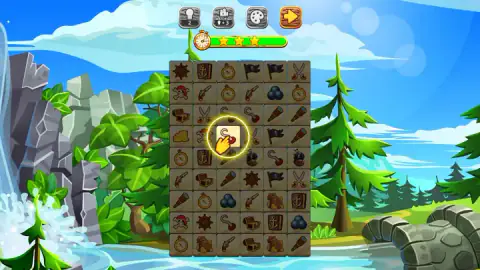
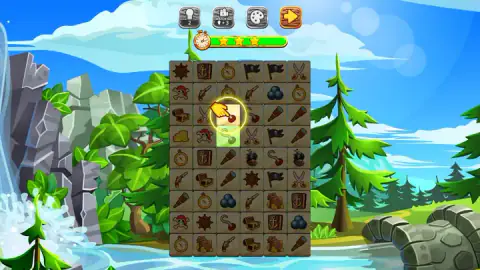
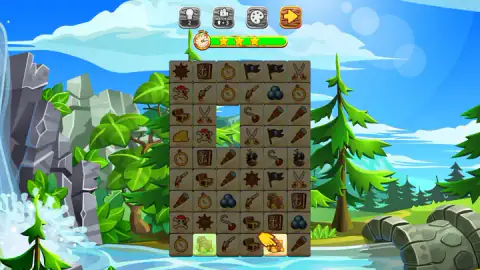
Taken by opening the game ourselves and letting it run — not supplied by the publisher, and not the same picture every other site shows.
How to play Pirates Tiles Challenge
- Wait out the orange LOADING screen. Level 1 opens with a tutorial hand already on the board.
- Click or tap the tile the hand points at. Its twin lights up green.
- Click the twin. If the path is clear, a rope joins the two tiles and both vanish, leaving a hole where the landscape shows through.
- Keep pairing until the board is empty. The game says that clears the level and awards up to three stars.
Tips from our session
- Do what the hand says first. We clicked around the board for a good two minutes while the hand sat on a pair of hooks. Nothing we clicked away from it changed the board. The tutorial waits for its pair and nothing else.
- Adjacent twins are free moves. The first tutorial pair is two hooks stacked one on top of the other. Side-by-side matches like that need no planning, so look for them first on any new board.
- Count before you commit. When a picture appears four or six times, it matters which two you take. Clearing the wrong pair can leave the remaining two walled in.
- Think about the rim. The second tutorial pair sits in the bottom row with a pistol and a chest between them. The only route goes down, along the outside of the board and back up.
- Keep the hints for the end. You start with two. The last few tiles of a board are where a missed route is hardest to see.
Controls
| Click or tap a tile | Selects it; the matching tile it can reach lights up green during the tutorial |
|---|---|
| Click or tap its twin | Links the two with a rope and removes both, if a path of up to three straight lines is free |
| Lightbulb button (marked 2) | A hint; we did not use it |
| WATCH AD button (bulb +3) | Adds three hints after an ad; we did not use it |
| Palette and orange arrow buttons | Sit next to the hints at the top; we did not press them |
Features
- A board of six columns and nine rows on level 1, 54 tiles in all
- Pirate pictures on the tiles, among them compasses, spyglasses, hooks, cannonballs, sabres, coin sacks, a ship's wheel and a Jolly Roger
- The connect rule of Shisen-Sho and Onet games, where the path between two tiles may bend no more than twice
- A tutorial hand on level 1 that waits on one pair at a time
- A stopwatch bar with three stars above the board
- Two hints to start with, and three more for watching an ad
Game details
- Developer
- SecGame
- Release date
- March 2026
- Last updated
- September 25, 2026
- Added here
- January 2026
- Technology
- HTML5 (2D)
- Platforms
- Browser (desktop), Browser (mobile & tablet, touch)
- Classification
- Puzzle
- Saved progress
- Saving, when available, is managed by this game. Mava cannot confirm your level.
FAQ
How do you play Pirates Tiles Challenge?
Click or tap a tile, then click its twin. If the two can be joined by a path of no more than three straight lines that does not run through other tiles, a rope links them and both disappear. You clear a level by emptying the board.
What is the three line rule in Pirates Tiles Challenge?
The path between two matching tiles may be straight, bend once or bend twice, but no more. Two identical tiles side by side always connect. Two identical tiles with a wall of other tiles between them may not, even if they look close.
Can the path go outside the board in Pirates Tiles Challenge?
The second pair the tutorial showed us were two coin sacks in the bottom row with a pistol and a chest between them, so the only route runs under the board. That is the classic rule in this family of games. We did not finish that move ourselves, so we have not seen the rope drawn around the edge.
How do stars work in Pirates Tiles Challenge?
Above the board sits a stopwatch with a green bar and three stars on it. The game says you can earn up to three stars per level, and the bar reads as time running down. In our first three minutes, all inside the tutorial, the bar stayed full.
How many hints do you get in Pirates Tiles Challenge?
The lightbulb button showed 2 when we played, which reads as two hints. A second button marked WATCH AD offers three more in exchange for an ad. We did not use either.
Who made Pirates Tiles Challenge?
It is credited to SecGame. Pirates Tiles Challenge was published in March 2026.
Is Pirates Tiles Challenge good for kids?
The pictures are easy to name and nothing on the board is violent beyond cartoon pistols and sabres. There is almost nothing to read. The clock bar may put pressure on younger players later, though it did not move during the tutorial we played.