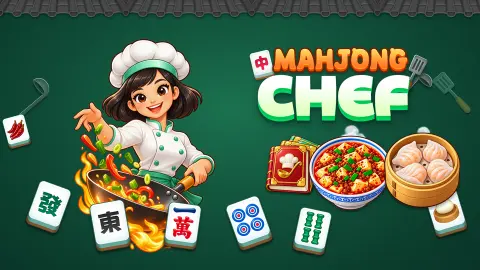



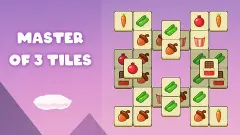


About Mahjong Chef
Every mahjong solitaire board asks the same question before it asks anything else: which of these tiles am I actually allowed to lift. Usually you work it out yourself. You look along the row, check whether the left edge is clear or the right edge is clear, check whether anything is resting on top, and only then click.
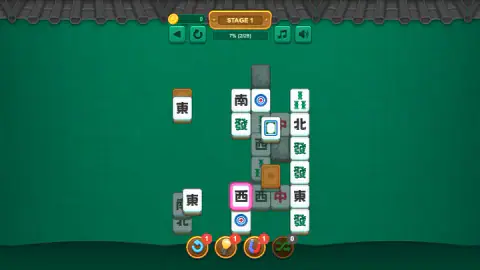
Mahjong Chef answers it in paint. A tile you may take is bright white. A tile you may not is washed out to the same flat grey as the table shadow, and stays grey until whatever pins it comes off. You are never really reading the stack. You are reading the colour.
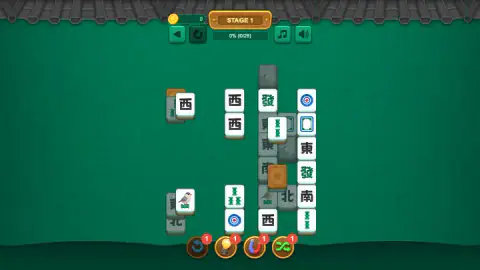
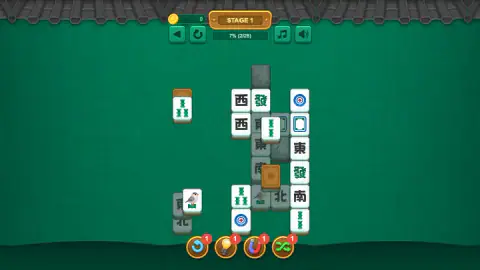
Stage one is not the turtle shape these games usually open with. It is a tall, narrow pile running down the middle of a dark green table, under a row of grey roof tiles, with a couple of loose tiles stranded to the left of it. A plaque at the top says STAGE 1 and the bar underneath counts what you owe: twenty-eight tiles, leaving in pairs. Our first match moved the counter from nothing to two in one step.
Two things in that pile are not tiles. A block of grey stone with a crack across it sits at the head of the centre column, showing no face at all. Further down, a tile lies face down, brown-backed, with a small pentagon stamped on it. Neither matches anything, and both are in the way.
The game is credited to sublevelgames. This one went up in April 2026 and was last updated in August.
A word on how far we got. We played for about four minutes on a desktop with a mouse and cleared two tiles out of twenty-eight, which is honest but thin. So this page can tell you what the board asks of you, what every button looks like, and what one of them costs when you spend it. It cannot tell you what finishing a stage looks like, or what the gold coins in the corner are for: that counter sat on zero throughout and we never saw it move. It cannot tell you where the chef of the title is, either. Stage one has no kitchen. No cook, no food, no recipe. Tiles.
The grey tiles are the rule, painted on
In mahjong solitaire a tile counts as free when it can slide out sideways without disturbing anything else. Not lifted. Slid. That is the whole rule, and two of its consequences catch people out.
The first is that a tile with another stacked on top is stuck, because it cannot go anywhere without tipping its passenger off. The second is subtler: a tile in the middle of a long row is stuck too, even with clear air above it, because both of its sides are walled in. Beginners click those constantly. So did we.
Painting the blocked tiles grey takes that calculation off the player, and quietly admits something uncomfortable: a board can lock. If the last two tiles bearing a face are both buried, patience will not free them, because the only things that free a tile are removals you can no longer make. That is why this kind of game hands you a shuffle, and why the shuffle is worth more than it looks.
Mahjong solitaire is a computer game from 1981, not an ancient one
The tiles are old. The puzzle is not.
Mahjong is a four-player game. The solitaire on this board was written by Brodie Lockard in 1981 on PLATO, an early educational computer network, under the name Mah-Jongg. Wikipedia's article on the genre puts the relationship between the two about as bluntly as it can be put: although it is named after the four-player tile game, the method of gameplay is unrelated.
What made it famous was Activision's Shanghai in 1986, and then Microsoft, which folded a version called Taipei into a Windows entertainment pack early in the nineties. The default layout of those versions has a name of its own, the turtle, which is why so many of these boards are wide, tapered and shallow. Activision sold the game as a descendant of a centuries-old Chinese pastime. Lockard never claimed that.
Knowing the puzzle is software explains the rule in front of you. A real pile of tiles would be cleared by lifting, and lifting makes a stack trivial. Sliding is a constraint you would only impose on drawings, and it is what turns a heap into a puzzle: the pile has a shape, the shape has ends, and the ends are the only places anything can happen.
Mahjong Chef's departure is the column. A turtle is wide and offers many free ends at once. A narrow stack offers two, which is a harder opening than it looks.
The faces are a real mahjong set, bird included
None of this is invented iconography. The four winds are there in black, with the green dragon, the red dragon and the blank blue-framed rectangle that is the white dragon and always throws newcomers. The green sticks are the bamboo suit, the blue circle with the red centre the circles suit. The bird on the left in the first two pictures is the one of bamboo, which traditional sets draw as a bird rather than a stick, usually a sparrow. It is not a mascot the studio added.
That matters practically. A full set runs to 144 tiles and the faces repeat in fours, so a face you are looking at probably has more than one partner in the pile. Finding the nearest match is not the skill. Choosing which of two identical matches to take, so the one you leave behind is not the one that ends up buried, is.
Four buttons, one use each, and what the shuffle cost us
Under the board sit four round brass buttons: an undo arrow, a hint bulb, a magnet and a shuffle drawn as two crossed green arrows. Each carries a small red badge with a 1 on it when the stage begins. That is not a price. It is the entire stock.
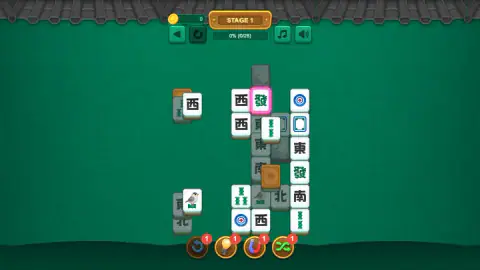
We spent the shuffle, and the two pictures either side of that moment are the clearest thing we learned all afternoon. Afterwards the badge had turned to a grey zero and the arrows had dimmed, and the faces had been dealt out again into different positions. The pile kept its exact shape, though: the cracked stone block stayed at the head of the column, the brown-backed tile stayed where it lay, and the counter did not move.
So a shuffle here rearranges what is painted on the tiles without touching the obstacles, and it costs you no progress. At the right moment, when the board has locked, that is a rescue. Spent early, out of impatience, it is the rescue you no longer have. We spent ours early.
More tile puzzles in the catalogue
Mahjong Alchemy is the closest comparison we have: the same pair-matching solitaire, with shaped boards and a shop that gives the coins something to do. Mahjong Lines changes the rule rather than the dressing, joining tiles along a path instead of freeing them at the ends. Mahjong Match belongs to the tray-and-triples family phone players recognise faster than the classic one. From the same studio, Cookie Match is a bakery sliding puzzle where every swipe moves all the dough at once, and Cube Sort turns a block of patterned tiles and asks you to feed two buckets. The rest of the shelf is in puzzle games.
Screenshots
How to play Mahjong Chef
- Hunt for white, ignore grey. Only bright tiles can be picked. The dim ones are not decoration: they are tiles something else is holding down, and they brighten on their own when it moves.
- Click one, then click its twin. The tile you choose gets a hot pink frame drawn around it and waits there. Click a second tile carrying the same face and the pair goes.
- Work from the top and the ends. A tile with another stacked on it, or wedged between neighbours, cannot come out. Row ends and stack tops are where the game is winnable.
- Watch what brightens after every pair. One removal can free several tiles further down the pile. The board tells you where to look next, in white, and that is the only free hint you get.
- Leave the four round buttons alone until you are stuck. Each carries a red 1, and that single use is the whole allowance for the stage.
What our run actually taught us:
- Grey tiles and grey stone are different things. A grey tile still has a face on it and is waiting its turn. The stone block has no face, has a crack through it, and never did anything while we played.
- Seeing a pair is not the same as having one. We spent a good stretch of those four minutes clicking two matching faces that were both pinned. The game does not complain; it simply declines.
- Repeating a click is wasted effort. If a tile did not answer once, it will not answer the fifth time.
- The keyboard is not part of this. We pressed arrow keys and letters throughout and got nothing out of them.
Controls
| Left click or tap | Pick a white tile, then click the tile with the same face. Both leave the board and the counter moves by two |
|---|---|
| Pink frame | Not a control but a reply. The tile you have picked is ringed in bright pink until you choose its twin |
| The four round buttons (bottom) | Undo, a bulb, a magnet and a shuffle. Each one starts the stage carrying a red 1, and that is all you get |
| Back arrow and circular arrow (top left) | Leave the stage and restart it. We pressed neither, so we cannot tell you where the arrow puts you |
| Music note and speaker (top right) | The two sound buttons. They sit in the corner of every screen we played |
| Keyboard | Nothing we could get out of it. Arrow keys and letters neither moved anything nor chose anything |
Features
- The board tells you the rule instead of making you work it out: a tile you may take is bright white, a tile you may not is washed out to grey, and it stays grey until whatever pins it comes off
- Stage one is a tall narrow column rather than the turtle shape most mahjong solitaires open with, and it asks you for twenty-eight tiles
- Two things in the pile are not tiles at all: a block of grey stone with a crack across it and no face, and a brown-backed tile lying face down with a pentagon stamped on it
- Four helpers under the board — undo, a hint bulb, a magnet and a shuffle — and each carries a single use for the whole stage
- Spending the shuffle redeals the faces and leaves the shape of the pile, the stone and the face-down tile exactly where they were. The counter does not move either way
- Proper mahjong faces: the four winds, the three dragons including the blank one, bamboo, circles, and the bird that every traditional set puts on the one of bamboo
- Made by sublevelgames
Game details
- Developer
- sublevelgames
- Release date
- April 2026
- Last updated
- August 10, 2026
- Added here
- February 2026
- Technology
- HTML5 (2D)
- Platforms
- Browser (desktop, mouse), Browser (mobile & tablet, touch)
- Classification
- Cards & Board , Cooking , Puzzle
- Saved progress
- Saving, when available, is managed by this game. Mava cannot confirm your level.
FAQ
How do you play Mahjong Chef?
You empty a stacked board two tiles at a time. Click a tile that is drawn bright white, then click another tile carrying the same face, and the pair leaves. A bar at the top counts what is left: it opened at 0% (0/28) for us and moved straight to two the first time we matched anything. Tiles drawn in grey cannot be picked at all.
What do the grey tiles mean in Mahjong Chef?
They are tiles that are blocked. In mahjong solitaire a tile can only be taken if it is able to slide out sideways without disturbing its neighbours, so anything buried in the middle of a row, or sitting under another tile, is out of play for now. This game saves you the arithmetic by washing those tiles out to grey and leaving only the available ones white.
What are the four buttons under the board in Mahjong Chef?
From the left: undo, a hint bulb, a magnet and a shuffle. Each one starts the stage with a red 1 on its badge, which is the number of times you may use it. We spent the shuffle and watched its badge turn to a grey 0 and the icon dim. We never used the other three, so we cannot tell you exactly what they do.
What are the stone blocks in Mahjong Chef?
They are grey blocks with a crack across them and no face on them at all, and one sits at the head of the main column from the first second of stage one. They cannot be matched, because they are not tiles. They never left the board in our four minutes, so we cannot tell you whether anything shifts them.
How many tiles do you have to clear in Mahjong Chef?
Stage one asks for twenty-eight. The bar under the STAGE 1 plaque shows the figure as a fraction and a percentage at the same time, so it reads 0% (0/28) at the start and 7% (2/28) once a pair is gone. We did not get past that stage, so we do not know whether later ones are bigger.
Is Mahjong Chef the same as the game mahjong?
No, and the confusion is old. Mahjong is a four-player game played with these tiles. Mahjong solitaire is a one-player puzzle created on a computer by Brodie Lockard in 1981, which borrowed the tiles and nothing else: Wikipedia puts it plainly, that it is named after the four-player game but the method of gameplay is unrelated. Mahjong Chef is the solitaire.
Who made Mahjong Chef?
The game is credited to sublevelgames. The game was published in April 2026 and was last updated in August. We found no studio website and no second source, so the name rests on that one portal.
Does Mahjong Chef work on a phone?
It is listed for Android and iOS alongside PC, and lists it for both landscape and portrait, which is unusual and suggests the board rearranges itself for a tall screen. A puzzle driven entirely by tapping one tile and then another should survive a touchscreen well. We only played it on a desktop with a mouse, so we have not checked it ourselves.