



About Jigsolitaire Puzzle
A jigsaw makes you find where each piece goes. A sliding puzzle makes you fight for room, one empty square at a time. Jigsolitaire Puzzle asks for less than either: pick up any tile, drop it on any other, and the two change places.
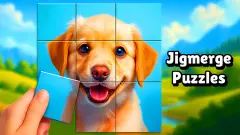
What turns that into a game is what happens when two tiles end up side by side the way they are in the photo. The white line between them disappears and they become one block. The board tells you what is right as you go, and the picture grows out of a few large pieces instead of many small ones.
The game's listing credits Good Games. It has been available since January 2026.
This page rests on about four minutes at a desktop with a mouse. We opened the first puzzle twice and finished it neither time. The reason we failed is the most useful thing we have to tell you, and it is further down.
Tiles that fit join up, even in the wrong place
The joining is the game's one real idea, and it has a catch worth knowing.
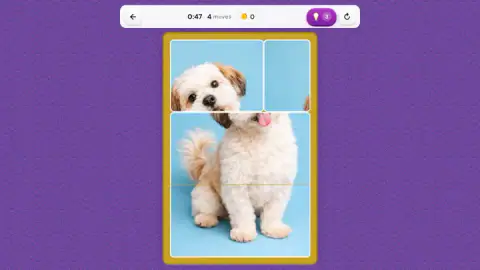
On our second attempt we brought the two halves of the dog's head together in the top row. The line between them vanished, and we had a head. Below it sat the body, all six tiles of the lower two rows in one block. It looked finished. The timer kept running.
It took a careful look at the picture afterwards to see why. The mouth was one tile to the left of the tongue. The head was whole, and it was sitting one column away from where it belongs, with the blue tile parked in the corner the head should reach. A white line still ran between the head and the body.
So a block means its tiles are right with each other. It does not mean they are in the right part of the board. The line to watch is the one between blocks: while it is there, something is still out of place, however good the photo looks.
The first puzzle starts two swaps from finished
This is our reading of the board, made after the session, and not something we played.
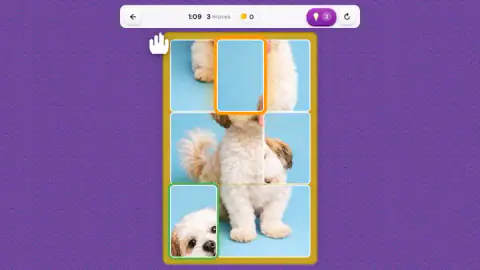
When the dog puzzle opens, five of its nine tiles are already joined: the tail, the body and the whole bottom row. Four tiles are loose. The face is in the top left corner with the blue tile beside it, and those two belong in each other's places. In the right-hand column, a tile of white fur with a pink tongue sits above the right half of the head, and those two are also the wrong way round.
Two swaps, then. We made eleven across our two attempts and did not finish.
The game did try to help. After our first move, a green frame appeared round the face and an orange frame round the blue tile, with a white hand drawn beside the board. The frames followed those two tiles wherever we put them, through three more swaps. They were marking the pair that needed to change places. We swapped the face with almost everything else.
On the second attempt we did swap the face with the blue tile, on our third move, and the frames were gone the next time we looked. By then both tiles had wandered from where they started, so the swap left us with the shifted head described above. Our last two moves then broke the bottom row, which had been right from the start.
A swap puzzle can always be solved, and a sliding one cannot
The best-known picture puzzle on a grid is the sliding one, fifteen tiles and a hole. It has a famous trap. Mix its tiles freely and half of all the arrangements you can make are impossible to put right by sliding, a fact mathematicians proved in 1879.
Swapping has no such trap. If any two tiles can change places, every arrangement can be undone, and there is a ceiling on the work: a board of nine tiles never needs more than eight swaps, and usually fewer. The count depends on how the misplaced tiles are tangled. Two tiles sitting in each other's places cost one swap. Three tiles that each sit in the next one's place cost two.
That is the sum behind the dog puzzle. Four tiles out of place in two pairs is two swaps. After our fourth move on the second attempt, we had three tiles in a ring along the top row, which is also two.
It also explains the name. Solitaire, in the old sense, is any game of patience for one player, and this one is a jigsaw picture played as patience: no opponent, and on the evidence of our four minutes, no clock running down.
What four minutes did not show us
A finished puzzle. We never saw the win screen, so we cannot say what it awards. The coin counter in the top bar read zero from start to end, and we do not know what coins buy.
We did not press the light bulb, and its stock was three when we stopped. We did not press the restart arrow. We cannot tell you whether a joined block can be moved in one piece, only that our drags on one did nothing.
The menu showed a set called Classic with a counter at 0 out of 20, and tabs marked DAILY, COLLECTIONS and QUESTS. We opened none of them. The provider's description speaks of larger grids, more collections, leaderboards and puzzles made from your own photos. All of that is the provider's word. What we can vouch for is one dog on nine tiles.
We heard one sound as the game opened and none we could tie to a swap.
Who it is for
Anyone who likes a jigsaw but not the hunt through a tray of loose pieces. Everything is on the board from the start, and the first puzzle rewards looking before dragging.
It also suits a young child, with one caution: the hand and the coloured frames are the only instruction we saw, and there are no words with them. We are proof that they can be misread.
If you want the snap of a knobbed piece going into its hole, this is not that. The tiles are squares.
More picture puzzles
Cozy Jigsaw Puzzles and Jigsaw Puzzles are the traditional kind, with pieces dragged from a tray onto the board. Jixora – Jigsaw Solitaire Puzzle is another take on the idea played here. For the fifteen tiles and a hole, there is Sliding Puzzle. The rest are under puzzle games.
Screenshots
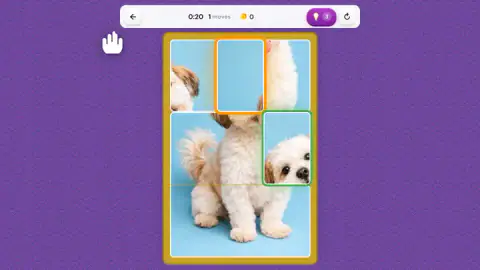
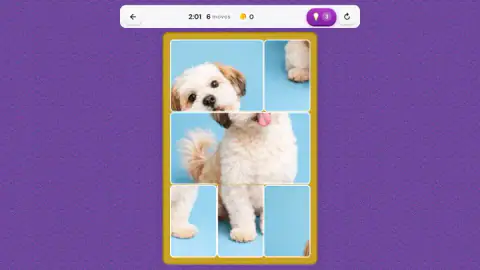
Taken by opening the game ourselves and letting it run — not supplied by the publisher, and not the same picture every other site shows.
How to play Jigsolitaire Puzzle
- On the menu, press the green PLAY button. The first puzzle is a photo of a small white dog with brown ears, on nine tiles.
- Look for the white lines. A tile with a line all the way round it is loose. Tiles with no line between them are already joined.
- Drag a loose tile and drop it on the tile whose place it should take. The two swap.
- Keep going until no white lines are left inside the picture.
What two attempts taught us:
- Start from the tile, not from the gap. There is no gap. One tile of the dog photo is nothing but blue background, and we spent our first minute treating it as an empty square to fill. It is a tile like the others and it has a place of its own.
- Grab loose tiles. Every swap that counted for us began on a tile with a line all round it. Several drags that began on a tile inside a joined block did nothing at all.
- A joined block is not locked. We dropped the dog's face onto the bottom left corner, and the correct tile that was there was thrown out to the top row. The block shrank from five tiles to four.
- The back arrow costs you the puzzle. We pressed it at five moves, and when we came back in, the board was as it had been at the start and both counters read zero.
Controls
| Drag a tile onto another tile | Swaps the two; each swap adds one to the move counter |
|---|---|
| PLAY (menu) | Opens the next puzzle of the set on screen |
| Arrow (top left) | Leaves the puzzle and returns to the menu; the puzzle starts again from zero when you come back |
| Light bulb (top right) | Hint button with a stock of three beside it; we did not press it |
| Round arrow (top right) | Restart button for the puzzle on screen; we did not press it |
Features
- A photo cut into square tiles that you put right by swapping any two, with no empty space and no sliding
- Tiles that fit each other lose the white line between them and become one block
- A first puzzle of nine tiles, a small dog on a blue background, that begins with five tiles already joined
- A green frame and an orange frame that mark a pair of tiles on the first puzzle
- A timer that counts up and a move counter, with no limit on either that we reached
- A coin counter and a stock of three hints in the top bar from the first puzzle
Game details
- Developer
- Good Games
- Release date
- January 2026
- Last updated
- August 10, 2026
- Added here
- November 2025
- Technology
- HTML5 (2D)
- Platforms
- Browser (desktop, mouse), Browser (mobile & tablet)
- Classification
- Cards & Board , Puzzle
- Saved progress
- Saving, when available, is managed by this game. Mava cannot confirm your level.
FAQ
How do you play Jigsolitaire Puzzle?
Press PLAY and a photo appears cut into square tiles, some of them in the wrong places. Drag one tile onto another and the two change places. Keep swapping until the picture is whole. Tiles that fit each other join into a block, which is how you can tell a part is right.
Is Jigsolitaire Puzzle a jigsaw or a sliding puzzle?
Neither, strictly. The tiles are plain squares with no knobs, so it is not a jigsaw in the usual sense, and there is no empty space to slide into. Any tile can change places with any other, wherever the two are on the board. That makes it a swap puzzle, which is the gentlest of the three.
What do the green and orange frames mean in Jigsolitaire Puzzle?
On the first puzzle, two tiles carried a coloured frame after our first move, green on the dog's face and orange on a tile of plain blue background, and the frames followed those tiles wherever they went. By our reading of the photo, those two tiles belong in each other's places. We take the frames for the game pointing at a swap, though no text on screen says so.
How do you solve the first puzzle in Jigsolitaire Puzzle?
We did not finish it, so this is our reading of the board and not a solution we played. Swap the dog's face with the plain blue tile to its right, then swap the two loose tiles in the right-hand column. The other five tiles are already joined in their places when the puzzle opens.
Is there a time limit or a move limit in Jigsolitaire Puzzle?
We did not run into one. The timer counts up from zero and passed two minutes on our longest attempt, and the move counter reached six, without the game stopping us. Leaving the puzzle with the back arrow reset both to zero.
How many puzzles are there in Jigsolitaire Puzzle?
The menu showed a set called Classic with a counter reading 0 out of 20, and tabs for a daily puzzle, collections and quests. We only opened the first Classic puzzle. The provider's description speaks of several collections and of grids up to nine tiles a side, none of which we saw.
Can you play Jigsolitaire Puzzle on a phone?
It is listed for PC, Android and iOS, in both landscape and portrait. Everything we did was a drag from one tile to another. Our own time with it was on a desktop with a mouse, so the phone side is the listing's word and not ours.
Who made Jigsolitaire Puzzle?
The game's listing names Good Games as the developer. The game was published in January 2026 and its last update is dated August 2026.