





About Solitaire: The Eternal Deck
Most browser solitaires sell their extras as free: undo as often as you like, hints whenever you are stuck. Solitaire: The Eternal Deck prints a price under its two help buttons. Hint costs 20 coins and Undo costs 15, and the gold tags sit right next to them all through the deal.
That small change shapes how you play. The rules are plain Klondike, the solitaire most people picture when they hear the word. But a take-back is no longer a reflex. Before you drag a card into a column, it pays to look one move further.
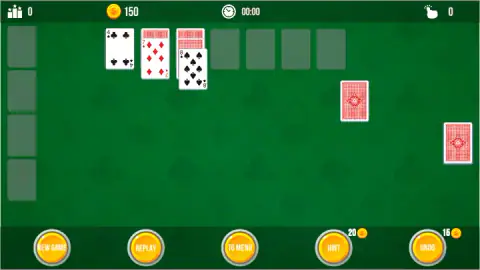
The rest of the table is calm on purpose. A dark green cloth, white cards with red backs, and a top bar with four readings: score, coins, a clock and a move counter. The game is played in landscape, so it fills a desktop window without bars at the sides.
The game is credited to the studio NewPlace and has been available since August 2026. We played one deal with a mouse for about four minutes. The notes below say what we saw, and where we stopped.
Our deal, card by card
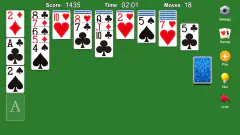
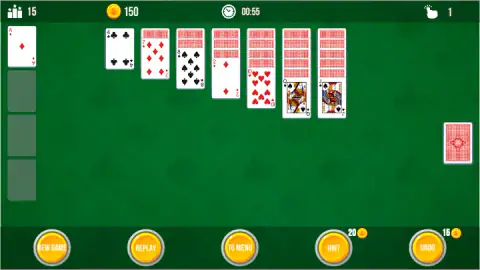
Klondike always opens the same way: seven columns, from one card on the left to seven on the right, with only the last card in each turned face up. Ours showed these seven faces, left to right:
| Column | Face-up card |
|---|---|
| 1 | four of clubs |
| 2 | seven of diamonds |
| 3 | eight of spades |
| 4 | two of diamonds |
| 5 | ten of hearts |
| 6 | queen of spades |
| 7 | jack of spades |
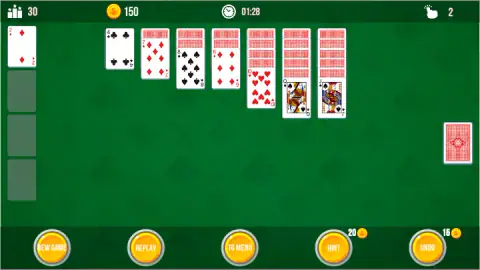
Our first move put the ace of diamonds on the top foundation, and the score read 15. The two of diamonds in column 4 followed it, which turned over the six of diamonds underneath. Score 30.
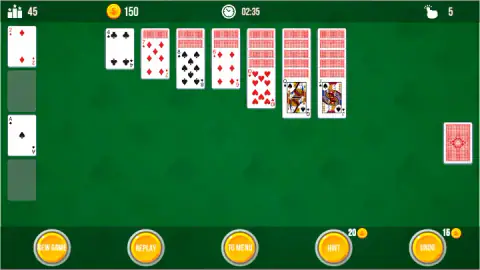
From the deck came the ace of spades, and it went straight onto the bottom slot for another 15. That made 45 points from three cards, after five moves and two and a half minutes. That is where our session ended. The black jack on the right had no red queen to land on yet, and the long face-down piles in the three right-hand columns were untouched.
So this page does not describe a won deal. We did not see the stock run out, the button that refills it, the auto-complete the listing promises once every card is face up, or the end screen.
Draw 1, Draw 3, Normal, Vegas: four words from 1990
The setup window is a direct echo of one program. Microsoft Solitaire was written by Wes Cherry, then an intern at Microsoft, and shipped with Windows 3.0 in 1990. Its card backs and faces were drawn by Susan Kare, who had designed the icons of the first Macintosh. According to its history on Wikipedia, part of its job was to teach people the mouse: dragging a card is a drag-and-drop.
Two of its options are the two choices this game asks you to make. Draw one or draw three: turn up one card from the stock or three at a time, with only the top one playable. Draw 3 hides two cards out of every three behind the one you can use, so the same deal becomes much harder.
Vegas scoring is the other. Guides to the Windows game describe it as a bet: a deal costs 52 dollars, one for each card, and every card you get onto a foundation pays 5 back. You need eleven cards up just to break even, and nobody plays for the clock. It turns patience into a game of how far you can get.
We left the setup as we found it and saw 15 points for each foundation card. Old Windows paid 10 in its standard mode, so this game's normal scoring, if that is what we had, is a little more generous. We did not test Vegas here.
Coins, medals and the shop
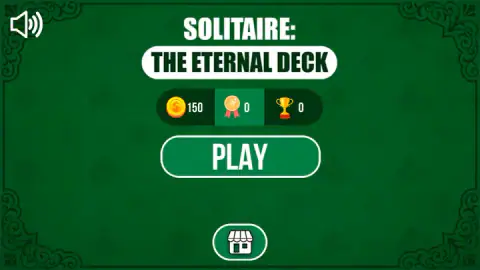
The title screen shows three counters: coins, a medal and a trophy. Ours read 150, 0 and 0. Below the Play button sits a shop icon, which we did not open.
The coins did not change during our deal, even while the score climbed to 45. So in this game points and coins are separate: points measure a deal, coins pay for help. What earns coins, and what the medal and trophy count, we did not find out in four minutes. A daily reward window, with Later and Claim, greeted us before the menu.
Who it is for
This is for anyone who already knows Klondike and wants it in a browser tab, without themes or story. The cards are large and easy to read, and nothing on the table moves unless you move it.
New players will need the rules from somewhere. We saw no tutorial and no text on the table that explains them. The steps above cover what you need.
Younger players can manage if they know the order from ace to king and can tell red suits from black. The only clock counts up, so there is no hurry.
More card tables, and more from NewPlace
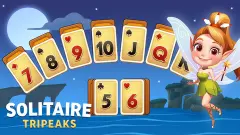
Solitaire Klondike - Treasure Island puts the same rules on a pirate map, and Solitaire is another plain Klondike table to compare. For a different solitaire, Solitaire Tripeaks clears pyramids by counting up and down. NewPlace also made Keyboard Escape: +1 Speed | Sweets, a runner on a floor of keycaps. For more, browse our puzzle games.
Screenshots
Taken by opening the game ourselves and letting it run — not supplied by the publisher, and not the same picture every other site shows.
How to play Solitaire: The Eternal Deck
- Press Play on the title screen. A Game Setup window asks for Draw 1 or Draw 3 and for Normal or Vegas scoring. Press Play again.
- Drag cards between the seven columns. Each column builds downwards in alternating colours, so a red nine goes on a black ten.
- Drag aces to the four grey slots down the left edge, then build each one up in its own suit, two, three and so on to the king.
- When nothing moves, click the face-down deck in the bottom right corner to draw.
- Only a king, or a run headed by a king, may fill an empty column.
What our deal taught us:
- Any ace takes any slot. The grey slots are not reserved for a suit. Our first ace went to the top, our second to the bottom, and we could drag that second ace up to another empty slot afterwards.
- The move counter counts everything. Moving that ace between two slots added a move and no points. The counter measures effort, the score measures progress.
- The clock counts up. It starts at 00:00 and nothing happens when it passes a round number. Take your time.
- Spend coins last. With Hint and Undo both priced, the cheapest help is a long look at the board before each drag.
Controls
| Drag a card | Moves it, or the run of face-up cards under it, to a column or a foundation slot |
|---|---|
| Click the face-down deck (bottom right) | Draws from the stock |
| Hint (20 coins) | Asks the game for a move |
| Undo (15 coins) | Takes back your last move |
| New Game / Replay / To Menu | Deal a fresh game, restart the same deal, or go back to the title screen |
Features
- Classic Klondike with seven columns, four foundation slots down the left edge and the stock in the bottom right corner
- A setup window before each deal with Draw 1 or Draw 3 and Normal or Vegas scoring
- Every card we put on a foundation added 15 points to the score at the top left
- A clock that counts up from 00:00 and a move counter that also counts moves worth no points
- Hint costs 20 coins and Undo costs 15, from a purse that starts at 150 on the menu
- Foundation slots are not tied to a suit, so the first ace you play can go in any of them
- Listed since August 2026
Game details
- Developer
- NewPlace
- Release date
- August 2026
- Last updated
- September 15, 2026
- Added here
- July 2026
- Technology
- HTML5
- Platforms
- Browser (desktop, mouse), Browser (mobile & tablet, touch)
- Classification
- Puzzle
- Saved progress
- Saving, when available, is managed by this game. Mava cannot confirm your level.
FAQ
How do you play Solitaire: The Eternal Deck?
It is Klondike. Build the seven columns downwards in alternating colours, a red six on a black seven, and only a king may fill an empty column. Send each suit to the four foundation slots on the left, ace first and king last. Click the face-down deck in the bottom right corner when you need a new card.
How do you win Solitaire: The Eternal Deck?
A deal is won when all four suits are on the foundations, from ace to king. We did not finish our deal, so we cannot describe the screen that follows. In our game, each card that reached a foundation added 15 points to the score.
Is Undo free in Solitaire: The Eternal Deck?
Not in the version we played. The Undo button carries a price of 15 coins and the Hint button 20, both printed next to the buttons. The menu showed a purse of 150 coins, and the coins did not move while we played.
What is the difference between Draw 1 and Draw 3?
The setup window before each deal offers both. With Draw 1 every click on the deck turns up one card and every card in the stock is reachable. With Draw 3 you turn three at a time and can only play the top one, which makes the deal harder.
What is Vegas scoring in Solitaire: The Eternal Deck?
It is the second scoring option in the setup window, next to Normal. The name comes from Windows Solitaire, where Vegas scoring treated each deal as a bet of 52 dollars that paid back 5 for every card on a foundation. We played without changing the setup and did not test Vegas.
Is Solitaire: The Eternal Deck good for kids?
It is a quiet card game with no timer pressure, since the clock only counts up. Children need to know the order of the cards and tell red suits from black ones. The Vegas option uses betting language, but there is no real money involved.
Who made Solitaire: The Eternal Deck?
The game is credited to NewPlace and has been available since August 2026, with a last update in September 2026. The same studio made Keyboard Escape: +1 Speed | Sweets.