

About Wordeck: Associations
Most browser games treat their opening level as a corridor: make the move, or be moved along. Wordeck: Associations treats it as a door it will hold open all afternoon. A pointing hand shows you the one card worth touching, a line of text explains why, and then the game stops and waits. It waited ten minutes for us, and it never once did the move itself.
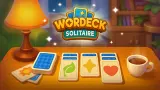
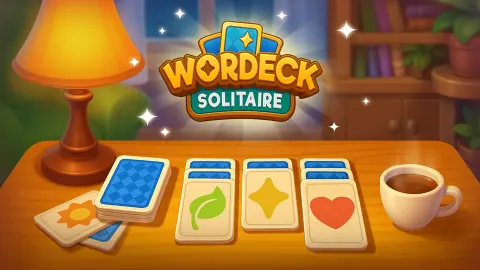
The table it waits on is solitaire furniture with the suits taken out. Green felt, a wooden rim, three columns of mostly face-down cards, a small deck up in the corner. Every card that is face up carries a word instead of a rank: Lily, Bed, Burger.
The job is to sort those words by what they have in common. What turns that from a quiz into a card game is that the themes are cards too. Food and Pets are not printed on the table anywhere. They are buried in the columns, underneath the very words they are meant to collect, and until you dig one out its words have nowhere to go.
The game is credited to Yellow Bird Games and has been available since July 2026. What follows comes from two sittings at level 1, a short one early in October and a longer one this week. Neither of them finished the level, and the things we never reached have a section of their own further down.
The level will wait all day, and that is worth knowing
It looks like a fault the first time it happens, and it is not.
In our long sitting the table did not change at all for the first three minutes. The hand went on lifting its pale copy of the Food card, the banner went on reading "Sort words into themes. Drag a card to move it!", and the game went on waiting. Then one drag landed properly and three cards went into place in quick succession: the Food theme up to the middle, Pizza onto it, Burger onto Pizza.
The banner answered "Nice! Move one more card.", dissolved into "Let's move another card with a theme up." — and then waited another six minutes while we failed to prise the Pets card out of the right-hand column.
Nothing escalated in all that time. No clock appeared, no second hint, no offer to skip, no score going down. Cards dropped in the wrong place went back where they came from, and no counter moved. The coin box in the corner read 300 at the start of the session and 300 at the end of it, and the little deck top right showed the same number throughout.
The patience cuts both ways. There is no pressure, which is plainly the point of a game dressed as a quiet card table. There is also nothing to tell you that the problem is your mouse hand rather than your vocabulary.
A word can turn up before its theme does
This is the part the first instruction does not mention. Take Pizza off the middle column and Dog turns over underneath it. At that moment the top row holds Flowers and Food, and a dog belongs to neither. The card simply sits there.
Its theme was two moves away, face down under Burger in the right-hand column. Burger had to go onto Food first. Only then did Pets turn over, and only once Pets reached the last free place in the top row did Dog have anywhere to go. In the earlier sitting, when we got that far, Cat was waiting underneath it.
So the order in which you clear the columns matters, even on a level this small. A word with no home is not a mistake. It is a sign that its theme is still under something. Level 1 keeps one such card in plain sight the whole way through: Bed, at the bottom of the left-hand column, which fits none of Flowers, Food or Pets. We still do not know where it ends up.
What it keeps from solitaire, and what it swaps
Anyone who has played Klondike, the solitaire that comes with most computers, will recognise the furniture. Columns of cards with only the last one face up. A card turning over when the one on top of it leaves. A row of piles at the top that you fill until they are complete. A spare deck off to one side.
The swap is in what decides where a card may go. In Klondike it is the suit and the next number along, and you can read it off the card. Here it is meaning: you have to know that a lily is a flower and a burger is food. The level-1 words are plain enough that the reading is never the hard part. The digging is.
What we still have not seen
It is a long list, and giving it is better than guessing.
- A finished theme. Food stopped at 2/4 and Pets never left its column.
- Level 1 completed, and everything that comes after it.
- The deck. The face-down deck in the corner showed a 3 from the first screen to the last and we never drew from it.
- The coins. They stayed at 300 in both sittings and we found nothing to spend them on.
- Where Bed goes, and whether a level can hold more than three themes.
- Phones. The game is listed for touch screens; we only ever played it with a mouse.
Who it suits
It suits someone who likes solitaire's digging and uncovering but would rather read words than count from ace to king. There is no clock in level 1, so there is time to think, and the vocabulary we saw is everyday English, which makes it reasonable practice for someone learning the language.
It suits less a player who wants a spelling game. You never form a word here; you only decide which group it belongs to. And it suits least a player who wants to be carried: this one really will sit there until you work the move out.
More word-sorting card games
The idea has close relatives on the site. Word Solitaire and Word Associations Solitaire both sort word cards under gold-framed theme cards on a solitaire table. Connect Associations and Words and Bubbles drop the cards and keep the grouping by theme. For the suits-and-numbers original there is Solitaire. The rest are under puzzle games.
Screenshots
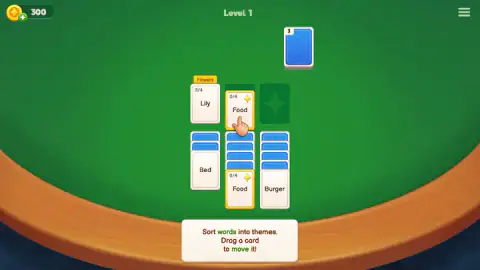
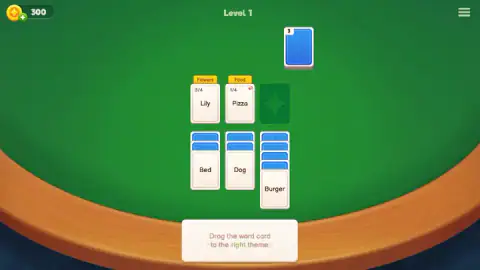
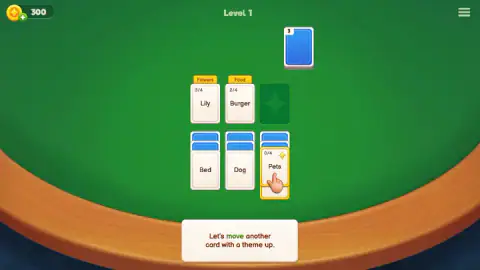
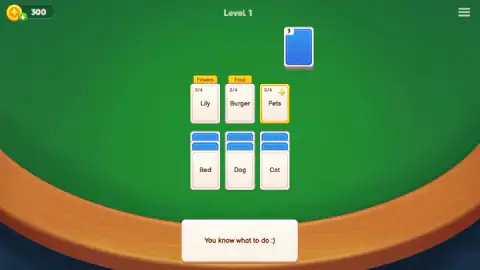
Taken by opening the game ourselves and letting it run — not supplied by the publisher, and not the same picture every other site shows.
How to play Wordeck: Associations
- Find a theme card. It has a gold frame, a four-point star and a counter reading 0/4. In level 1 the first one, Food, sits face up at the bottom of the middle column.
- Drag it to the top row. There are three places up there, and an empty one is dark green with a star on it. Drop a theme card on one and that place starts collecting that theme.
- Drag each word onto its theme. Pizza goes on Food and the counter moves to 1/4. At the same moment the theme's own name jumps up into a yellow tab above the pile.
- Watch what turns over. Every time a face-up card leaves a column, the face-down card under it flips. That new card is your next move, or your next problem.
- Keep going until the themes are full. Each of the three themes we saw wanted four words. We never filled one.
What we picked up while playing:
- Dragging is the only verb. Clicking a card leaves it exactly where it is. The gold frame around Food and Pets is not a selection either, however much it looks like one: it is simply how a theme card is drawn, and it is already there before you touch anything.
- Aim at the place, not near it. The drags that worked ended inside a top-row place. Ones that stopped short of it, or came back down onto the column, put the card straight back where it started.
- A pile only shows its last word. Once Burger landed on Food it covered Pizza. The Flowers pile opens the level at 3/4 with Lily on top, and the two flowers underneath are never named.
- The pointing hand is a hint, not a move. It lifts a pale copy of the right card, carries it to the right place, drops it and starts again. The real card has not moved at all.
Controls
| Mouse drag | Carries a theme card to an empty place in the top row, or a word card onto its theme pile |
|---|---|
| Mouse click | Does not move a card; we clicked one many times across two sittings and it stayed where it was |
| Arrow keys | No response |
Features
- A solitaire layout with words in place of suits: three columns of mostly face-down cards under a top row of three places
- Gold-framed theme cards such as Food and Pets that have to be dug out of the columns and dragged to the top row before any word can go on them
- A counter on every theme pile, such as 2/4, showing how many of its words are in
- A face-down card turns over each time the card on top of it leaves the column
- A guided first level that explains each move with a pointing hand and one line of text, and then waits as long as it takes
- No clock, no move counter and no mistake counter on screen in level 1; a wrong drop puts the card back and costs nothing
- Made by Yellow Bird Games and listed since July 2026
Game details
- Developer
- Yellow Bird Games
- Release date
- July 2026
- Last updated
- September 25, 2026
- Added here
- May 2026
- Technology
- HTML5
- Platforms
- Browser (desktop, mouse), Browser (mobile & tablet, touch)
- Classification
- Puzzle
- Saved progress
- Saving, when available, is managed by this game. Mava cannot confirm your level.
FAQ
How do you play Wordeck: Associations?
You sort word cards into themes on a solitaire-style table. A gold-framed theme card, such as Food, is dragged to an empty place in the top row, and then the words that belong to it, such as Pizza and Burger, are dragged onto it. Every card you take off a column turns over the face-down card beneath it.
Do you click or drag the cards in Wordeck: Associations?
You drag them. Across two sittings we clicked cards over and over and nothing ever moved. Holding a card, carrying it to its place and letting go there is what works, and the game's first instruction says the same: drag a card to move it.
What do the numbers on the theme cards mean?
They count the words placed on that theme. Food started at 0/4, read 1/4 once Pizza was on it and 2/4 once Burger followed. All three themes we saw in level 1 asked for four words. We never filled one, so we cannot say what happens at 4/4.
Is Wordeck: Associations timed?
Level 1 showed no clock and no move counter. We sat on the same screen for ten minutes and nothing counted down, nothing escalated and no hint changed. The header holds a coin counter, the level number, a menu button and a small face-down deck, and nothing else.
What happens if you put a card in the wrong place in Wordeck: Associations?
In level 1, nothing. A card dropped anywhere other than a theme pile goes back to where it came from, no counter moves and nothing is taken off the table. The game's own blurb mentions that later levels can limit mistakes, but level 1 showed no mistake counter at all, so we cannot confirm that.
What are the coins for in Wordeck: Associations?
We do not know. The counter read 300 when level 1 opened and still read 300 at the end of both our sittings, and nothing asked us to spend any. There is a green plus sign beside it that we did not press.
How many levels does Wordeck: Associations have?
We cannot say. We played the guided part of level 1 twice without finishing it, and we saw no level map. The level we saw used three themes and everyday words such as Lily, Dog and Bed.
Who made Wordeck: Associations?
It is credited to Yellow Bird Games. It was published on 2 July 2026 and its page was last updated on 25 September 2026. It is listed for desktop and for phones.