




About Solitaire Emperor - Secrets of Fate
Most solitaire in a browser is Klondike: seven columns, red on black, kings into the empty spaces. Solitaire Emperor - Secrets of Fate asks for none of that. Its table is a wide fan of cards laid over a painted village at sunset, there is one card sitting alone at the bottom of the screen, and every move comes down to the same question: is the card I am looking at one rank higher or one rank lower than that one?
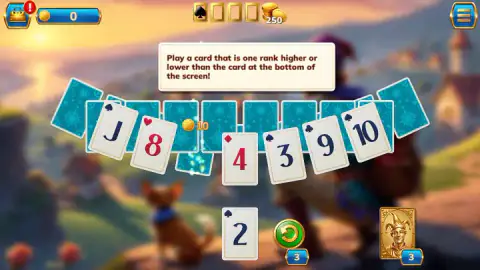
The game does not hide the rule. In the first level it is printed in a banner across the table: "Play a card that is one rank higher or lower than the card at the bottom of the screen!" Suit never comes into it. Hearts go onto spades and clubs onto diamonds; only the number counts. The card you play then becomes the new card at the bottom, so the target moves every time you touch it.
It is listed under the developer name Boris_borr, published in December 2024. We have played it twice. The first run ended early, stuck in the tutorial; the second lasted about ten minutes, took the coin counter past 800 and still did not finish level one. What follows is what the table showed us; where something comes from the game's own instructions, we say so.
Ace to king in one run: the ladder is the whole puzzle
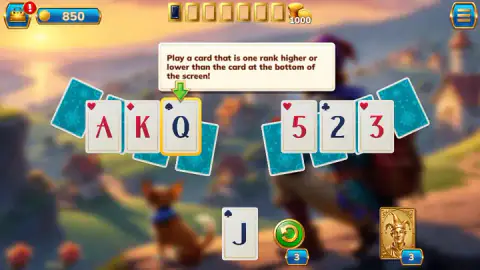
The clearest thing we can tell you about this game is what the bottom card did. It began our last run as an ace and ended it as a king, climbing rank by rank, with the suit changing underneath it the whole way.
That is the shape of a good level here. You are not sorting cards into families, you are building a staircase and looking for the next step. A strong position is one where the fan still holds a neighbour for whatever you are about to put down; a weak one is a fan full of 9s and 10s with a 3 at the bottom.
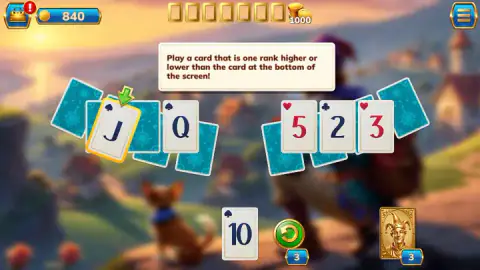
The fan itself changes as you work. At the deal it was one arc of about ten cards, with light blue patterned backs crowding behind them. Later in the same level it had thinned into two clusters, an ace, a king and a queen on the left, a 5, a 2 and a 3 on the right. Buried cards had surfaced, and the shape of the table showed how far along we were.
Chains pay, single cards barely do
The coin counter sits top left behind a coin icon. It read 0 when the cards came down, and while we picked cards off one at a time it crept up in small steps.
Then the table opened and one unbroken run carried it from 320 to 840 — more than the previous minutes had earned put together. That is the lesson: a card removed on its own is almost worthless, and the same card removed as the fifth link in a chain is where the game pays.
Beside the counter there is a row of small cards that fills up as you clear the table. That is your progress through the level, and the only honest read you get on how much is left. A second number next to the coins rose in steps as we did, from 250 near the start to 1,000 once our coins had passed 840. It behaves like a target raised each time you reach it, though nothing on screen said so and nothing was paid out in front of us.
The instructions add the one piece of strategy you cannot see on the table: the more cards are left in the deck when you clear the field, the more coins you get at the end. Chains pay, and thrift pays twice.
The two helpers, and the one interruption
To the right of the bottom card sit the draw pile and a gold jester card marked 3. The jester is the interesting one. The game's instructions describe a gold card you can throw in when you are stuck, and say it does not break your chain. In a game that pays for unbroken runs, a card that keeps a run alive is worth more than any ordinary move, and three is not many for a level.
Level one teaches itself without a word beyond that banner. A green arrow drops over the card it wants next, that card gets a yellow border, and at one point a white hand pointed from our selected card to the one it wanted played.
One thing to expect: the level breaks for an advert. Ours came roughly two minutes in, as a panel over the table with a Continue playing button back to the cards. The game also pauses itself and waits for a click when it loses your attention, so a level is never lost while you are away.
Golf, TriPeaks and why the suit never matters
The move at the heart of this game is far older than any browser. In the traditional patience called Golf, you also move cards from a layout onto a single pile, one rank up or down, with the suit playing no part. The name comes from the scoring: the cards you could not clear count like strokes on a course, so a low number is a good round.
The suit is ignored for a reason, and it tells you where the difficulty lives. In Klondike the puzzle is colour and sequence at once, over seven tidy columns. In the Golf family there is one question per card, so all the difficulty has to come from the deal, from which cards are buried under which. That is why these games spend their imagination on the shape of the table.
TriPeaks is the version most people have met, dealing the cards into three overlapping pyramids; clearing a card that covers another turns the hidden one face up. Solitaire Emperor keeps that idea and gives it a different silhouette, the fan. It also turns Golf's scoring inside out: instead of counting the cards you failed to clear against you, it pays you for the ones you never needed to draw.
What we have not seen yet
We did not finish level one, so we have not seen the end-of-level screen, how many levels there are, or what the coins buy. The listing mentions Tarot cards and a different mix of mechanics each level; the first level dealt an ordinary deck plus that gold jester, and no story appeared while we played, so whether the "secrets of fate" of the title turn up is something we still owe you. One smaller question is open too: the instructions list the order as ace, king, queen, jack, ten and so on, which would put an ace next to a king, but our run climbed to a king and stopped.
More solitaire to try
Boris_borr also made Solitaire Klondike - Treasure Island, a classic Klondike with a pirate story, and Rift of Hell - Demons War, which is not a card game at all. For more of the same move, Solitaire Tripeaks deals it into the usual three pyramids and Magic Tri Peaks Solitaire builds the ladder on another table. More in our puzzle games.
Screenshots
Taken by opening the game ourselves and letting it run — not supplied by the publisher, and not the same picture every other site shows.
How to play Solitaire Emperor - Secrets of Fate
- Press LEVEL 1. The opening screen is not a card table: a traveller in a purple cap and a small dog look down on a village at sunset, with a green LEVEL 1 button beneath them. The solitaire is wrapped in a journey, told level by level.
- Find the card at the bottom. It sits alone, centre bottom. Everything is played onto it, and it is never a card you pick up and move.
- Click a face-up card in the fan. Any card one rank above or below the bottom card can go. A 5 takes a 4 or a 6; a jack takes a 10 or a queen.
- Keep the chain alive. Cards played one after another without a break are where the coins are. The instructions say a level is won when the field is empty.
- Draw only when the fan has nothing left. The round green button to the right of the bottom card is the draw pile, and the small number on it is how many cards remain.
Tips from our table:
- Click the fan, not the bottom card. This is how we lost our first run. With a 3 at the bottom and a 4 glowing in the fan, we tapped the 3 for nearly two minutes. Nothing happened: the bottom card is a destination, not a piece.
- Treat every draw as a cost. The instructions say the cards left in the deck at the end are worth coins, so a draw is not a free rescue: it is a card out of your bonus. Exhaust the fan first.
- Look under what you clear. Cards lie on top of other cards. In our first run, playing a 2 uncovered a 4 beneath it, and that 4 became our next move two cards later.
- Check which way the run is going. A climb can turn and come back down, so ask what the fan still offers for the card you are about to put down.
- Nothing is on the keyboard. Arrow keys and Enter did nothing in either run; every move is a click or a tap.
Controls
| Click or tap a face-up card in the fan | Plays it onto the card at the bottom, if it is one rank higher or lower |
|---|---|
| Round green button, right of the bottom card | The draw pile; the small number on it is how many cards are left in the deck |
| Gold jester card, bottom right | A helper marked 3 that, according to the game's instructions, keeps a chain going when you are stuck |
| Menu button, top right | Opens the game menu |
Features
- One rule for every move, printed on the table in the first level - play a card one rank above or below the card at the bottom
- Suit and colour are ignored; in our last run the bottom card climbed from an ace to a king, one rank at a time
- Chains are the whole economy: a single run took our coin counter from 320 to 840, more than the previous ten minutes had earned
- The table is a wide fan of about ten cards laid over a painted village at sunset, with light blue face-down cards behind them
- Clearing a card can uncover the one lying under it, so the fan reshapes itself as you work through it
- A round green draw pile sits beside the bottom card with the number of remaining cards on it, and the game's instructions say leftover cards are worth coins at the end
- The first level teaches itself with a green arrow, a yellow border and a pointing hand, so nobody has to guess the rule
- One ad break interrupted level one about two minutes in, with a Continue playing button back to the table
Game details
- Developer
- Boris_borr
- Release date
- December 2024
- Last updated
- August 10, 2026
- Added here
- April 2025
- Technology
- HTML5 (2D)
- Platforms
- Browser (desktop, mouse), Browser (mobile & tablet, touch)
- Classification
- Puzzle
- Saved progress
- Saving, when available, is managed by this game. Mava cannot confirm your level.
FAQ
How do you play Solitaire Emperor - Secrets of Fate?
You clear a fan of cards by playing them onto the single card at the bottom of the screen. A card can go there only if it is one rank higher or one rank lower, so a 6 can follow a 5 or a 7. Suits and colours do not matter. Each card you play becomes the new card at the bottom, and the game's instructions say a level is won when the field is empty.
Does the suit matter in Solitaire Emperor?
No. Only the rank counts, which is what separates this family of solitaire from Klondike. In our last run we climbed from an ace all the way to a king without the suit ever blocking a move, mixing hearts, spades, clubs and diamonds freely.
How do you earn coins in Solitaire Emperor - Secrets of Fate?
Coins come from chains, not from single cards. Picking cards off one at a time moved our counter in small steps, while one unbroken run carried it from 320 to 840. The game's instructions add that the more cards are still left in the deck when you clear a level, the more coins you collect at the end.
Can a king follow an ace in Solitaire Emperor?
The game's instructions list the removal order as ace, king, queen, jack, ten and so on, which would put an ace next to a king. We climbed from an ace up to a king in one run and stopped there, so we have not seen the wrap from king back to ace with our own eyes.
What are the two buttons next to the card at the bottom?
The round green one is the draw pile, and the small number on it is how many cards the deck still holds. Beside it sits a gold jester card marked 3. The game's instructions say a gold card can be thrown in when no move is left and does not break your chain; we never needed to use ours.
Is Solitaire Emperor the same as TriPeaks?
It uses the same move as TriPeaks and the older patience called Golf, where cards go onto a single pile one rank up or down and the suit is ignored. The layout is its own. Instead of three pyramids there is a wide fan of cards over a painted landscape, which thins out into separate groups as you clear it.
Who made Solitaire Emperor - Secrets of Fate?
It is listed under the developer name Boris_borr. It was published in December 2024.
Can you play Solitaire Emperor on a phone?
The game is listed as playable on phones and tablets, and every move is a single tap on a card or a button, with nothing on the keyboard. We played it on a computer with a mouse and have not tested a touch screen ourselves.