







About Tri Peaks Emerland Solitaire
Most solitaires ask you to build something: a suit in order, a foundation, a stack that comes out even. This one asks for a number that is one away.
A single card sits face up at the bottom of the screen. Anything on the board one rank above it or one rank below it can be taken, and the suit never enters into it. A red six and a black six are the same move. Then the card you took becomes the card at the bottom, and that is where Tri Peaks Emerland Solitaire stops being a matching game and starts being a chain.
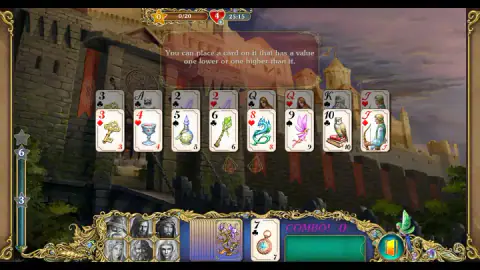
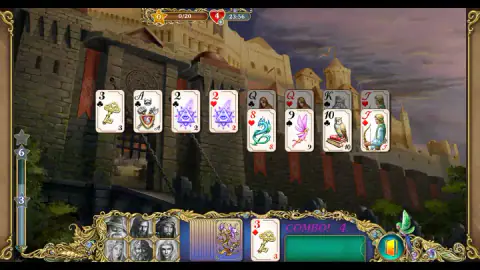
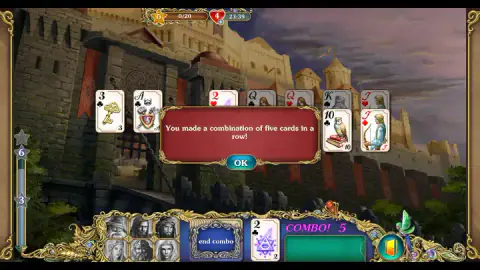
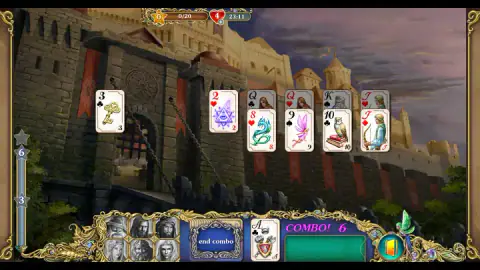
Because your card keeps changing, one move sets up the next. A seven clears a six, the six clears a five, and the run carries on until nothing on the board is one away. A counter in pink letters marked COMBO climbs with every link. Ours reached eight without going back to the deck once, and on the fifth link the game paused to put a red banner across the board: "You made a combination of five cards in a row!"
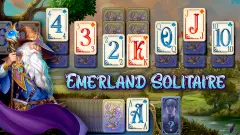
Everything else is a castle. The board hangs in front of a stone wall at sunset, with red banners down the battlements and a gate behind the cards. The cards themselves are painted rather than printed — a goblet, a potion bottle, a dragon, a fairy, an owl asleep on a pile of red books.
The game is credited to Rainbow Games, a studio listed under the name Andrey Mesheryakov. The portal dates this one to December 2024, with a revision in the August that followed.
A word on how far we got. We played about four minutes on a desktop with a mouse, on level one, and left the board jammed with four cards still standing. So this page can tell you what the rule is, how the chain works and why a board like this one strands you. It cannot tell you what finishing a level looks like, how many levels there are, or what the counter reading 0/20 at the top counts: twelve cards came off the board in front of us and it never moved. The hearts never moved either, so we never found out what costs you one.
The rule has an author and a date: Robert Hogue, 1989
Tri peaks is not an old parlour game dressed up for a browser. It is a computer patience, written by Robert Hogue in 1989, and Wikipedia's article on it places it next to Golf and Black Hole rather than anywhere near Klondike.
The classic deal is eighteen cards face down in three pyramids of six, a row of ten underneath them, and the rest left as stock. And the rule, as Wikipedia states it, is that for a card to be moved to the waste pile it must be a rank higher or lower regardless of suit.
Those last three words are the whole design. Drop the suit and you drop the bookkeeping: you are not tracking four separate sequences, you are tracking one number. That makes the game fast, and fast is what makes chains possible, because by the time you have found one legal card your eye is already on the next.
This game paints that rule rather than explaining it. The artwork belongs to the number, not the suit. On the opening board a three of diamonds stands in the front row and a three of clubs behind it, and both carry the same gold key. Later a two of clubs and a two of hearts turn up in our hand one after the other, both carrying the same purple amulet. You stop reading pips almost immediately and start reading pictures, which is exactly the habit the rule wants from you.
The chain is the other half. In the classic game a long run is simply worth more points. Here it has been pulled to the front of the screen and given a number that ticks up in front of you, plus a banner when you hit five. Same idea, louder.
Level one is not three peaks
The name sets an expectation the opening board does not meet. There are no pyramids in level one. There are two rows of eight, laid across the castle wall, with the back row sitting half hidden behind the front one so that only its top corner shows.
What has been kept is the part that matters: overlap. A covered card is out of play until the card in front of it leaves. So the board has a grain to it. You work the front row, and each card you clear opens a window onto the one behind.
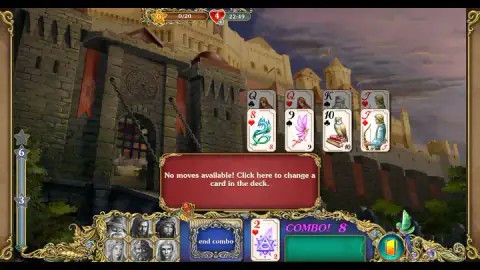
That sounds gentle. It is not, and the end of our game shows why. We ran a chain of eight cards through the left-hand side of the board and cleared it out beautifully, which left four cards standing on the right — and every one of them was a back-row card, still pinned by the dragon, the fairy, the owl and the archer in front of it. Our card in hand was a two. Nothing a two can reach was uncovered. The game put up its red banner and we were done.
That is the tri peaks trap in miniature. Clearing greedily down one side feels like progress because the counter climbs, but the cards you leave behind are the ones that decide whether the board finishes.
What the screen tells you while you play, and what it does not
Four things sit around the board, and we can only vouch for two of them.
The clock is real and it runs down. It read 25:15 the first time we looked and 22:49 in our last picture, which is roughly wall time, so a level is a generous half-hour rather than a sprint. The combo counter is real too, and it is the only number in the game we saw move.
The rest stayed stubbornly still. A counter at the top reads 0/20 and sat there through a dozen removals, so whatever it counts, it is not cards. A gold star beside it held at zero. Up the left-hand edge runs a gauge with star markers at three and six and an empty star crowning it, and nothing we did put anything into it. Along the bottom sit six portraits in stone frames — an old man in a hat, a bearded traveller, a man in a turban, an elf woman, a dwarf, a fair-haired woman — all of them drawn in grey, none of them doing anything in front of us.
There is one more honest gap. While a chain is live, the deck is replaced by a plaque reading end combo. In our pictures the deck is a deck at four links and a plaque from five onwards. So when the banner finally told us to change a card in the deck, the deck was not there to click, and clicking the banner did nothing at all. The likely answer is to close the chain first and then draw. We ran out of game before we could prove it, and we would rather say that than pretend.
More solitaires by Rainbow Games
Magic Tri Peaks Solitaire is the closest thing on the shelf: the same studio and the same one-up-one-down rule, without the castle. Solitaire Crime Stories hangs the same card game on an investigation instead of a fantasy map, and Emily's Hotel Solitaire on a tropical hotel. Magic Story of Solitaire is the quietest of the four, played by a fireside. If you came here for the rule rather than the story, Solitaire Tripeaks gives you the deal and nothing else. The rest of the shelf is in puzzle games.
Screenshots
How to play Tri Peaks Emerland Solitaire
- Read the card at the bottom first, not the board. That is the card everything is measured against. Everything else on screen is a candidate or it is nothing.
- Take anything one rank up or one rank down. Suit is irrelevant, and the game goes out of its way to show you that.
- Keep going. The card you just took is your new card, so look again immediately. The chain is the scoring, and stopping to think costs you nothing but the clock.
- Watch what you uncover. A card with another lying over it cannot be taken. Clearing the front card is what puts the one behind it into play.
- Go to the deck only when the board is dead. It deals you a fresh card and starts you over.
What our own run taught us:
- Clearing the front row is the real job. Every card we could not take at the end was a back-row card with something still parked in front of it.
- A card you can see is not a card you can have. We spent a good part of those four minutes clicking cards that were the right number and still half covered.
- Clicking twice never helped. If a card declined once, it declined every time.
- Think about which of two equal cards to take. Ranks repeat, and the copy you leave behind may be the one that ends up buried.
- The keyboard is not part of this. Arrow keys and letters got nothing out of the game at all.
Controls
| Left click or tap | Take a card. Click any uncovered card on the board one rank above or one rank below the card at the bottom of the screen. It leaves the board and becomes your new card |
|---|---|
| A covered card | Not a control but the limit. A card with another card lying over it cannot be taken until the one in front of it goes |
| The deck (left of the card in hand) | Deals you a new card when nothing on the board will do. While a chain is running, a plaque reading "end combo" sits over it |
| end combo | Closes the chain you are on. It appeared in our game once the chain had reached five and stayed there afterwards |
| Golden door button (bottom right) | The only other button on the board, an open door on a teal disc. We never pressed it, so we cannot tell you where it puts you |
| Keyboard | Nothing we could find. Arrow keys and letters neither chose a card nor moved anything |
Features
- One rule and no exceptions: you may take any uncovered card one rank above or one rank below the card in your hand, and the suit never comes into it
- Every card you take becomes the card in your hand, so each move hands you the next one. That is where the chains come from
- A counter marked COMBO climbs one with every link in the chain. Ours reached eight without touching the deck, and the game stopped at the fifth link to say so
- While a chain is live the deck is covered by a plaque reading end combo, so drawing and chaining are not things you can do at the same time
- The artwork is tied to the number rather than the suit: both threes on the opening board carry the same gold key, and both twos the same purple amulet
- Level one deals two overlapping rows of eight rather than the three pyramids the name leads you to expect
- Made by Rainbow Games.
Game details
- Developer
- Rainbow Games (Andrey Mesheryakov)
- Release date
- December 2024
- Last updated
- August 10, 2026
- Added here
- April 2025
- Technology
- HTML5 (2D)
- Platforms
- Browser (desktop, mouse), Browser (mobile & tablet, touch)
- Classification
- Cards & Board , Casual
- Saved progress
- Saving, when available, is managed by this game. Mava cannot confirm your level.
FAQ
How do you play Tri Peaks Emerland Solitaire?
One card sits face up at the bottom of the screen. Any card on the board that is one rank above it or one rank below it can be clicked, and the suit is irrelevant: a red six and a black six are the same move. The card you take then becomes the card at the bottom, so the next move is chosen against it. Cards with another card lying over them cannot be taken until the one in front of them goes.
What is the COMBO counter in Tri Peaks Emerland Solitaire?
It counts the cards you have taken one after another without going back to the deck. It sits in pink beside the card in your hand and climbs by one with every card. When ours reached five the game stopped play to put a red banner on screen reading 'You made a combination of five cards in a row!'. We got the chain to eight before the board ran out of legal moves.
What does end combo mean in Tri Peaks Emerland Solitaire?
It is a plaque that appears over the face-down deck while you are in the middle of a chain, and it closes that chain. In our game the deck was visible while the counter read four and was covered by the plaque from five onwards. We never pressed it, so we cannot tell you what closing a chain is worth.
What do you do when Tri Peaks Emerland Solitaire says there are no moves available?
The game puts up a red banner reading 'No moves available! Click here to change a card in the deck.' We clicked the banner repeatedly and nothing happened, which is honestly where our run ended. Looking at it afterwards, the deck it wants you to use was underneath the end combo plaque at the time, so closing the chain first is the likely answer. We did not get to test that.
What is tri peaks solitaire?
It is a patience game created by Robert Hogue in 1989, close kin to Golf and Black Hole. Eighteen cards are dealt face down as three pyramids of six with a row of ten beneath them, and the rest become the stock. Wikipedia states the rule plainly: for a card to be moved to the waste pile it must be a rank higher or lower regardless of suit. That single rule is what this game is built on.
Is Tri Peaks Emerland Solitaire laid out in three peaks?
Not in level one. Instead of three pyramids it deals two rows of eight that overlap, with the back row sitting half hidden behind the front one. The overlap works the way the classic game does, so a card only becomes available when the card covering it leaves. We never got past level one, so we cannot say whether later boards take the pyramid shape.
Who made Tri Peaks Emerland Solitaire?
The game is credited to Rainbow Games (Andrey Mesheryakov). The game was published in December 2024 and was last updated in August 2026. We found no studio website and no second source, so the name rests on that one portal.
Does Tri Peaks Emerland Solitaire work on a phone?
It is listed for Android and iOS alongside PC, but landscape only, so a phone held upright will not give you the board. A game played entirely by clicking one card and then another should take to a touchscreen well enough. We only played it on a desktop with a mouse, so we have not checked it ourselves.