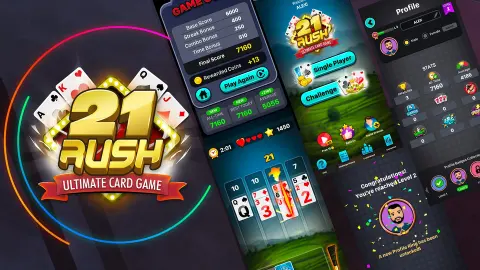








About 21 Rush - Ultimate Card Game
Blackjack gives you one hand and one decision: another card or not. 21 Rush takes the decision away. A card is turned up whether you want it or not, and the only question left is where it goes. There are four lanes, each with its own running total, and the card has to land on one of them.
Bring a lane to exactly 21 and it empties and scores. Push it past 21 and, by the game's own instructions, the lane busts and costs one of the three hearts at the top of the screen. All of this happens against a clock that starts at three minutes.
The game is credited to ChennaiGames. It was published on 19 April 2026.
We should be plain about how far we got. We played one single-player round to the last second of its clock, slowly: 11 cards placed, one lane completed, no bust. We did not see the end-of-round screen, the trash in use, a combo or the Challenge mode. This page covers that one round and stops there.
The ace changes value from lane to lane
The help page says an ace is worth 1 or 11, "whichever helps you most". On the board that is decided separately for every lane, and the hints show it before you commit.
With the ace of diamonds in hand, our lanes stood on 15, 4, 19 and 20. The hints above them read 16, 15, 20 and 21. On the lane holding only a 4 the ace was being counted as 11; on the other three, where 11 would have bust, it was counted as 1. The same card, four offers.
So an ace is the one card that is never dangerous, and the only card that can finish a lane stuck on 20.
A lane on 20 is a worse place than a lane on 11
This is where the blackjack arithmetic helps, and it holds for any standard deck. A deck of 52 has sixteen cards worth ten: the tens, jacks, queens and kings. It has four aces.
A lane on 11 is therefore finished by sixteen different cards. A lane on 20 is finished by four, and every other card in the deck busts it. The deck counter under the pile starts at 51 with one card already turned up, which points to a single standard deck.
For a stretch of our round two lanes sat on 20 at the same time, and only one of them ever got its ace. Stopping a lane at 11 and waiting for a picture card is the stronger habit; 20 looks close and is mostly a trap.
What one 21 is worth
Our only completed lane was a queen, a 7, a 3 and an ace. When the ace landed, the lane went back to zero and the score beside the star went from 0 to 500. The three hearts were untouched.
That is all we can report on scoring. The game's instructions mention combos, streak bonuses and a time bonus for finishing the deck before the clock runs out; with one 21 in three minutes we triggered none of them. There is also a bin in the bottom-right corner, which the instructions describe as a trash button for skipping a dangerous card. We never pressed it, so we cannot say what it costs or how often it can be used.
Who it suits
It suits anyone who likes quick mental sums under mild pressure: the rules fit on one help page and a round is over in three minutes. It is a score chase for one player, not a casino table. Nothing is bet on a hand and there is no dealer to beat.
It suits less a player who wants to sit and think. The clock does not allow it, as our 11 cards show.
More card games
For cards without a clock, Solitaire opens on a classic Klondike deal, and Solitaire Tripeaks is the quick one-up-one-down kind. Solitaire Klondike - Treasure Island wraps Klondike in a story, and Cardivo Adventure is a card-sorting puzzle about themed sets. The rest are under puzzle games.
Screenshots
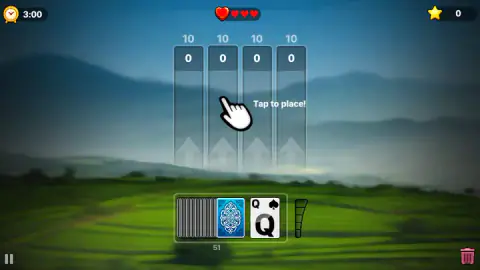
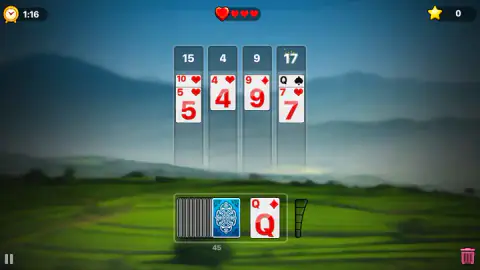
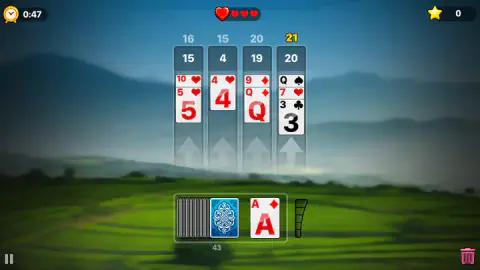
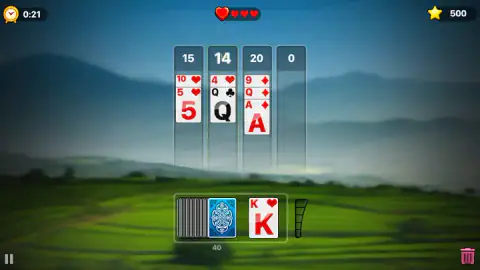
Taken by opening the game ourselves and letting it run — not supplied by the publisher, and not the same picture every other site shows.
How to play 21 Rush - Ultimate Card Game
- Get past the welcome dialog. The game opens on a dialog announcing a welcome bonus of 100 coins and 5 tickets and asking for a nickname. Its Continue button does nothing while the field is empty. We clicked it for a good while before working that out. Click the field, type any name, then Continue.
- Skim the help. A "How to play?" screen follows, eight pages long by the dots along the bottom. The first page gives the card values: face cards 10, number cards their face value, aces 1 or 11.
- Start a single-player round and click a lane. The round starts with four empty lanes, a queen face up and a "Tap to place!" prompt. Clicking a lane drops the card there.
- Make 21. Each lane shows its total in a box at the top. Hit 21 exactly and the lane clears.
- Watch the clock and the hearts. Time is top left, hearts in the middle, score beside the star on the right.
What we picked up while playing:
- The game does the sum for you. Above each lane sits a faint second number: the total that lane would have if the current card went there. With a 5 in hand and lanes on 10, 4, 9 and 10, the hints read 15, 9, 14 and 15. When a hint reaches 21 it turns yellow.
- Read the yellow number before you click. We had an ace in hand and a lane on 20 with a yellow 21 above it, and put the ace on the lane next door instead. The 21 came three cards later, when a second ace turned up.
- The clock is the real opponent. Three minutes for a 52-card deck is about three and a half seconds a card. At our pace the deck counter still read 40 with 21 seconds left.
Controls
| Click a lane | Places the face-up card on that lane and adds its value to the lane total |
|---|---|
| Click the bin (bottom right) | Trash button; the instructions say it skips a card. We did not use it |
| Click the pause icon (bottom left) | Pause button; we did not open it |
Features
- Four lanes and one face-up card at a time: every click is a choice between four totals
- A lane that reaches exactly 21 empties; our first one took the score from 0 to 500
- A three-minute clock per round and a counter under the deck that starts at 51
- A faint number above each lane shows what its total would become before you click
- Aces count as 11 where that fits and as 1 where it does not, lane by lane
- Three hearts at the top; the instructions say three busts end the round
- Made by ChennaiGames
Game details
- Developer
- ChennaiGames
- Release date
- April 2026
- Last updated
- August 10, 2026
- Added here
- February 2026
- Technology
- HTML5
- Platforms
- Browser (desktop, mouse), Browser (mobile & tablet, touch)
- Classification
- Cards & Board
- Saved progress
- Saving, when available, is managed by this game. Mava cannot confirm your level.
FAQ
How do you play 21 Rush - Ultimate Card Game?
The game turns up one card at a time and you click one of four lanes to place it. Each lane shows the sum of its cards. Bring a lane to exactly 21 and it clears and scores; a round runs on a three-minute clock.
Why does the Continue button not work when 21 Rush opens?
The welcome dialog asks for a nickname, and Continue does nothing while that field is empty. Click inside the field, type any short name, then click Continue. It is a name for the game, not a sign-in.
How much are aces and face cards worth in 21 Rush?
The game's own help page says jacks, queens and kings are worth 10, number cards their face value, and aces 1 or 11, whichever helps. On the board we saw the same ace previewed as 11 on a lane holding 4 and as 1 on lanes holding 15, 19.
What happens when a lane reaches 21?
The lane empties and you score. In our round a lane standing on 20 took one more card, went back to zero, and the score rose from 0 to 500 with all three hearts still in place.
What happens if you go over 21?
We did not bust a lane, so we cannot describe it first hand. The game's instructions say a lane that goes over 21 busts and that three busts end the game, which matches the three hearts shown at the top of the screen.
How long does a round of 21 Rush last?
The clock starts at 3:00 and counts down. We played it to its last second having placed only 11 of the 52 cards, so we did not see the bonus the instructions promise for finishing the deck in time.
Who made 21 Rush - Ultimate Card Game?
It is credited to ChennaiGames. It was published on 19 April 2026. It is listed for PC, Android and iOS, in landscape and portrait.