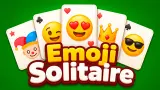
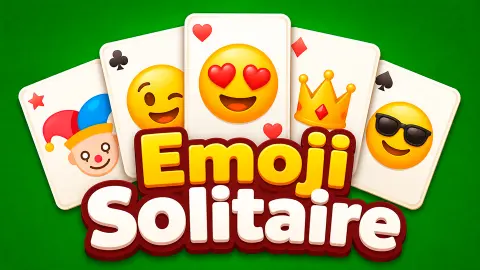



About Emoji Solitaire
Klondike has a quiet mercy built into it that nobody ever mentions: you never have to know what anything means. A seven of clubs is a seven of clubs. You do not have to think about clubs, or about sevens, you only have to see that the card in your hand is one lower and the other colour than the card already on the pile. Strip the pictures off and the game still works. It is shape-matching in a costume.
Emoji Solitaire takes that mercy away, and that single decision is the whole game.
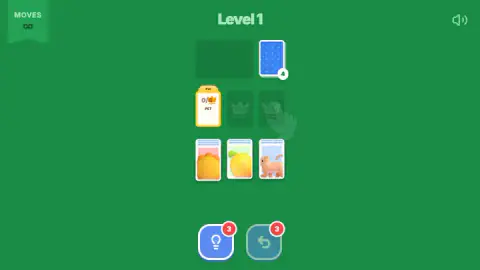
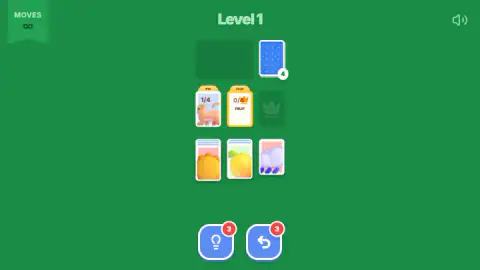
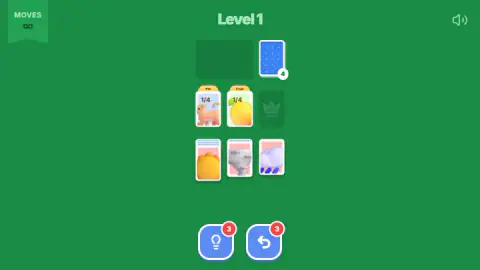
The table looks familiar enough. Plain green, a blue polka-dot deck up in the corner with a little white badge counting what is left in it, a row of slots to build on and a row of cards to play from. Then you look at a card and there is no number on it, no suit, nothing to count. There is a picture: a sun, a mango, a dog, a tornado. Above them sit the slots you are meant to fill, and two of them are dark rectangles stamped with a crown outline, which is the game's way of saying this is a category, and you have not found it yet.
It is by Kshtult, published in June 2026.
Our own account stops early, and it is better to say so now. We played level 1 and did not finish it. Two categories opened, Pet and Fruit, and each of them took one card. We never saw a second level, a win screen, a move limit or whatever is behind the third crowned slot. What follows is what the board actually did in front of us, and the reason the idea underneath it is sharper than it looks.
Suits were drawn for the eye. Categories are read with the head.
Patience games first turn up in print in northern Europe towards the end of the 1700s. The English called the whole family patience; Americans settled on solitaire, and the version almost everybody means by that word is Klondike, which took its name from the Yukon gold rush of the 1890s.
Microsoft put Klondike into Windows in 1990, and the stated reason was not entertainment: it was there to teach a generation of office workers to drag something across a screen with a mouse. This game is played with that exact gesture and nothing else.
What all of those versions have in common is the thing Emoji Solitaire removes. The suits we use came out of French card workshops around the 1480s, and they won because they were cheap: flat silhouettes in two colours could be stencilled rather than painted. Cheapness had a side effect that turned out to matter more. A heart is legible in a quarter of a second, from across a table, upside down. You identify a card without spending any thought on it, which leaves all of your thought free for planning.
That is the hidden engine of every solitaire ever made. Identification is free, so difficulty lives entirely in sequencing. Should I move this now or wait. Which column do I open first.
Take the suits out and put categories in and you have moved the cost. A tornado is weather. A mango is fruit. Neither is remotely hard, but neither is free either, and the half-second you spend deciding is a half-second Klondike never charged you. Play for a few minutes and you feel it as a different texture: a small verbal click before every move, where the old game had none. That is also why a card that could plausibly sit in two categories is the most interesting object on the table, and why the designer has been careful about which pictures appear together.
The coloured panel is the new suit
Here is the detail that shows somebody thought this through, and it is sitting in plain sight on every card.
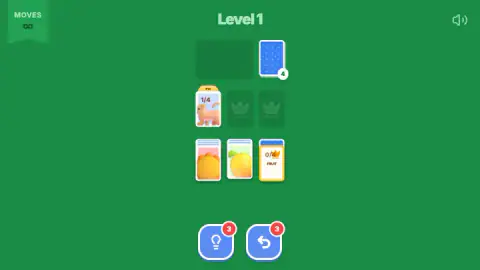
The picture is never alone. It sits on a flat coloured panel that fills most of the card, and that colour is not decoration. The dog is on blue, and the Pet foundation, once it holds the dog, is blue too. The mango is on green, and so is the Fruit foundation. The sun, the tornado and the rain cloud are all on the same pink, which is how we knew they were one group before anything on screen named them.
So the game gives a category back the one property a suit had and a category does not: you can read it without reading it. Scan the row, see two greens and a pink, and you already know what your options are before you have identified a single picture. The semantic work is still there, but it has been moved to the moment a new category opens rather than charged on every move.
It is a small piece of design and it is doing a lot. Without it, a row of unrelated pictures would be a reading exercise. With it, the row sorts itself at a glance, and you only slow down for the genuinely ambiguous card, which is where the thinking belongs.
What level one tells you about the rest
Three things on that first screen are promises about levels we never reached.
The MOVES banner in the corner shows an infinity sign. A counter built to display infinity is a counter built to display a number, so somewhere there is a level that rations moves. The deck carries a badge, and ours read four from the first screen to the last, which means we never once got stuck badly enough to need it. And the third crowned slot never opened, with a set of weather cards piling up in the row below it and nowhere to put them.
We would rather leave those as open questions than fill them in. What we can say is that the first level is generous to the point of being a lesson: unlimited moves, a hand that points, three hints and three undos nobody needs. That is a game confident that its idea is easy to grasp and hard to put down, and on the evidence of four minutes it is right about the first half.
More cards on green felt
Word Associations Solitaire is the closest relative we have, and the direct comparison: it runs the same substitution with words in place of pictures, which makes the reading step explicit rather than hidden. Word Solitaire goes further still and asks you to build something out of what you collect. For the original rules with the suits left in, Solitaire Klondike Treasure Island is the version this game is quietly arguing with, and Solitaire TriPeaks is the one that keeps the ranks and throws out the columns instead. The rest are in puzzle games.
Screenshots
How to play Emoji Solitaire
- Find the gold cards first. A category does not exist until you open it. The gold-framed card with a word on it, PET, FRUIT, is the key: drag it from the bottom row into an empty crowned slot and that category is now live, showing a crown and a counter reading zero of four.
- Then feed it. Drag any card whose picture belongs to that category straight onto the foundation. The counter steps up, the foundation takes on the picture of the card you just gave it, and a new card turns over in the row below.
- Work the bottom row. Cards come up three at a time and the thin blue lines along the top of one tell you there are more underneath it. Clearing a card is what reveals the next.
- Fill each category four times. That is what the counter under the crown is asking for, and nothing we saw suggests a shortcut.
What our session taught us:
- Open a category before you need it. A card you cannot file is a card that blocks the pile it sits on. The dog in the bottom row is useless until the Pet card is up top, and the sun, the tornado and the rain cloud sat there in front of us for the entire session with nowhere to go.
- Judge by colour before you judge by picture. Every card's picture sits on a coloured panel, and the colour is shared by everything in the same category. Blue behind the dog. Green behind the mango. Pink behind all three weather pictures. You can sort the row without looking closely at a single one of them.
- You will not need the help on level 1. A pale hand appears and points at the card the game wants next. Both the lightbulb and the undo arrow started on three and were still on three when we stopped.
- The ads land mid-level. The board gets covered while you are in the middle of a hand, not between levels. One of ours put up a line reading "We skipped the ad this time - enjoy the game!" with a button to continue. Nothing you had arranged is lost.
Controls
| Click and drag, or touch and drag | The only input the game needs. You pick a card up off the bottom row and drop it on the slot you think it belongs to |
|---|---|
| Drag a card onto a matching foundation | Adds it to that category and pushes its counter up by one, towards four |
| Drag a gold category card onto an empty crowned slot | Opens that category. Until you do, the slot is a dark rectangle with a crown outline and nothing can be filed in it |
| The blue deck, top right of the board | Face-down reserve, with a white badge counting what is left in it. Ours read four from the first screen to the last |
| Lightbulb button, bottom left | Hints. A red badge says how many you have, and it starts at three |
| Circular arrow, bottom right | Undo, also three of them. It sits greyed out until there is a move to take back, then turns blue |
| Speaker icon, top right | Sound on and off. It is the only setting on the playing screen |
Features
- No suits and no ranks: a card is a picture, and where it goes depends on what the picture is of
- Foundations are categories that you have to open yourself, by finding the gold card that names one
- Each category wants four cards, and says so with a counter under a crown
- The picture sits on a coloured panel, and the colour is the same for everything in one category: blue behind the dog, green behind the mango, pink behind the sun, the tornado and the rain cloud
- Three hints and three undos per level, shown as red badges on two round buttons
- Level 1 gives you unlimited moves: the counter in the corner shows an infinity sign rather than a number
- A guided hand points at the card it wants during the first level, so nothing is left to guesswork at the start
- It was published in June 2026
Game details
- Developer
- Kshtult
- Release date
- June 2026
- Added here
- April 2026
- Technology
- HTML5 (2D)
- Platforms
- Browser (desktop), Browser (mobile & tablet, touch)
- Classification
- Cards & Board , Puzzle
- Saved progress
- Saving, when available, is managed by this game. Mava cannot confirm your level.
FAQ
How do you play Emoji Solitaire?
You drag cards from the row at the bottom onto the slots above. The slots are categories rather than suits, so a dog goes on the Pet foundation and a mango goes on the Fruit one. Each category takes four cards and shows its progress as a counter under a crown. A category only accepts cards once you have found the gold card that names it and dropped that into an empty crowned slot.
Is Emoji Solitaire the same as classic Klondike solitaire?
No. It borrows the furniture of patience, a green table, a face-down deck, foundations to build on, and then throws out the part that makes Klondike work: suits and ranks. There is nothing to count up or down, and no red and black. Sorting is by meaning instead, which is a different kind of thinking from the one Klondike asks for.
What are the categories in Emoji Solitaire?
We saw two named on screen during our session, Pet and Fruit, each written on a gold card that has to be placed before that category opens. A third crowned slot sat empty the whole time we played, and a run of weather pictures turned up in the tableau without a home, so there are certainly more. We did not get far enough to list them, and we would rather say that than guess.
Does Emoji Solitaire have a move limit?
Not on level 1. The banner in the top left corner is headed MOVES and shows an infinity sign instead of a number, so you can take as long and as many tries as you like. A counter that is capable of reading infinity is presumably capable of reading a number as well, but we never reached a level that showed one.
How many hints and undos do you get?
Three of each per level, counted down by small red badges on the two round buttons at the bottom of the screen. The lightbulb is the hint and the circular arrow is the undo. The undo button stays greyed out until there is actually a move to take back. We finished our session with both badges still on three, because the guided hand on level 1 made them unnecessary.
Who made Emoji Solitaire?
Kshtult, a developer publishing, and it was published on 14 June 2026. It runs in a browser tab at a widescreen size and works with touch as well as a mouse, which suits a game whose only input is dragging a card from one place to another.
Can you play Emoji Solitaire on a phone?
Yes. The whole game is one gesture, picking a card up and dropping it somewhere else, which works at least as naturally with a finger as with a mouse. Our own session was on a desktop, so we cannot tell you how comfortably the card spacing scales down to a small screen.
Are there ads in Emoji Solitaire?
There are, and they arrive in the middle of a level rather than between levels. One interrupted our run and put a panel over the board; another time a line came up reading "We skipped the ad this time - enjoy the game!" with a button to carry on. Either way the board is covered until you click through, and nothing you had set up is lost.