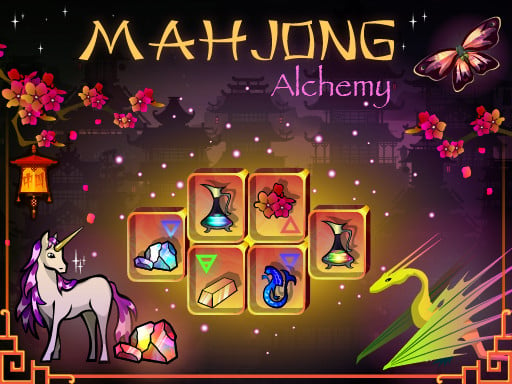
About Mahjong Alchemy
Every board in Mahjong Alchemy can be cleared at the moment it appears. That is not luck. Before a single card is drawn, the game starts from an empty table, works out which slots would be reachable, drops a pair into two of them, and repeats until the pile is built — so the finished board can always be taken apart by undoing that construction in reverse. Then it hands the board to you and quietly lets you wreck it.
Wrecking it is easy, because the pictures repeat more than twice. Each pair gets its face picked at random from a deck of 35, so the same lantern or the same retort routinely turns up on four cards, and on the biggest boards on a dozen or more. Four identical cards can be split into pairs three different ways, and only some of those ways survive. Match the two convenient ones and you may have locked the other two under a card that only they could have freed. We simulated thousands of runs using the game's own code: a player matching whatever came to hand ended up staring at a dead board about half the time, and on the Butterfly board nearly nine times out of ten.
So the game is not about spotting pairs. Every card is face up from the first second, and a dark overlay covers every card you are not allowed to touch. It is about which pair to take.
It was published through GameMonetize on 21 October 2021 under the name Little Missle, but the build is in Russian, titled «Маджонг Алхимия», with a Yandex Games toolkit sitting commented out in its source and a language button offering Russian, English and Turkish. It was written for the Russian portal first and ported here afterwards. Sber's app catalogue lists the same game under an individual developer, Andrey Cherkashin.
The game everyone calls mahjong is not mahjong
Mahjong is a game for four people. It comes from late-Qing China — the oldest tile sets that survive date to around 1870 — and it works like rummy: you draw, you discard, you build a hand.
None of that is what happens here. The solitaire game of clearing a pile of matching tiles was invented in 1981 by Brodie Lockard, an American programmer, on the PLATO university computer network. Lockard had been left quadriplegic by a trampoline accident in December 1979 and wrote the game with a mouth stick on a touch-screen terminal, borrowing the tiles and a layout called the Turtle from the physical game someone at his hospital had taught him. He had no way to draw depth, so he gave the tiles on higher layers thicker bevelled edges — the visual trick every version since has copied, this one included.
Activision published Shanghai in July 1986 with Lockard programming, sold it as an ancient Chinese pastime, and that is how a five-year-old mainframe curiosity became the thing a billion people mean by the word mahjong. The classic Turtle it inherited is 144 tiles in five layers, 87 of them on the ground. Mahjong Alchemy's biggest board, Chaos, is 180 cards in four even layers of 45 — larger than the Turtle and flatter, which makes it slower to open and harder to read.
Why the deal has to be built backwards
Deal a Turtle genuinely at random and some of the results cannot be won at all. Michiel de Bondt ran ten million random deals and found around 3 per cent unsolvable even for a player allowed to see through the stack. Three players in a hundred losing before they touch anything is intolerable in a casual game, and that is why serious versions stopped dealing tiles and started assembling boards from reachable slots — which is what this one does, retrying until it succeeds.
The guarantee has an asterisk the game never mentions: one solution exists at the deal, not that yours survives contact. Hence the reshuffle button matters more here than elsewhere. It rebuilds the arrangement from the cards still on the table, so it does not shuffle, it restores the guarantee.
Seventeen boards, a shop and a fox
The boards are drawn shapes rather than variations on a pile: a butterfly, a spider, a crane, a torii gate, a tree, a yin-yang, a frog, a five-storey pyramid. Two are cheerfully borrowed silhouettes from other games. They run from 18 cards to 180, so a board is anything from nine matches to ninety — a bus stop or an evening.
The pyramid is the odd one. Its shape has room for 132 cards but the game only ever deals 126, so six slots stay empty — and which six changes every time. It is never quite the same board twice.
Between boards a nine-tailed fox congratulates you and takes you to the shop, which sells 23 extra card designs on top of the 35 you start with, at 10, 20, 50 and 100 coins. You do not choose: you buy a tier and it hands you one you do not own. The full set costs 930 coins and every pair pays one, so owning all 58 faces means clearing all seventeen boards about one and a half times over. Nothing here costs money.
Two things are broken. The board never tells you when it has no moves left; and clearing Chaos, the last board in the list, then pressing the next-level arrow leaves the game stuck on a blank screen. Go back to the board list instead.
Playing Mahjong Alchemy unblocked at school
Tile games are permanent fixtures on unblocked lists, and the reason here is dull and structural: one web page, no plugin, no installer, no account, nothing kept on a server. Your coins, your unlocked cards and your best score per board sit in your own browser's storage on the machine you are using. A shared computer, a guest session or a browser that clears site data at logout takes it all, and your laptop at home starts you at zero.
Filters work on addresses, not on games. There is no filter-proof build of this one — every "unblocked" copy on the web is this same page sitting somewhere else — so whether it loads comes down to which sites your network permits, and that is your school's decision rather than the game's. Do not go looking for a way around it.
Two practical notes if it does open. There is no pause and no saved board, so pick one that fits the time you have. And on a phone the small boards are comfortable while the largest squeeze the cards to roughly a fingernail's width — fine for looking, awkward for tapping.
More puzzle games on Mava Games
Nothing else here shares this game's author, so the neighbours are picked by the thinking they ask for. Brain Test: IQ Challenge is the closest in spirit: a puzzle that punishes the obvious first move. Hero Rescue Puzzle and Pull Him Out Online both turn on sequencing — one wrong order and the level is unwinnable, which is the same trap this game sets with four identical cards. If what you want is the calm rather than the puzzle, Pop It Now asks nothing of you at all. The rest of the shelf is in puzzle games.
How to play Mahjong Alchemy
- Pick a board from the seventeen tiles on the menu. They are sorted smallest first, from an 18-card opener to a 180-card slab, and every one is unlocked from your first visit.
- Click a card that is lit, then click its twin. A card is playable when nothing sits on top of it and either its left or its right side is clear. Everything else is greyed out, so the rule is shown to you rather than explained.
- Match fast if you want points. A pair taken inside a second is worth 10; after nine seconds it is worth 1. Coins ignore speed entirely — one per pair, always.
- Use the right-hand buttons when you stall. The magnifier buys a hint for 3 coins and lights one legal pair. The arrows redeal the faces for 5 coins and always leave a solvable board.
- Clear the table. The last pair ends the board, and only your best score on it is kept.
What a few hours on it teaches:
- Take four-of-a-kind while all four are free. When one picture is showing on four cards and all of them are reachable, clear both pairs immediately. Leaving two behind is the single most common way to strand a board.
- Work downwards. A card on the top layer holds down everything under it and blocks nothing beside it, so taking it always opens more than it closes.
- The game will not tell you that you are stuck. The check that used to detect a dead board is disabled in this build. When no moves remain, nothing happens at all — no message, no automatic reshuffle. Noticing is your job.
- Pay for the shuffle rather than watching for it. The 5-coin reshuffle is unlimited. The free one, behind an advert, works once per board; ask a second time and the game closes the board on you with 50 consolation points.
- Do not start a board you cannot finish. Leaving to the menu and coming back deals a fresh table. Your coins are already banked, but the score for that board is gone.
Controls
| Left click or tap a card | Select it. Only cards with nothing on top and one long side clear can be picked, and the game dims every card that is buried |
|---|---|
| Click or tap a second matching card | Remove the pair. Picking a different face instead just moves your selection to the new card, so a wrong click costs nothing |
| Magnifier button (right edge) | Buy a hint for 3 coins. It lights up one pair that is legal right now |
| Arrows button (right edge) | Reshuffle the faces for 5 coins. The board is redealt into a solvable arrangement without moving any card off the table |
| Note button (right edge) | Mute the background music |
| (no keyboard, no undo) | The whole game is one pointer. There is no undo, no timer and no pause |
Features
- Seventeen hand-built boards, from an 18-card opener to a 180-card slab, all unlocked from the first visit and listed smallest first
- Every board is generated backwards from an empty table, so the deal you get always has at least one full solution
- 58 card faces in total — 35 you start with and 23 sold in the shop at 10, 20, 50 and 100 coins
- [object Object]
- [object Object]
- Only your best score on each board counts, so replaying a board you have already cleared only adds the improvement
- Progress lives in your own browser, with no account, no login and nothing to install
Game details
- Developer
- Little Missle
- Release date
- October 2021
- Added here
- December 2019
- Technology
- HTML5 (PixiJS, WebGL)
- Platforms
- Browser (desktop), Browser (mobile & tablet, touch), Chromebook
- Classification
- Puzzle
FAQ
Is Mahjong Alchemy the same game as mahjong?
No, and neither is any other tile-matching game that uses the name. Mahjong is a four-player Chinese game from the late nineteenth century, played with draws and discards. The one-player game of removing matching tiles from a pile was written by Brodie Lockard in 1981 on the PLATO computer system and popularised by Activision's Shanghai in 1986. Mahjong Alchemy is a version of the 1981 game with alchemical cards in place of tiles.
How do you play Mahjong Alchemy?
Click one card, then click another with the same picture, and the pair disappears. A card can only be picked if nothing is lying on top of it and at least one of its left or right sides is clear — the game darkens every card that fails the test, so you never have to work it out yourself. Clear the whole board to finish it.
Can a board in Mahjong Alchemy become impossible?
Yes, and it will be your doing rather than the game's. Every board is built backwards from an empty table, so the deal always has a solution. But the same picture can appear on four or six cards, and matching the wrong two of them can strand the rest. In our simulations, matching whatever came to hand left the board dead about half the time.
What do you do when there are no moves left in Mahjong Alchemy?
Press the arrows button on the right edge and pay 5 coins. That redeals the faces across the cards still on the table and guarantees a solvable board again. The free version of the same button, behind an advert, works once per board — ask for it a second time and the game ends the board and awards you 50 consolation points.
How many levels does Mahjong Alchemy have?
Seventeen, and all of them are open from your first visit. They are listed smallest first, from Fruit Ninja at 18 cards to Chaos at 180, and together they hold 1,172 cards. There is no lock, no star gate and no order you have to follow.
How do you get coins and new cards in Mahjong Alchemy?
Every pair you remove pays exactly one coin, whether you took a second or a minute over it. The shop sells 23 extra card designs in four tiers priced at 10, 20, 50 and 100 coins, and it picks which one you get at random. Owning all 23 costs 930 coins, which is more than one full sweep of all seventeen boards.
Who made Mahjong Alchemy?
GameMonetize credits a studio called Little Missle and dates the listing 21 October 2021. The build itself is in Russian, titled «Маджонг Алхимия», and carries a commented-out Yandex Games toolkit, so it was written for the Russian portal first. Sber's app catalogue lists the same game, with the same description, under an individual developer named Andrey Cherkashin.
Can I play Mahjong Alchemy on my phone?
Yes. The game detects a touch device and lays itself out in portrait, and the small boards are comfortable — an 18-card board gives you cards about as wide as a thumbnail. The three or four largest boards shrink the cards to roughly the width of a fingernail on a normal phone screen, so those are worth saving for a laptop.