
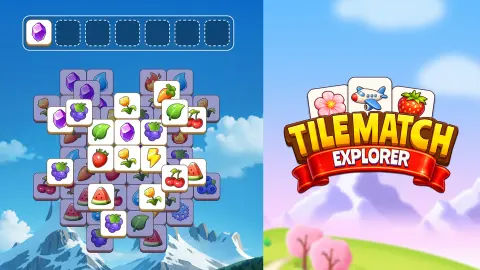











About Tile Match Explorer
Most matching games forgive you. Swap two gems in the wrong place and the board shrugs and gives you another try. Tile Match Explorer keeps a record. Every tile you pick goes into a tray of seven slots at the bottom of the screen, and it stays there until two more just like it arrive.
That one rule turns a picture puzzle into a planning puzzle. Matching is easy: there are three trowels on the board, so you pick three trowels. The hard part is the order, because the third trowel may be buried under a frying pan, and every tile you move out of the way takes up a slot of its own.
We played Tile Match Explorer on a computer with a mouse in October 2026, for about four minutes, all of it on level 1. We did not clear that level and we did not lose it either. What we did manage was the mistake almost everyone makes on their first board, and it is the most useful thing on this page.
The game is credited to Drivix Games. Tile Match Explorer was published in May 2026.
The seven-slot tray is the whole game
Seven is a small number, and that is the point. Three slots are spoken for by whatever set you are building. That leaves four for everything else: tiles you have to move to reach something, and tiles you take because they were there.
Our run shows how fast that runs out. Two trowels and two saws make four tiles that each need a partner. Add one stray flashlight and the tray has two free slots left, with three half-built sets competing for them. From there, any tile that does not finish a set brings you a step closer to a full tray.
The way out is to work one set at a time and to dig toward its missing piece before you touch anything else. It feels slower. It leaves room in the tray, and room is what you are actually spending.
Two layers, and how to read them
On level 1 the tiles sit in two layers. The top layer is bright white. The bottom layer is a grid of shaded tiles, partly hidden by the ones above.
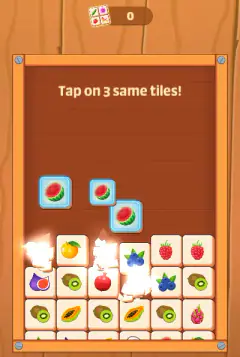
You can see the rule work in our screenshots. When we took the top tiles off the upper right of the board, the shaded flashlight and the nail polish beneath them turned bright. That change of colour is the signal to watch.
That is the main thing the first level teaches. The board you can see is not the board you can play, and the useful question is not "where is the third trowel" but "what do I have to lift to get to it".
The objects themselves are the kind you would find in a kitchen or a garden shed: trowels, hand saws, frying pans, flashlights, bananas, sushi and a bottle of nail polish. They are clear and easy to tell apart, which keeps the difficulty in the planning, not in squinting at icons.
Where this kind of puzzle comes from
Pulling free tiles off a stack is an old idea. Mahjong solitaire has done it since the 1980s, when Activision sold it as Shanghai in 1986. You can only take a tile that is not covered, the same rule Tile Match Explorer uses for its shaded layer.
The tray is newer. Mahjong solitaire removes pairs straight off the board. Triple-tile games send each pick to a small bar and wait for three, which means every wrong pick stays in front of you. The format spread widely in 2022 with Sheep a Sheep, a Chinese mobile game whose trivial first level and brutal second one became a national talking point.
Tile Match Explorer sits in that family. On the board we played, it is the gentle version: two layers, large clear tiles, and three boosters to bail you out.
Boosters and coins
Under the tray sit three buttons: a wand, a shuffle and an undo arrow. Each carries a small red 1, which reads as a single use each. Shuffle and undo do what their icons suggest. We never pressed any of them, so we cannot tell you what the wand does or whether the charges come back on the next level.
A coin counter sits at the top right, with a small plus sign beside it. It showed 0 for our whole session, because we never finished a level. We do not know what coins pay for. More boosters would be the obvious guess, but we did not see a shop or a price.
What we did not see
We stayed on level 1. We do not know how many levels there are, whether the layers get deeper, or whether the landscape behind the board changes as you go, which the word Explorer in the title hints at. We never saw a win screen or a fail screen. The arrow keys and the space bar did nothing for us that we could hear.
We also played only on a computer. The game is listed for touch screens in portrait, and tapping a tile with a finger is the obvious way to play on a phone.
Who it is for
Tile Match Explorer suits anyone who likes a calm puzzle with no clock. We saw no timer on level 1, there is nothing violent, and the only words on the board are a level number and a coin count. Children can name every object on the tiles.
The difficulty is all about thinking two moves ahead. A younger player will fill the tray quickly the first few times, and that is fine: the board teaches the rule about shaded tiles quickly.
More from Drivix Games, and other tile puzzles
Drivix Games also made Tile Match, another triple-match game, and Sheepdoku, a logic puzzle where each coloured area gets one sheep. For a different kind of sorting from the same studio, try Magic Water Sort. If you want the older pair-matching rule without a tray, Mahjong Classic is a mahjong solitaire. Browse the rest of the puzzle games.
Screenshots




Taken by opening the game ourselves and letting it run — not supplied by the publisher, and not the same picture every other site shows.
How to play Tile Match Explorer
- Press PLAY on the title screen. The first time, it is marked Tutorial and opens a short introduction, which you can skip.
- Look at the board before you tap. Bright tiles are free. Shaded tiles sit underneath and cannot be picked yet.
- Tap a bright tile. It flies down into the tray at the bottom.
- Collect three of the same object in the tray and they vanish, giving you the slots back.
- Empty the board to clear the level. Fill all seven slots and, according to the game's own instructions, the level may fail.
Tips from our session
- Count before you commit. Before you tap the first trowel, find the other two. If one of them is shaded, you are about to park a tile you cannot finish.
- Do not start two sets at once. This is where we went wrong. We took two trowels, then two saws, then a flashlight, and ended up with five of the seven slots full and not one set cleared.
- Treat shaded tiles as invisible. The third trowel we wanted sat in the lower layer at the bottom left. It looked one tap away. It was not, and we tapped it several times before noticing nothing happened.
- Uncover with purpose. Picking a top tile is worth a slot only if that tile helps a set, or if it frees the one you need underneath.
- Save the undo. Each booster starts with one charge. An undo spent early cannot save you when the tray is at six.
Controls
| Click or tap a bright tile | Sends it down to the tray at the bottom of the screen |
|---|---|
| Wand button (bottom left) | A booster; it showed one charge, and we did not use it |
| Shuffle button (bottom centre) | Shuffles the tiles left on the board; one charge, not used by us |
| Undo arrow (bottom right) | Takes back your last pick; one charge, not used by us |
| Blue pause button (top left) | Pauses the level |
Features
- A seven-slot tray that decides the whole game, since every tile you pick goes there first
- Tiles stacked in two layers on level 1, with the covered ones shaded until the tile above them leaves
- Everyday objects on the tiles, among them trowels, hand saws, frying pans, flashlights, bananas, sushi and nail polish
- Three boosters, a wand, a shuffle and an undo, each starting with one charge
- A coin counter on the title screen and in every level, at 0 for our whole session
- A painted lake-and-mountain landscape behind the board, with a church tower on the far shore
Game details
- Developer
- Drivix Games
- Release date
- May 2026
- Last updated
- August 10, 2026
- Added here
- March 2026
- Technology
- HTML5 (2D)
- Platforms
- Browser (desktop), Browser (mobile & tablet, touch)
- Classification
- Adventure , Cards & Board , Puzzle
- Saved progress
- Saving, when available, is managed by this game. Mava cannot confirm your level.
FAQ
How do you play Tile Match Explorer?
Tap a tile that is not covered by another one and it flies down to a tray of seven slots. When three identical tiles meet in the tray, they disappear. You clear the level by emptying the board, and you lose room every time you pick a tile that does not complete a set.
What happens when the tray is full in Tile Match Explorer?
The game's own instructions say the level may fail if you fill the tray completely. We got to five of the seven slots without clearing a set, but we did not fill it, so we have not seen the fail screen ourselves.
Which tiles can I tap in Tile Match Explorer?
Only the bright ones. Tiles in the lower layer are shaded while something sits on top of them, and they light up as soon as that tile leaves. A shaded tile can look close and easy to reach, but it is not free yet.
What do the three buttons under the tray do?
They are boosters: a wand, a shuffle and an undo arrow, each with a small red 1 on it, which reads as one use each. The shuffle and undo do what their icons suggest. We did not press any of them, so we cannot tell you what the wand does.
Who made Tile Match Explorer?
It is credited to Drivix Games. Tile Match Explorer was published in May 2026.
Is Tile Match Explorer good for kids?
There is no timer that we saw, no violence and almost nothing to read: a level number, a coin counter and the word PLAY. The pictures are everyday objects a child can name. The hard part is planning ahead, so a younger player may fill the tray quickly at first.
How many levels does Tile Match Explorer have?
We do not know. Our session stayed on level 1 for about four minutes and did not clear it, so we never reached a level select or a level count. The game's instructions say finishing a level unlocks new puzzles.