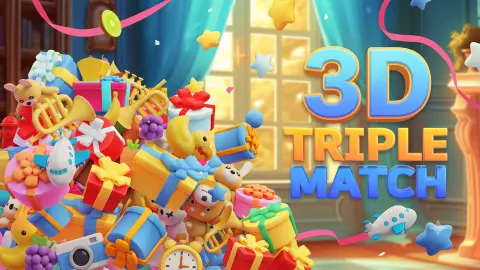










About 3D Triple Match
A five-minute countdown sounds like pressure until you see what it is counting down over. The first level of 3D Triple Match puts a small cluster of balls on screen — rugby balls and beach balls in blue, purple and yellow, floating against a plain brown background — and a row of empty pedestals underneath, waiting. The clock is not what is going to beat you here.
The loop is one gesture. You tap a ball and it lifts out of the pile and comes down on the next free pedestal in the row below. Get three of the same kind sitting in that row at once and they merge and vanish, and the places they were occupying come back. That is the entire instruction set. What turns it into a puzzle rather than a chore is that the row is finite: any ball you take before its two brothers are findable sits there holding a place until you can complete it.
The game is credited to HyperJoy Games, and the studio's page there explains a great deal about it. Its catalogue reads like one long obsession — colour water sort, hexa sort, gem sorting, magic block sort, coffee sort puzzle, bubble merge. These are people who make sorting games and essentially nothing else. It shows in the right place: the loop is smooth, legible in about four seconds, and never once ambiguous about what a tap just did. The game was listed in August 2026.
Here is what this page is built on, because the gaps matter as much as the findings. We played one run of roughly four minutes on a desktop, came in at level one and were still on level one when we stopped. We never finished a level, never saw a win screen or a game-over, and never met an object that was not a ball.
Six places, and a video badge over the last one
The row under the pile is the most interesting object in the game. Six round pedestals, evenly spaced, bright blue when empty and a washed-out grey-blue when something stands on them. You can read your own position in half a glance, which is exactly right for a game that asks for fast taps.
Over the sixth pedestal — the far right one — a small magenta badge hovers, stamped with the white play triangle that means video everywhere on the internet. We pressed it, and what came back was not an advert but the game's own notice saying there was no ad available right now, with a button offering to let us carry on. So the badge is plainly offering something in exchange for watching something, and what it offers is a thing we cannot tell you.
Below the row sits a small bar with two more of these. One is a gold stopwatch on a green disc marked +60S, a straightforward offer of another minute on the clock. The other is a blue ball on a gold disc with a green plus and the label +3. Three of what, we do not know. Both carry the same video badge and both are labelled FREE, which here means free of money rather than free of effort.
What all of this circles is the tray's limit. In every puzzle built on this pattern, the row under the board is the fail state and the clock is decoration: run out of places to put mismatched pieces and the run is over, whatever the timer says. We never found out whether this game follows that convention, because we never came close. Three occupied pedestals was our high-water mark. That is the biggest hole in this page, and naming it beats papering over it.
The pile is a mahjong board standing on its end
Nothing about this game's shape is new, and knowing where it comes from makes it easier to play.
The layered pile where only certain pieces can be taken is mahjong solitaire, and mahjong solitaire on a computer has a first author and a date. Brodie Lockard built it in 1981 on the PLATO system, and his rule is still the rule: a tile is available only if it is free — if it can be slid out sideways without disturbing anything resting on it. Everything else waits its turn, which is why the board is a puzzle of order rather than a puzzle of spotting. Activision published Shanghai in 1986, with Lockard behind it again, and that is the version that turned a curiosity into a genre.
The other half is much more recent. In September 2022 a Chinese mini-game called Sheep a Sheep became a national event, played by tens of millions of people inside a few weeks, and it changed two things. Pairs became trios, which roughly triples how far ahead you have to think. And a finite row of holding slots appeared under the board, turning every speculative pick into a cost you carry.
3D Triple Match takes both halves without pretending otherwise: layers and hidden pieces above, a budget below. What it does with them is deliberately plain — three colours, one family of objects, a countdown generous enough to look before you tap. For a game you might play for ninety seconds on a phone, that plainness is defensible.
Four minutes of level one, exactly as they went
We started with the clock at five minutes and the coin counter already reading a hundred, which is to say the coins were there before we had earned anything. The tutorial hand pointed at a blue ball; we took it. Over the next stretch the pile went from six balls down to four and then to three — real progress, interrupted twice by the "Click to keep playing" banner, repeatedly by the settings panel, and once by the empty ad slot over the sixth pedestal.
When we stopped, the clock read one minute thirty and the coin counter read 102. Two coins in four minutes, neither obviously tied to anything we had done, which tells you that clearing trios is not how you get paid here. Finishing levels presumably is, and we did not finish one: three balls were still floating, with a purple object parked on the first pedestal. The level was two or three taps from closing and we did not close it.
So the loop is clean and the tutorial does its job — and level one is not where the design of a game like this lives. Everything that would complete this page sits past a finish line we did not cross.
More puzzles in the same corner
If the appeal here is the tray rather than the balls, Block Crush is the nearest relative we have: pieces arrive from a holding area, they never rotate, and every placement spends room you cannot get back. Sand Blocks plays the same anxiety from the other direction, filling a grid with falling sand that clears in lines when the colours meet. For the same hunting instinct without any clock at all, Word Blossom hides its pieces in letters. And Pull Him Out Online is the purest form of what this game really asks you to practise — reading the whole arrangement before touching any of it, because the order you pick in is the only thing that matters. The rest are in puzzle games.
Screenshots
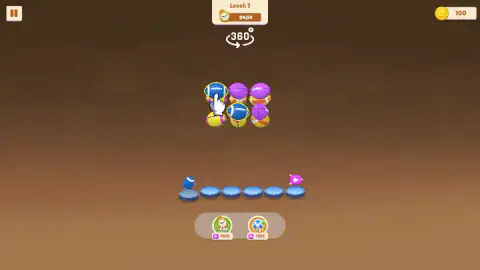
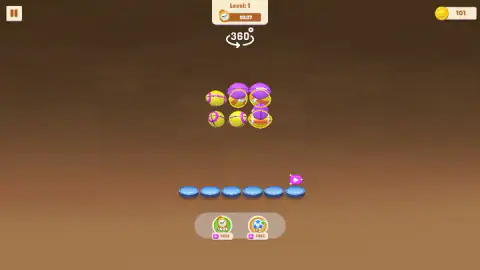
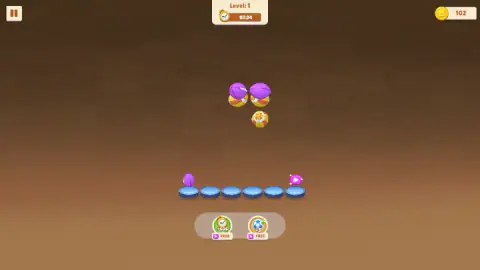
How to play 3D Triple Match
- Tap a ball in the pile. It lifts out and lands on the leftmost free pedestal in the row at the bottom. That pedestal turns pale, so the row doubles as your damage report.
- Find two more of the same kind and take those too. The moment three identical balls are down there together they merge and clear, and their pedestals go bright blue again.
- Keep the row as short as you can. A ball you take speculatively is a place you no longer have. There is no undo and no way to put something back.
- Work the pile down in layers. It is not one flat heap: clearing the top brings a fresh set up from underneath, which is why the cluster can look like it is not shrinking while you are making progress.
- Use the pause button, top left, if you need to stop. It freezes the clock and opens a settings panel with sound, music, continue and home.
What the run taught us that the screen does not announce:
- A bright yellow rim marks some of the balls and not others. We read it as the game pointing at what is available right now; it held in the moments we checked, though not exhaustively enough to call it a rule.
- A white tutorial hand holds your own hand for the first few taps, pointing at a ball and waiting. It stops once you are moving on your own.
- The pile is smaller than it looks. Level one opens with as many balls as there are pedestals, so in principle the whole opening layer could sit in the tray at once. That margin does not last — the layers underneath are what the places are really for.
- A banner reading "Click to keep playing" turned up twice during our run. A click anywhere brings the game back; it is neither an error nor an ad.
- The keyboard did nothing we could see. We pressed the arrow keys and the space bar repeatedly and the pile never reacted. Plan on playing this with a pointer.
Controls
| Left mouse button | Lifts the ball you click out of the pile and onto the next free pedestal |
|---|---|
| Tap (touchscreen) | The same thing, on a phone or a tablet |
| Pause button (top left) | Stops the clock and opens the settings panel, with sound, music, continue and home |
| Arrow keys and space bar | Nothing we could see or hear. We pressed all of them during the run and the pile did not move |
Features
- One verb: you tap a ball and it goes into the tray, and nothing else on screen takes an instruction
- Three of a kind sitting in the tray together merge and clear, giving their places back
- The tray has six pedestals, and the occupied ones go pale so you can read the damage at a glance
- The pile is built in layers: clearing the top brings a fresh set up from underneath
- Level one gives five minutes on a countdown and an opening pile of six balls
- Two power-ups sit under the tray, one offering sixty extra seconds and one marked +3, both labelled FREE in exchange for a video
- Made by HyperJoy Games
Game details
- Developer
- HyperJoy Games
- Release date
- August 2026
- Last updated
- August 28, 2026
- Added here
- August 2026
- Technology
- HTML5 (3D)
- Platforms
- Browser (desktop, mouse), Browser (mobile & tablet, touch)
- Saved progress
- Saving, when available, is managed by this game. Mava cannot confirm your level.
FAQ
How do you play 3D Triple Match?
You tap a ball in the floating pile and it drops onto the next free pedestal in the row beneath. When three identical balls are sitting in that row at the same time they merge and disappear, and the pedestals they were using come back. The pile is stacked in layers, so clearing the top of it brings more up from below.
How many slots does the tray in 3D Triple Match have?
Six. We counted them in every screenshot of the run, and they are easy to read because a pedestal with something on it turns pale while the empty ones stay bright blue. Six is fewer than most games of this kind give you, which means fewer loose balls you can afford to be carrying at once.
What happens if the tray fills up in 3D Triple Match?
We cannot tell you from experience. Every puzzle built on this pattern treats a full tray as the losing condition rather than the clock, but we never got close — three occupied pedestals was the most we ever had at once, out of six. No game-over screen appeared during our run, so what this one does at that moment is a gap in this page.
What is the 360 button in 3D Triple Match?
A white 360 degree mark with a curved arrow under it hovers above the pile, and it comes and goes rather than sitting there permanently. We pressed it and could not confirm that anything changed. In games with a stacked pile it normally means you can spin the view to see what is hidden behind, but we are not going to state that as a fact about this one.
How many levels does 3D Triple Match have?
Nobody publishes a number we would trust, and we did not get far enough to count. We came in at level one and we were still on level one when we stopped, about four minutes later. The level counter sits in the middle of the top bar next to the clock, so the game clearly expects you to go a long way past where we got to.
Are there ads in 3D Triple Match?
It is built around them. A small magenta video badge floats over the sixth pedestal, and two more sit on the power-ups under the tray, each next to the word FREE. We pressed the one over the sixth pedestal and the game answered with its own notice saying no ad was available right now, along with a button to carry on playing, which is what we did.
Who made 3D Triple Match?
HyperJoy Games, according to the game's listing, where the studio page header reads forty games and the list is almost all sorting and matching: colour water sort, hexa sort, gem sorting, magic block sort, coffee sort puzzle, bubble merge. This game was published in August 2026. Several unrelated mobile games carry nearly the same name and are not this one.
Can you play 3D Triple Match on a phone?
It is listed for desktop, mobile and tablet, and the whole design points that way: a single tap is the only input, the targets are large, and the keyboard did nothing when we tried it. We played on a desktop with a mouse, in a wide frame that the game filled without trouble, so we have not tested the phone version ourselves.