









About Tile Matcher Triple Fun
Classic mahjong solitaire gives you one kind of move: find two matching tiles that are both free and take them off together. Tile Matcher Triple Fun splits that move in two. First you pick a tile up, on its own, and it drops into a wooden tray under the board. Only later, when two more of the same picture have joined it, do all three disappear.
That small change is the whole game. You may take a chilli now even though the other two chillies are still buried. But until you dig them out, that chilli sits in the tray and takes up room. Every click is a small loan against a tray that is not very long.
The game is credited to a developer listed as SecGame. It was published in February 2026.
The honest part comes early. We played for about four minutes. That was enough to finish the guided first level with three stars and to clear two triples on the second. We never filled the tray, never lost, and never touched the helper buttons. This page tells you how the board works and what to watch for; it cannot tell you how hard the later levels get.
The first level is a guided dozen
Level 1 is a lesson. Twelve tiles sit on a wooden table in two layers, in only three pictures: chillies, red apples and blueberries. A white hand hovers over the board and points at a tile to take.
There are no helper buttons here, and nothing on the screen counts time. With only three pictures you cannot really get stuck. We clicked our way through it without much of a plan, at one point holding two apples and a chilli together, and still cleared the table in under two minutes.
It ends on a result screen with three stars and the game's mascots, a yellow bird with a strawberry and a mushroom. Under them is a bar that runs from a basket to a gift box. After one level ours read 4.8%. At that pace the gift would be about twenty levels away, though we did not play far enough to see whether every level is worth the same.
That screen also shows two counters, one for diamonds and one for stars. Ours read 0. We did not find out what diamonds are for.
Level 2 hides more than it shows
The second level is where the real game begins. We counted 30 tiles in six pictures: mushrooms, plums, red apples, yellow apples, blueberries and chillies.
The layout matters more than the count. In each corner there is a block of four dark tiles with a single lit tile sitting on top, like a lid. Take the lid and all four tiles under it light up at once. We saw this in the top left corner: one mushroom came off and a blueberry, a chilli, a mushroom and another blueberry became playable.
So a lid is the most valuable tile on the board, and also the most tempting mistake. Taking a lid you cannot match yet opens four tiles and costs one tray slot. Taking four lids that way costs four.
This is also where three helper buttons appear down the right side: a curved arrow, a light bulb and a pair of crossed arrows, each with a 3 under it. The developer's instructions call the bulb a hint and the crossed arrows a shuffle. We left all three alone. In the top left corner there is a pause button and a small wheel with a video badge, which we did not press either.
The post on the left is your star meter
Beside the board stands a wooden post with a basket at its foot. It is easy to take for decoration. It is the score.
Each time a triple left the table, the post filled a little from the bottom, and stars lit up along it. On level 1 the first star came with the first triple. On level 2 it took two triples, which fits a board more than twice the size.
We finished level 1 with all three stars. What we cannot tell you is whether the post only measures how much of the board you have cleared, or whether slow play or helper use can leave you short of the third star.
Where the tray comes from: pairs became threes
The computer game people call mahjong solitaire dates from 1981, when Brodie Lockard wrote Mah-Jongg for the PLATO system. Activision's Shanghai took it to home computers in 1986. Its rule is strict: 144 tiles, removed in pairs, and a tile is free only if it can slide out to the left or the right.
The tray version loosened that rule and added a new risk. Its best-known example is Sheep a Sheep, a game by Beijing Jianyou Technology that spread through WeChat in September 2022. According to The China Project, it had just two levels: a tutorial, and a second level that about 0.1% of its players beat.
Tile Matcher Triple Fun has the same shape in a gentler mood. The opening level teaches, the second one is suddenly much bigger, and the tray under the board looks, by its width, to have room for about seven tiles, the number Sheep a Sheep used. In games of this family a full tray ends the level. We never held more than four tiles at once, so we did not see what a loss looks like here.
The tray also explains why threes replaced pairs. With pairs, a tray would almost never fill. With threes, every picture you start is two more tiles you must find.
Who it is for
It suits anyone who likes mahjong solitaire and wants shorter boards with a little more risk. The first two levels ask for no reading at all, so children can follow them, and there was no clock on either.
A note on the scenery: the developer's description speaks of a tropical beach. Our two levels were played on a wooden table with a farm behind it. The beach may come later.
More tile games to try next
Master of 3 Tiles uses the same rule of three with a different set of pictures. Happy Zoo: Mahjong Triple Match swaps the fruit for animals and builds its boards as pyramids. Tile Valley is another mahjong-inspired tile matcher, and Fresh Drop: Triple Match moves the sets of three into 3D. The rest are under puzzle games.
Screenshots


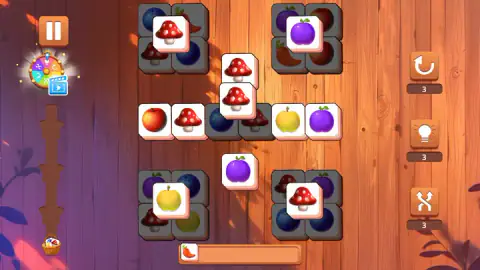

Taken by opening the game ourselves and letting it run — not supplied by the publisher, and not the same picture every other site shows.
How to play Tile Matcher Triple Fun
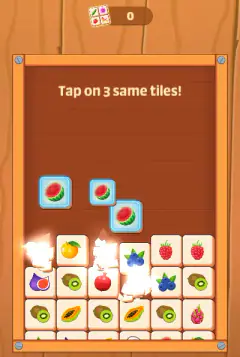
- Look for the lit tiles. A tile with nothing lying on it is drawn in full colour. A covered tile is dark.
- Click a lit tile. It leaves the board and lands in the tray at the bottom of the screen.
- Collect three of the same picture. When the third one arrives, the three vanish and the tray has room again.
- Uncover what is underneath. Each tile you take may light up the ones below it.
- Empty the table. The level ends when no tile is left.
What our session taught us:
- The tray keeps like with like. We had chillies in the tray, added two blueberries and then took one more chilli. It did not go to the end of the row: it slid in beside the other chillies. You can read the tray as a list of pairs waiting for a third.
- Finish what is already in the tray. On level 2 we held two mushrooms and took a blueberry anyway. Nothing went wrong, but that blueberry then sat there doing nothing. With more pictures in play, loose singles are how a tray fills.
- The two apples are different tiles. Level 2 has a red apple and a yellow one. They are easy to tell apart on the board and less so at tray size. They do not match each other.
- Count before you commit. If you can see only two plums that are lit, taking both means waiting for a third you have not found yet.
Controls
| Click a lit tile | Sends it to the tray at the bottom; three identical tiles in the tray vanish |
|---|---|
| Curved arrow, light bulb and crossed arrows (right side, from level 2) | The three helpers, each showing a 3; we did not use any of them |
| Pause button (top left) | Pauses the level |
| Wheel with a video badge (top left, from level 2) | We did not press it |
Features
- Fruit and vegetable tiles stacked in layers, cleared three at a time through a tray under the board
- A guided first level of 12 tiles, with a hand that points at a tile to take
- A second level of 30 tiles in six pictures, including a red apple and a yellow one that do not match each other
- A post on the left that fills with up to three stars as triples leave the board
- Three helpers from level 2 on, each with three uses shown under its button
- A bar on the result screen that read 4.8% after one level, with a gift box at its far end
- Made by SecGame
Game details
- Developer
- SecGame
- Release date
- February 2026
- Last updated
- August 10, 2026
- Added here
- December 2025
- Technology
- HTML5 (2D)
- Platforms
- Browser (desktop, mouse), Browser (mobile & tablet)
- Classification
- Cards & Board , Puzzle
- Saved progress
- Saving, when available, is managed by this game. Mava cannot confirm your level.
FAQ
How do you play Tile Matcher Triple Fun?
Click any tile that is not covered by another and it drops into the tray under the board. When the tray holds three tiles with the same picture, those three vanish. The level is won when every tile has left the table.
How is Tile Matcher Triple Fun different from mahjong solitaire?
Mahjong solitaire removes tiles in pairs, straight from the board. Here a tile first goes into a tray, and it takes three of a kind to clear them. That means you can pick up a tile before its partners are free, at the price of a tray slot until they are.
Why are some tiles dark in Tile Matcher Triple Fun?
A dark tile has another tile lying on it. When we took the single tile that capped a stack of four, all four below lit up at once. Plan around those caps: one click can open four new tiles.
What do the three buttons on the right do in Tile Matcher Triple Fun?
They appear from level 2 and show a curved arrow, a light bulb and a pair of crossed arrows, each with a 3 under it. The developer's instructions describe the bulb as a hint and the crossed arrows as a shuffle of the board. We did not press any of them, so we cannot confirm what each does or how you get more.
How do you get three stars in Tile Matcher Triple Fun?
A post on the left of the board fills as triples leave the table, and stars light up along it. We finished the first level with three. We did not finish a level with fewer, so we cannot say whether that is possible or what it would cost you.
How many levels does Tile Matcher Triple Fun have?
We completed level 1 and played part of level 2, so we cannot count them. The first level has 12 tiles and the second has 30. The developer describes levels that keep getting harder.
Can you lose a level in Tile Matcher Triple Fun?
We did not lose one. Our tray never held more than four tiles, and by its width it has room for about seven. In games of this kind a full tray ends the level; we did not fill ours to see it happen here.
Who made Tile Matcher Triple Fun?
It is credited to a developer listed as SecGame. It was published on 26 February 2026.