










About Tile Valley
Most tile puzzles that borrow the word mahjong ask you to find two of a kind. Tile Valley asks for three, and then adds a rule that changes the whole problem: the tile you pick does not vanish. It goes to a tray with seven slots and waits there until two more of its kind join it.
That tray is the game. The board is only a pile of pictures; the question on every click is how many slots you are about to tie up, and for how long. A watermelon you can finish in three clicks costs nothing. An apple whose last copy is buried costs two slots until you dig it out.
The game is by Obumo Games. It was published in January 2026. We played the first level for about four minutes and came within one tile of clearing it. Everything below comes from that level, and we say so wherever the publisher claims more than we saw.
Level 1 is 27 tiles, and we counted every one
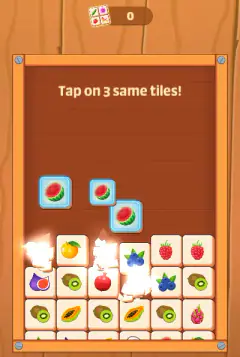
The first board looks small. It is two layers. Underneath, fifteen tiles lie flat in a block five wide and three deep. On top sit twelve more, shifted half a tile sideways and half a tile down, so that each upper tile rests across the corners of the ones below.
That half-tile shift matters. A tile in the middle of the lower block can be pinned by four upper tiles at once, and it stays grey until the last of them is gone. A tile on the edge may be held by a single neighbour.
There are six pictures: a watermelon slice, a lightning bolt, a red apple, a wedge of cheese, a blue macaron and a green wrapped candy. Watermelons, bolts and macarons each appear six times. Apples, cheeses and candies appear three times each. That is nine trios.
The layers are not dealt evenly. All three candies are on the lower layer, so there is no point thinking about them until the top has thinned out. The macarons are the other way around: two start on top and four are underneath, three of them packed together near the middle. They were the last tiles on our board.
The apple that cost us two slots
Our first two clicks were the two apples on the upper layer. It felt like a safe opening: two of three, one to go. Then we looked for the third. It was in the top right corner of the lower block, grey, with a lightning bolt lying across it.
So the apples waited. To reach that bolt we took other things on the way, a macaron, a watermelon, a cheese, and none of them made a trio. The tray stood at five tiles out of seven with only one pair in it. Two more wrong picks and, by the publisher's rule, the level would have been over. On level 1.
Lifting the bolt freed the apple and the trio cleared. The habit worth taking from it: do not pick the first tile of a picture until you can see where the other two are and what is sitting on them. The rest of our level went trio by trio, cheeses, bolts, watermelons, candies.
The lesson is cheap to state and easy to forget. A pair in the tray is not progress. It is a loan, and the third tile is how you pay it back.
What four minutes showed us, and what they did not
We stopped with two macarons in the tray and the last macaron alone on the board, one click from an empty stack. We collected 26 of the 27 tiles and cleared eight trios. We did not see the screen that follows a cleared level, and we did not see level 2.
We also never pressed the four helper buttons under the tray. Each carries a small red badge that read 3 from the first moment to the last. Their icons are a light bulb, two crossed green arrows, an orange back arrow and a purple +1. Those are familiar signs in this kind of puzzle, but we will not tell you what a button does when we have not pressed it. We can say that the first level does not need them.
The publisher's notes speak of hundreds of levels and of other tile sets, with sweets and shapes besides food. Our level was all food and one bolt of lightning, on a background of blue sky, mountains and a green hill.
Mahjong lent the stack, not the rules
The publisher calls the game inspired by mahjong. The debt is to mahjong solitaire, which is a different thing from the four-player game. Brodie Lockard wrote the first computer version in 1981 on the PLATO system, and Activision sold it as Shanghai from 1986. It uses the 144 tiles of a mahjong set, piled in layers, and you remove them in matching pairs.
The rule Tile Valley keeps is the one about access: a tile can be taken only when it is free of the tiles around it. In mahjong solitaire that means it can slide out to the left or right. Here it means simply that nothing rests on top.
The rule it changes is what happens next. In mahjong solitaire both halves of a pair must be free at the same moment, and you lose when no free pair remains. In Tile Valley you may take one tile now and its partners later, which sounds more forgiving. The tray is the price of that freedom. You are allowed to plan ahead, and you are charged a slot for every step of the plan that is not finished yet.
Who it suits
Players who like to stop and count. There is no clock on screen, the first level fits in a few minutes, and the first board can be read completely before you touch it. It suits a short break, and it is simple enough to share with a child who knows what three of a kind means.
It is less suited to anyone who wants speed, scores or a rival. The playing screen shows a level number and nothing else to chase.
More tile puzzles on Mava Games
Happy Zoo: Mahjong Triple Match uses the same seven-slot tray with animals on the tiles, and Mahjong Match plays the tray against a level clock. For the older rule, pairs and no tray, there is Mahjong Classic. The rest are filed under puzzle games.
Screenshots





Taken by opening the game ourselves and letting it run — not supplied by the publisher, and not the same picture every other site shows.
How to play Tile Valley
- Look for white tiles. A white tile has nothing on top of it and can be taken. A grey tile is covered, at least partly, by another one.
- Click or tap a white tile. It drops into the tray under the board.
- Collect three of the same picture. The moment the third one lands, all three disappear and their slots are free again.
- Empty the stack. Taking tiles off the top turns the grey ones underneath white. The level is finished when nothing is left.
- Mind the seven slots. According to the publisher's rules, a full tray ends the level. We never filled ours, so we did not see what that looks like.
Things worth knowing before the first click:
- Grey does not mean hidden. You can see the picture on every covered tile. Read the lower layer before you touch the upper one.
- The tray sorts itself. We picked a second cheese while a lightning bolt sat at the end of the row, and the cheese slid in next to the first one, ahead of the bolt. Twins always sit together, so the tray is easy to read at a glance.
- Some pictures have no spare copies. In the first level, apples, cheeses and candies come in exactly three. Start one of those and you must find all of them.
- In our run only white tiles ever moved. Some of our clicks changed nothing on screen. Clicking takes no time off you, because there is no clock, but it does not help either.
Controls
| Click or tap a white tile | Sends it to the tray under the board; three of the same picture in the tray disappear |
|---|---|
| Four round buttons under the tray | Helpers with a light bulb, crossed arrows, a back arrow and a +1, each with a badge that reads 3; we did not press them |
| House button (top left) | Leaves the level; we did not press it |
Features
- A first level of 27 tiles in two layers, with six pictures: watermelon, lightning bolt, apple, cheese, blue macaron and green candy
- A tray of seven slots that sorts itself, so a tile you pick lands beside its twin and not at the end of the row
- Covered tiles shown in grey and free tiles in white, so you can read what is underneath before you uncover it
- Four helper buttons, each starting the level with three uses
- No timer, no score and no move counter on the playing screen: only the level number
- Made by Obumo Games and listed in eleven languages, in landscape and portrait
Game details
- Developer
- Obumo Games
- Release date
- January 2026
- Last updated
- July 28, 2026
- Added here
- November 2025
- Technology
- HTML5
- Platforms
- Browser (desktop, mouse), Browser (mobile & tablet)
- Classification
- Cards & Board , Casual , Puzzle
- Saved progress
- Saving, when available, is managed by this game. Mava cannot confirm your level.
FAQ
How do you play Tile Valley?
Click or tap a white tile and it drops into the tray below the board. When the tray holds three tiles with the same picture, those three vanish. Grey tiles are covered by others and turn white once the tiles on top are gone. The level is done when the stack is empty.
How many slots does the tray have in Tile Valley?
Seven. Each tile you pick takes one slot until its trio is complete, and the publisher's rules say the level is lost when all seven are full. In our first level the tray reached five tiles at its worst, so we never saw the losing screen ourselves.
How many tiles are in the first level of Tile Valley?
We counted 27, which makes nine trios. Fifteen lie flat in a block and twelve sit on top of them, shifted half a tile. There are six different pictures: watermelons, lightning bolts and macarons come six apiece, while apples, cheeses and candies come three apiece.
Is there a time limit in Tile Valley?
We saw none. The playing screen shows the level number, the board, the tray and four helper buttons, with no clock, score or move counter. We spent about four minutes on the first level and nothing hurried us.
What do the four buttons under the tray do?
They are helpers, and each one starts with a badge that reads 3. Their icons are a light bulb, two crossed arrows, a back arrow and a +1. We finished our session without pressing any of them, so we describe what they look like and not what they do.
Is Tile Valley the same as mahjong?
No. It borrows the stacked layout of mahjong solitaire, where a tile can only be taken once nothing lies on top of it. The tiles here show food, they are cleared three at a time and not in pairs, and they pass through a tray first.
Who made Tile Valley?
Obumo Games. The game was published in January 2026 and last updated in July 2026. It is free and runs in the browser with no download.
Can I play Tile Valley on a phone?
The publisher lists it for Android and iOS browsers as well as PC, in both landscape and portrait. We played it on a desktop with a mouse, where every action is a single click, and did not test a touch screen.