



About Monster Tile Party
Most tile games end when the board runs out of legal moves. This one ends when you run out of shelf.
Underneath the board sits a tray with seven slots. Every tile you tap lands in it, and the only way a tile ever leaves again is by being the third of its kind. Our run finished with the tray holding a pair of green monsters, a pair of purple ones, a pair of acorns and a lone wedge of cheese: three pairs and an orphan, no trio anywhere, and no room left to go hunting for one. The board above was still half full.
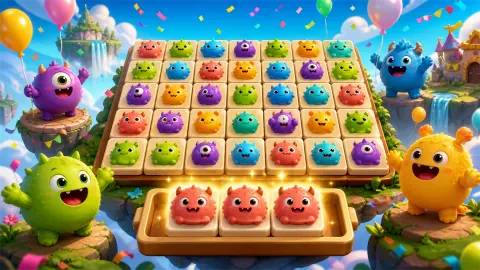
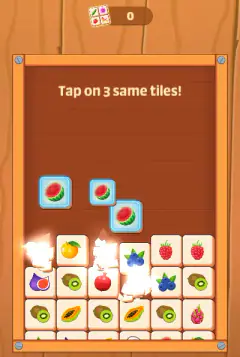
The board itself is not flat. Tiles sit in layers, offset by half a width so each one covers the corners of those below, and the game tells you which ones you may touch purely by how they are drawn. Full colour and a pale cream frame means free. Dim and grey means pinned under something. Take the bright ones, the dim ones come up into the light, and any three identical tiles that meet in the tray pop on their own.
The game is credited to HONG KONG SKYREACH INTERACTIVE LIMITED and has been available since August 2026. Nothing on screen names the studio while you play.
Our own session ran about four minutes, on a desktop, and ended on a green card reading "LEVEL FAILED" — on level one. The card offers to bring you back if you watch an advert. We did not take it. Everything below is written from the losing side of that card, which is a better place to write from than it sounds.
Seven slots, and a pair costs you two of them
Seven is a deliberately awkward number. It is two trios plus one, so the tray holds two sets in progress and a single speculative tile — and that spare is where runs go to die. Take a tile you are not already holding one of, and you have begun a third set with nowhere to put its partner.
The arithmetic is unforgiving once you write it out. Three pairs fill six slots, so your seventh tap must complete one of them or the level ends there, and whether it can is decided by what the board is willing to show you. We reached six-of-seven holding greens, pale blue ghosts and purples in pairs. We found a third ghost, which bought three slots back. We spent them on acorns and cheese and finished in the same hole, only worse.
That is also why the layers matter more than they first appear. A pair is only stranded if its third is buried, so the question stops being "what can I match" and becomes "what am I about to be able to match".
When the tray does fill, the board dims, a red heart marked 5 appears at the top of the screen next to the word "FULL!", and the green failure card drops in with its offer of a revive for an advert. We can tell you the heart is there. We cannot tell you what it counts.
Mahjong solitaire with one rule changed
The layered board is not a decoration borrowed from somewhere. It is the whole inheritance, and the thing it was inherited from is younger than most people assume.
Mahjong solitaire is a computer game, not an old parlour game dressed up. Brodie Lockard wrote the first version in 1981 on the PLATO system, naming it after the tile set it borrowed, and Activision published its own version, Shanghai, in 1986. Its two rules are the ones you are playing here. A tile is available only if it can be slid out left or right without disturbing its neighbours, and matching tiles are removed from the board.
Triple-tile changes two things, and the second one matters. It asks for three identical tiles instead of two. And because you can no longer point at two tiles and watch them vanish, it needs somewhere to put the first and second while you look for the third. That somewhere is the tray.
Add a tray and you have invented a way to lose that mahjong solitaire never had. The older game ends when no legal pair remains, a slow death you can see coming ten moves out. This one ends when your hand is full, which can happen while the board is still rich with options, and it happens fast.
The modern version of that idea arrived through phones. In September 2022 a Chinese mobile game called Sheep a Sheep, made by Beijing Jianyou Technology, became the hit of the year there on a format that reads like a blueprint for this one: a stacked board, three identical cards to eliminate, a holding tray that fits exactly seven, a game-over the moment it overflows, boosters that undo and reshuffle, and a revive paid for by watching an advert. Monster Tile Party has no connection to that game, or to Shanghai, or to any other commercial series. It is one of many browser games built on conventions that stopped belonging to anyone long ago.
The tutorial teaches four things, and misses the one that kills you
The game opens on a flat purple screen and walks you through four cards, each with a white pointing hand and a small "Skip" link in the top right. "Welcome" over "Clear the game field". "Great" over "Let's merge 3 other tiles". Then the one that actually teaches something, "Unlock tile" over "On the lower layer", showing a small grid where bright tiles sit on dim ones. Last, "Use a hint" over "If you get stuck".
Then the purple goes and the real level appears on a painted forest, with a house icon and a blue badge reading "LEVEL 1" on a bar across the top. The difficulty jumps with the scenery: the tutorial board is a tidy handful of tiles, the first real board a layered heap where half of what you can see is greyed out.
What those four cards never mention is that the tray can fill. They teach the tap, the trio, the layers and the hint, and leave out the lose condition entirely. The game's listing goes further than the game does, describing daily rewards and a level map that grows as you go — neither of which the game showed us.
More games by the same studio
The studio's page on the game's listing gives forty-five games and we carry a fair few. ExitBlocks: Color Match Puzzle is the nearest in spirit, another crowded board cleared by colour. Cardivo Adventure is a card-sorting puzzle about this game's real subject, which is running out of room to put things.
If it is the tray you came for, Happy Zoo: Mahjong Triple Match is the closest relative we have: layered pyramids, animals instead of monsters, three of a kind into a tray. Tile Matcher Triple Fun runs the same format with fruit, and Master of 3 Tiles strips the decoration back to the rule itself. The rest is in puzzle games.
Screenshots
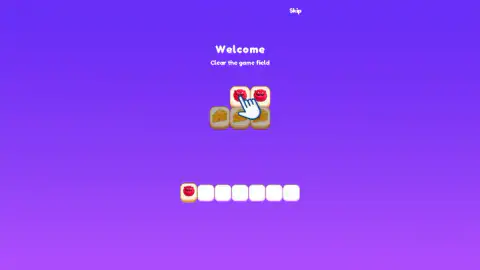
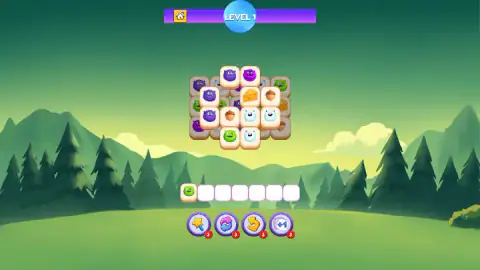
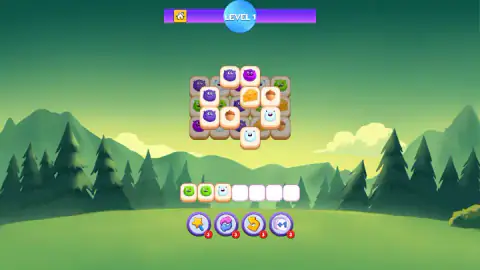
Taken by opening the game ourselves and letting it run — not supplied by the publisher, and not the same picture every other site shows.
How to play Monster Tile Party
- Tap any tile drawn in full colour. It flies down into the first free slot in the tray. Dim, greyed tiles are underneath something and will not respond.
- Collect three of a kind in the tray. The moment the third one lands, all three disappear and hand the slots back. You never drag anything onto anything.
- Work the top layer to free the one below. Every tile you take from above turns the tiles under it from grey to colour, which is the only way the board opens up.
- Empty the board to win the level. The tray filling is the lose condition, not a timer — we never saw a clock anywhere on screen.
- Keep the four round buttons under the tray in reserve. A gold star on a wand is the hint, as the tutorial says outright. The game's listing names the other three as Undo, Shuffle and Extra Slot. Each starts the level badged with three uses.
What the session taught us:
- Count the tray before every tap, not after. A pair you cannot finish occupies two slots indefinitely. Three stranded pairs occupy six, which leaves you one tap and it had better be a third of something. We sat in exactly that position two minutes before we lost.
- Aim only at tiles that are properly lit. There is a stretch of our run where the screen does not change for about half a minute, because we kept clicking tiles pinned under others. A dead tap does nothing at all — no buzz, no shake.
- Two monsters of roughly the same colour are not the same tile. One lavender monster has horns and a worried face, another is brighter purple with a wide grin, and at tile size they read as one colour and two expressions.
- Not everything in the set is a monster. A wedge of cheese and an acorn are in the same mix, and in our final tray they took three of the seven slots.
- The hint button is there from the first second. Ours still showed three uses when the failure card came up. We drowned with a full set of boosters in hand, which is the most avoidable way to lose this game.
Controls
| Left mouse button on a tile | Sends that tile down into the tray. It is the only control we needed all session |
|---|---|
| Single finger tap | The same thing on a touchscreen, according to the listing's control notes |
| The four round buttons under the tray | Hint, shuffle, undo and one extra slot. Each carried a red badge reading 3 when our level began |
| House icon, top left | Leaves the level. It sits on the purple bar beside the level number |
| Skip | Top right of every tutorial card, in small white text. Four cards stand between you and the first level |
Features
- A tray of exactly seven slots under the board, which is the whole difficulty of the game in one number
- A board stacked in layers and offset by half a tile, with covered tiles drawn dim and free ones in full colour
- Monster faces plus cheese wedges and acorns in the same set, and two shades of purple monster that are not the same tile
- Four boosters in a row under the tray - hint, shuffle, undo and extra slot - each starting the level with three uses
- A four-card tutorial before the first level, each card skippable from a small link in the top right
- A failure card that offers to bring you back in exchange for watching an advert
- Available since August 2026 and updated at the end of that month
Game details
- Developer
- HONG KONG SKYREACH INTERACTIVE LIMITED
- Release date
- August 2026
- Last updated
- August 31, 2026
- Added here
- July 2026
- Technology
- HTML5 (2D)
- Platforms
- Browser (desktop), Browser (mobile & tablet, touch)
- Classification
- Puzzle
- Saved progress
- Saving, when available, is managed by this game. Mava cannot confirm your level.
FAQ
How do you play Monster Tile Party?
You tap tiles on a layered board and each one you tap flies into a tray of seven slots underneath. When three identical tiles are sitting in that tray at once they vanish by themselves and give the slots back. Clear every tile off the board and the level is won. Fill all seven slots without completing a trio and the level ends there.
How many slots does the tray have in Monster Tile Party?
Seven, and the count never changed in our session. It is the number that decides everything else, because a pair you cannot complete sits in two of those slots until you find its third. Three stranded pairs leave you one free slot and one chance to get it right.
Why can't I click some of the tiles?
Because they are underneath something. The board is built in layers and the game shows you the difference by drawing covered tiles dim and grey while the ones you can take keep their full colour and a cream frame. One of the tutorial cards spells this out under the heading "Unlock tile". For about half a minute of our run the screen did not move at all, because we kept aiming at tiles that were pinned.
What are the four buttons under the tray?
Left to right, a gold star on a wand, two curling arrows, a single yellow arrow and a card marked "+1". The tutorial names the first one as the hint. The game's own listing names the other three as Undo, Shuffle and Extra Slot. Each one carried a red badge reading three when our level started, and since we never spent one we cannot tell you from experience what they do.
Who made Monster Tile Party?
The game is credited to HONG KONG SKYREACH INTERACTIVE LIMITED. No studio name appears on screen while you play. It has been available since August 2026 and was updated at the end of that month.
Does Monster Tile Party have ads?
The one advert offer we met in four minutes came after we lost. The failure card carries a purple button reading "WATCH AD TO REVIVE", which is the format's usual bargain - your place in the level back in exchange for a video. We did not press it, so we cannot tell you how long the video runs or what state the board returns in.
Where does the triple-tile format come from?
From mahjong solitaire, which is itself a computer game rather than an old parlour one - Brodie Lockard wrote the first version in 1981 and Activision published Shanghai in 1986. That game stacks tiles in layers, lets you take only the ones nothing is resting on, and removes matching pairs. Triple-tile keeps the layers, asks for three instead of two, and adds the holding tray that makes the whole thing losable.
Is Monster Tile Party hard?
Harder than it looks, and the difficulty is arithmetic rather than reflex. We failed level one in about four minutes on a desktop, with the tray holding two green monsters, two purple ones, two acorns and a single cheese wedge. Six of the seven slots were spoken for by pairs that never found a third. Nothing about that was fast or unfair - it was just bad counting.