




About Onet Puzzle - Tile Match Game
Most matching games hide something from you. Memory games turn the cards face down. Stacked mahjong buries half its tiles under the other half. Onet Puzzle - Tile Match Game hides nothing: every tile is face up from the first second, and all the copies of the picture you want are there in plain sight. The question is never where the partner is. It is whether you can get to it.
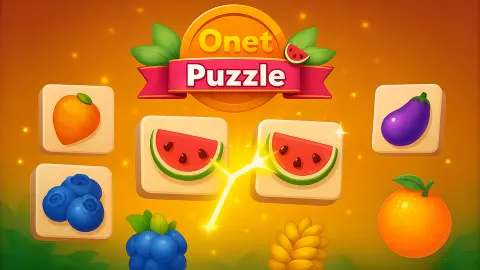
That is the rule of the whole onet family. Two identical tiles clear only when an open path joins them without crossing a third. Here the tiles carry fruit and vegetables on a wooden wall with flowers growing along the bottom: watermelon slices, mangosteens, cherries, a purple aubergine, a knob of ginger, a tomato with its green crown still on.
We went back for a longer session this month, and it corrected something we had written after a shorter one. Level 1 is not a fixed puzzle. We opened it twice in the same sitting and got two different boards carrying two different sets of fruit. The size never moved. The arrangement never repeated.
It is made by 29Studio. What follows is as far as we got: ten minutes, two boards, one pair cleared on a real level. We never emptied the first level, so we never saw the second.
Forty tiles, ten pictures, and a board you have not seen before
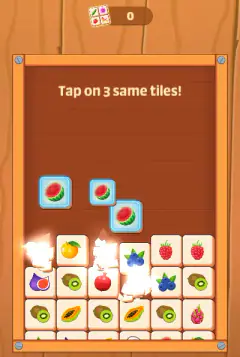
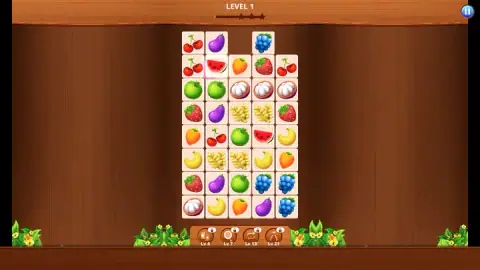
The first level is a block of forty tiles, standing five across and eight down, taller than it is wide, with wood panelling filling the rest of the screen.
There are ten different pictures and four copies of each. We counted them by hand on two separate boards and got the same shape both times, which is the dull half of the finding.
The interesting half is that the two boards were not the same. One carried grapes, mangosteens, watermelon, bananas, tomatoes, pears, mangoes, strawberries, green apples and a yellow melon. The other swapped half of that for cherries, aubergines and ginger; a board from an earlier session had pumpkins and beetroot on it.
So the pictures are drawn fresh from a bigger pool every time, and the layout is built again from scratch. You cannot learn this level. You can only read it.
What stays the same is the arithmetic, and it is what turns a search into a decision. Nothing slides when a pair goes, either: the holes stay holes and every other tile keeps the cell it was in. The board will not tidy itself up in your favour. The only thing that changes it is you, two gaps at a time.
The tutorial is twenty tiles and two taps
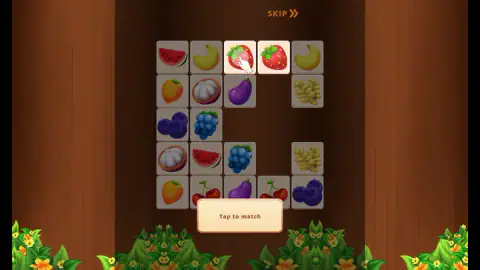
The practice board you meet first looks like a smaller version of the game. It is something cleverer: twenty tiles, ten pictures with two copies of each, laid out with holes already punched in it.
With a single pair per picture there is nothing to choose, so the only thing left to learn is the thing that matters, and it teaches that in two steps. First the hand lights a pair of strawberries sitting side by side: tap, tap, gone, no route required. Then it lights a pair of bananas on the same top row, with the cells the strawberries just left sitting between them. The second lesson is only possible because of the first. Empty cells are road; tiles are wall; and the gap you made a moment ago is what lets the next pair go.
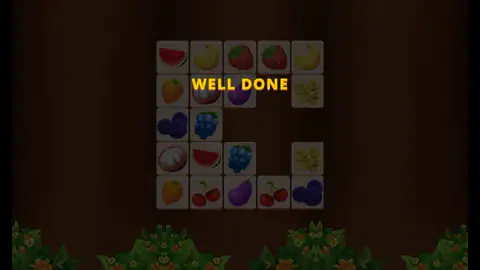
Then comes a yellow WELL DONE over a dimmed board, and that is the one thing on screen that reads as a lie. It is not a level cleared: every tile is still exactly where it was, strawberries included. It is the tutorial signing off, and the real first level opens straight after.
The line is allowed to leave the board
In an onet game the path between two tiles is made of straight stretches, and the limit is on how often it may turn. The classic rule of the genre is three stretches, which means two bends. This game's own instructions are looser: a line that bends no more than three times.
What neither version tells you is where the line may run. Our clue came from a board we were partway through. Two cells were missing from the top row with a bunch of grapes still sitting between them, and every picture still had its full four tiles except the watermelons, which were down to two. So the pair that went was two watermelons with a tile between them, and the only route that could have joined them stepped off the top of the board, ran along the outside and came back down.
That is the half-hidden rule of the family, and it changes how you read a board: the rim is an open road. A tile on the edge is far better connected than it looks, which is also why the ones in the middle feel glued down until you have opened the outside.
The puzzle is older than the fruit. It comes from Shisen-Sho, a Japanese computer game of the late 1980s that laid mahjong tiles flat in a rectangle and asked for exactly this: pairs joined by a short bent line. Onet is the name the same idea travels under on phones and browser portals, usually with animals or fruit in place of the mahjong suits.
The bar fills, and the padlocks open slowly
Under the words LEVEL 1 there is a bar with three dark stars spaced along its right-hand half, and we had it wrong before. It is not a clock running out. On a full board the bar is empty, and after our first pair went a thin gold sliver appeared at its left end. It fills. The stars sit well past the halfway mark, so they are what you fill it towards. The description does promise a time limit on every level, but nothing on screen counted anything down.
Along the bottom sit four round buttons, every one of them padlocked, marked to open at levels 4, 7, 13 and 21.
You can make out a magnifying glass and a pair of looping arrows among the icons, but what any of them does we cannot say: not one was within reach of the level we never finished. The padlocks make the point for you. The opening levels are meant to be played with no help at all.
The description promises more than we reached: bigger grids with more kinds of tile as you climb, a treasure box, a score, and more than twenty themes with their own music. We only ever saw the wooden one.
Who it is for, and what it is not
It suits players who would rather look than hurry: no hidden information, no luck in the reading, only the block in front of you and the question of what opens what. Reloading the page sends you back to the title card and a brand new first level, so this is a game of single sittings rather than a campaign. If you wanted the stacked kind of mahjong, with layers and tiles freed from the ends of rows, this is flatter and more patient than that.
More games like this
Mahjong Lines is the same connecting rule played with mahjong tiles, and Onet Animals plays it with animal faces instead of fruit. Tile Pair Jam: Mahjong Master turns the idea around: there you slide the tiles until two of a kind face each other. From the same studio, Slide Block Jam is a sliding-block puzzle and Cube Drop Puzzle stacks instead of clearing. More are in the puzzle category.
Screenshots
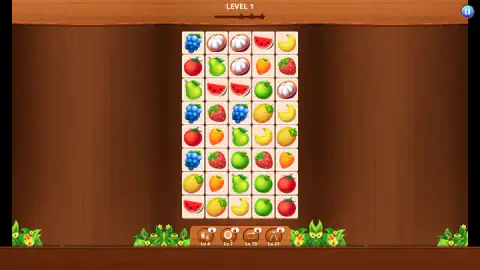
Taken by opening the game ourselves and letting it run — not supplied by the publisher, and not the same picture every other site shows.
How to play Onet Puzzle - Tile Match Game
- The game opens on a title card with a purple Let's Play button. Press it and the tutorial begins: the board dims, a card at the bottom reads Tap to match, and a pointing hand picks out two lit tiles.
- Follow the hand, or press the orange SKIP at the top. Either way the real first level is up about ten seconds after you arrive.
- Tap a tile. It turns bright white, with a pink line drawn along its edge.
- Tap a second tile carrying the same picture. If an open path joins the two, both vanish and leave holes.
- Keep clearing. The holes you make are the roads you will need later.
Tips from our run:
- Take the touching pairs first. Two of a kind side by side need no route at all. One of our boards opened with three mangosteens in a row, any two of which would have gone.
- Four of a kind is a choice, not a gift. Every picture has three possible partners, and picking the wrong two can strand the other two behind a wall of tiles. Clear the pair that opens the most ground, not the one you noticed first.
- It is a tapping game, not a dragging one. We tried dragging from one tile to its twin several times and nothing happened. One tap to choose, one tap to pair.
- A lit tile will not light twice. Tap the one you already chose and you only let it go again.
- Look along the outside edge. A tile on the rim has the whole outside to route through, which is more room than anything in the middle gets.
Controls
| Left click or tap on a tile | Selects it; the tile turns bright white and a pink line is drawn at its edge |
|---|---|
| Left click or tap on a second, identical tile | Removes both if an open path joins them |
| SKIP (top of the screen, tutorial only) | Ends the tutorial and opens the first level |
| Pause button (top right) | Pauses the level |
Features
- A first level of 40 fruit and vegetable tiles standing five across and eight down on a wooden wall
- Ten pictures with four copies of each, so every tile has three possible partners and not one
- The board is rebuilt every time you open level 1, with a different set of ten pictures on it
- Everything is face up from the first second; the puzzle is the route between two tiles, not remembering where they are
- Cleared tiles leave holes and the rest stay put, which is what opens new routes
- A bar under the level name that fills as you clear, with three stars marked along its right-hand half
- Four helper tools along the bottom, all padlocked at the start and marked to open at levels 4, 7, 13 and 21
- A twenty-tile tutorial that teaches the two ideas of the game and can be left at any moment with SKIP
- Made by 29Studio
Game details
- Developer
- 29Studio
- Release date
- October 2025
- Last updated
- August 10, 2026
- Added here
- August 2025
- Technology
- HTML5
- Platforms
- Browser (desktop, mouse), Browser (mobile & tablet, touch)
- Saved progress
- Saving, when available, is managed by this game. Mava cannot confirm your level.
FAQ
How do you play Onet Puzzle - Tile Match Game?
You tap one tile and then a second tile carrying the same picture. If an open path joins the two, both disappear and leave holes. The level is a block of fruit and vegetable tiles, all face up, and the aim is to empty it pair by pair. It is a tapping game, not a dragging one; dragging from tile to tile does nothing.
Is level 1 of Onet Puzzle - Tile Match Game always the same board?
No. We opened the first level twice in one session and got two different boards with two different sets of fruit on them. The size was the same both times, forty tiles standing five across and eight down, but the arrangement never repeated and only some of the pictures came back.
What is the connecting rule in Onet Puzzle - Tile Match Game?
Two identical tiles clear when a line of straight stretches joins them without crossing a third tile. The game's own instructions allow a line that bends up to three times, which is one bend more than the classic rule of the genre. The line is also allowed to run outside the edge of the board, which is how the one pair we cleared on a real level could go at all.
How many tiles are there in level 1 of Onet Puzzle - Tile Match Game?
Forty, standing five across and eight down. There are ten different pictures and four copies of each, so every tile can pair with any of three others. The tutorial board before it is half that, twenty tiles with ten pictures, two of each.
What are the locked buttons at the bottom of Onet Puzzle - Tile Match Game?
They are four helper tools, each shown with a padlock and the level that opens it. The first opens at level 4 and the last at level 21, so the early levels are played with no help at all. We did not get far enough to unlock one, so we cannot say what each does.
Is there a time limit in Onet Puzzle - Tile Match Game?
The game's description says each level has a time limit, but nothing on screen counts down. The bar under the level name does the opposite. It starts empty and gains a sliver each time a pair goes. We never reached the end of a level, so we cannot say what happens when the bar is full.
What does WELL DONE mean in Onet Puzzle - Tile Match Game?
It is how the tutorial signs off, not a level cleared. The yellow card appears over the practice board with every tile still sitting where it was, and the real first level opens straight afterwards, about ten seconds after you press play.
Who made Onet Puzzle - Tile Match Game?
It is made by 29Studio. It was published in October 2025 and last updated in August 2026.
Can you play Onet Puzzle - Tile Match Game on a phone?
It runs in the browser with no download, and it is listed for both desktop and mobile browsers. The board is upright, taller than it is wide, and the only action is a tap on a tile.