
About Worms
The worm is not the piece in this puzzle. It is the pen.
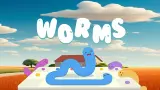
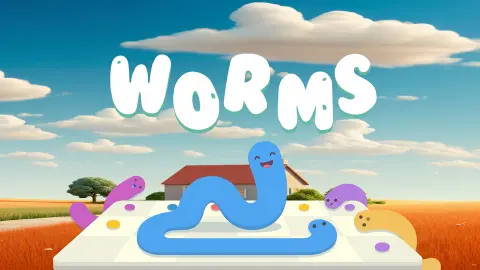
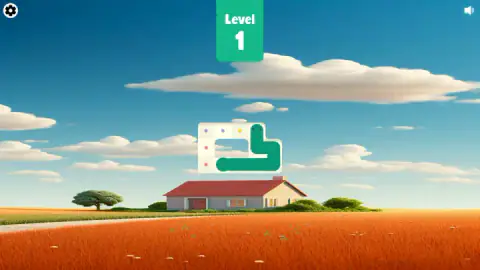
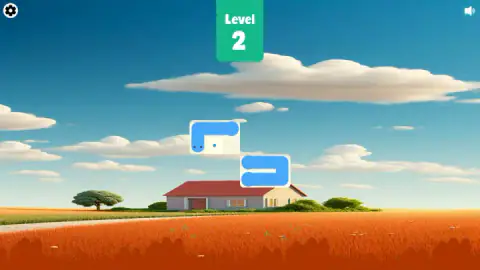
A small white board floats in the sky above a farmhouse with a red roof, divided into pale squares, and every square has a single coloured dot sitting on it. Steer the worm over a square and the square fills in with the worm's colour, the dot goes, and the worm is that much longer. Cover the whole board and you are done. There is nothing to fit anywhere, nothing to match against anything, and no clock.
What makes it a puzzle rather than a doodle is that the filling stays. A square you have crossed is solid colour from then on, and the worm does not go back over itself. So every move is also a move you have thrown away, and by the time the board is half full your own body is the wall you keep running into. The only question Worms ever asks is the order, and the order is the whole of it.
The game is credited to The Butterfly Game Studio. The listing puts both the release and the last update in June 2026.
Our own session was short and we would rather be exact about it than vague. We played for about four minutes, finished level one, pressed the arrow on the win card, finished level two, and stopped there. Everything on this page comes out of those two boards.
A route that touches every square once, and the toy that failed at it
Covering every point of a board exactly once is not a casual-games invention. It has a name, a date and an unsuccessful wooden ancestor.
In 1856 the Irish mathematician William Rowan Hamilton worked out a puzzle and then had it made into a toy. It was a flat wooden board with numbered pegs standing at the corners of a flattened-out dodecahedron, and the player had to run a route from peg to peg that touched every one of the twenty pegs and came back to where it started, never calling at a peg twice. Hamilton sold the publishing rights to a London games maker, Jaques and Son, for a licence fee of twenty-five pounds, and it went on sale three years after he thought of it.
It flopped, and the reason is the one no toymaker wants to hear: on that board the puzzle was too easy. The dodecahedron is generous. Routes are everywhere on it, and once a child has found one the next is barely harder. Mathematicians kept the idea anyway, and a route that passes through every point of a network exactly once is called a Hamiltonian path to this day. For a big enough network nobody has ever found a quick way to work out whether such a route exists at all, which is a strange thing to be able to say about a Victorian parlour game.
Worms is that same puzzle, shrunk to something a seven-year-old can hold, and it fixes Hamilton's problem in the only place the problem can be fixed: not in the rule, in the board. Hamilton had one shape and kept it. This game changes the shape every level, and that is where you should be looking.
The board is the difficulty, and level two cuts it in two
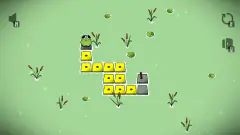
Count the first board and it looks like four squares across and three down. It is not. Two squares are missing from the middle, so you can see clouds straight through the hole, and the right-hand edge steps out by one extra square along the bottom. Neither of those is decoration. The hole turns the middle of the board into an island you have to go round, and the step hangs one square off the side where it is easy to leave stranded. A plain rectangle of the same size would be close to trivial. With a hole and a step in it, it is a thing you have to stop and look at for a few seconds, which is exactly the right amount of time for the audience this is built for.
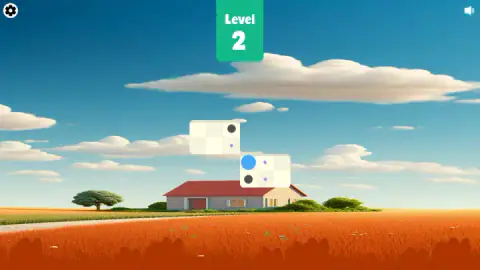
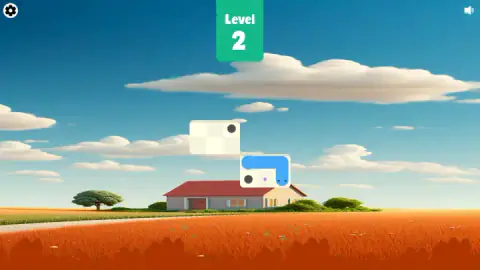
The second level goes further and splits the puzzle in half. Instead of one board there are two, each three squares by two, set like steps so that they touch at a single corner, and each one has its own worm to unroll. You do not get to treat them as one big grid. You get two small problems that have to both come out, and the win card only arrives when neither board has a pale square left anywhere on it.
One thing we saw and cannot explain. Each board starts with its worms curled into single squares as fat circles, and the lower board in our second level started with two of them: one bright blue and one almost black. The bright one was the one that answered. By the time that board was full, the dark circle had gone as well and every square on it was the same blue. The obvious reading is that the dark one is a second worm waiting its turn, and that is probably right — but no picture we have catches it changing, so we are flagging it as a guess rather than telling you it is true.
The dots are the other thing we could not pin down. They come in purple, yellow, pink and blue, and the colour does not appear to gate anything: a green worm cleared purple, yellow and pink in level one, and a blue one cleared blue and purple together in level two. They look like markers for this square is still empty, dressed up. If there is a rule behind the colours, two levels were not enough to find it.
Where to go next
Worms is a route puzzle, so the nearest thing in our catalogue is the one that also makes you think about what connects to what: Circuit Master 2 lays out wires and machines and makes you get the power from one end to the other. If what you liked was the grid rather than the route, Animal Blocks is the opposite bargain — the squares stay put and the pieces come to you. Squishy Sheep is the other kind of short level, where you take one thing away and watch what happens, and Where Are the Puffies? is the calmest of the four, a set of illustrated scenes with something hidden in each. We have not played those four down to a finished level the way we played this one, so take them as signposts and nothing firmer. The rest of the shelf is in games for kids.
Screenshots
How to play Worms
- Find the board. It is the small white panel floating in the middle of the screen. Everything else — sky, clouds, tree, house, the wide orange field — is painted scenery and does not answer.
- Find the worm. In the first level it is dark green with two black eyes. In the second it is blue, and it begins curled up as a fat circle filling a single square, which does not look like a worm at all until it moves.
- Move it onto a pale square next to it. The square fills with the worm's colour, its dot disappears and the worm grows by one. We did this by dragging the worm itself.
- Keep going until there is no pale square and no dot left on any board on the screen. The scene dims, confetti falls and a card reads YOU WIN.
- Press the round yellow button with the arrow on it to go on. The green sign at the top counts up by one.
What we only learned by being there:
- Plan the finish, not the start. The squares behind you are walls, so the route has to end somewhere it is allowed to end. Pick the square you intend to fill last before you take the first one, and work backwards from it.
- Corners and dead ends go early. A square with only one way in and one way out has to be passed through, not visited. Leave one of those for late and the board is already lost, quietly, several moves before anything tells you so.
- The backdrop is not a button. We spent a fair slice of our first minute clicking the house, the field and the sky, and the game watched us do it without a flicker.
- We never got the keyboard to work. We pressed all four arrow keys more than once and no worm moved. Dragging the worm did move it. We are not going to tell you the keys do nothing, because we would only be guessing, but that is how our session went.
Controls
| Drag the worm, or swipe it on a touchscreen | This is what moved the worms for us. The worm itself is the only thing on the screen that answers to anything |
|---|---|
| The squares the worm has already crossed | They fill with its colour and stay filled. We never saw a worm pass back over its own body, so a square you have taken is a square you have spent |
| Arrow keys | We pressed all four, early and more than once, and could not get a worm to move. We are not telling you the keys are dead, only that we could not make them work |
| The sky, the clouds, the tree, the house and the orange field | Nothing at all. The countryside is a painted backdrop and we wasted a good part of our first minute clicking on it |
| The green sign at the top of the screen | Not a button. It is the level number and nothing else |
| The round yellow button with an arrow, on the win card | Goes on to the next level. We pressed it once: the card cleared and the sign at the top changed from Level 1 to Level 2 |
| The round yellow button with three lines, on the win card | A menu, by the look of it. We never pressed it, so we will not tell you what is behind it |
| The gear, top left, and the speaker, top right | Settings and sound. Both are there in every frame we have and we opened neither |
Features
- Every pale square on a board carries one dot, and a level ends when there is not a single dot or pale square left: the board we won was solid colour from edge to edge
- The worm fills each square it crosses and the filling stays, so every move you make takes a square away from the move after it
- The boards are not plain rectangles — level one is four squares by three with a two-square hole punched through the middle and a step where the right edge juts out
- Level two splits the puzzle into two separate boards that meet at a single corner, each with its own worm
- A worm starts curled up as a fat circle in one square and only looks like a worm once it has somewhere to go
- Short levels: we finished the first two in about four minutes, win cards and confetti included
- No score, no timer and no move counter anywhere on the play screen — the only number on it is the level, on a green sign at the top
Game details
- Developer
- The Butterfly Game Studio
- Release date
- June 2026
- Last updated
- October 24, 2026
- Added here
- April 2026
- Technology
- HTML5
- Platforms
- Browser (desktop), Browser (mobile & tablet, touch)
- Saved progress
- Saving, when available, is managed by this game. Mava cannot confirm your level.
FAQ
What kind of game is Worms?
It is a free browser puzzle for younger players, built on small square grids. A white board floats in the sky above a cartoon farmhouse, divided into pale squares with a single coloured dot on each, and you steer a worm around it. The squares the worm crosses fill in with its colour and stay filled. The level is over when the whole board is covered and no dots are left.
How do you play Worms?
You move one worm at a time around a small grid, and the only thing you have to decide is the order you take the squares in. Each square the worm crosses fills with its colour behind it, which means you can never take that square again. Cover every square on every board on the screen and the level is finished. We moved the worms by dragging them.
How do you know when a level in Worms is finished?
The board tells you before the game does. Watch the pale squares disappear one by one as the worm fills them, and when the last dot goes the screen dims, confetti falls and a card reads YOU WIN over the board you have just filled. Two round yellow buttons sit under it, one with three lines and one with an arrow. The arrow takes you to the next level.
Is Worms related to the other games called Worms?
No. This is a small grid puzzle for children about covering every square of a board, made by The Butterfly Game Studio and published in 2026. The word is a common one and several unconnected games have used it over the years, some of them for completely different kinds of game and much better known than this one. Nothing on this page is about any of them.
Does Worms work on a phone or tablet?
It runs in the browser on a desktop computer and on a phone or tablet, and the platform lists it for both landscape and portrait. The board is a small panel in the middle of a wide painted background, so a phone held sideways gives you the most room. We played with a pointer rather than a finger, so we cannot describe how a swipe feels, only that the game is built to take one.
What do the colours of the dots mean in Worms?
As far as we could tell, nothing. The dots we saw were purple, yellow, pink and blue, and one worm happily covered dots of several different colours in the same level. On one board a run of blue dots and a purple one all vanished under the same blue worm. We would rather say we could not work out a rule than invent one.
Who made Worms and when did it come out?
It is credited to The Butterfly Game Studio, which has eleven games on the same platform. The listing gives June 2026 both for the release and for the most recent update. Only the month is printed anywhere we could find, never a day, which is why this page does not claim a precise date.
How many levels does Worms have?
We do not know, and nothing on the game screen tells you. There is no level map and no total printed anywhere, just a green sign with the current number on it. We finished the first two levels in about four minutes and never reached a third, so nothing on this page describes what the later boards look like or how hard they get.